 Add to Chrome
 Add to Firefox
 Add to Edge
Revisiting Scene Graph Generation from the Perspective of Detector-Conditioned Reachability
Jul 07, 2026
Scene graph generation (SGG) approaches can be broadly classified into detector-based and query-based methods according to their underlying reasoning mechanisms. However, the discrepancy in their predictive behaviors, induced by these distinct mechanisms, has not been systematically analyzed. In this work, we design a controlled experimental setup to examine prediction discrepancies from the perspective of detector-conditioned reachability. The results suggest clear complementary clues. Motivated by this observation, we introduce a Dual-SGG method that consolidates both reasoning mechanisms via a dual-query design, thereby leveraging the complementary predictive behaviors of both detector-based and query-based methods. Extensive experiments on the Visual Genome, Open Images v6, and GQA-200 datasets demonstrate the effectiveness of the proposed method.

Salience-SGG: Enhancing Unbiased Scene Graph Generation with Iterative Salience Estimation
Jan 13, 2026Scene Graph Generation (SGG) suffers from a long-tailed distribution, where a few predicate classes dominate while many others are underrepresented, leading to biased models that underperform on rare relations. Unbiased-SGG methods address this issue by implementing debiasing strategies, but often at the cost of spatial understanding, resulting in an over-reliance on semantic priors. We introduce Salience-SGG, a novel framework featuring an Iterative Salience Decoder (ISD) that emphasizes triplets with salient spatial structures. To support this, we propose semantic-agnostic salience labels guiding ISD. Evaluations on Visual Genome, Open Images V6, and GQA-200 show that Salience-SGG achieves state-of-the-art performance and improves existing Unbiased-SGG methods in their spatial understanding as demonstrated by the Pairwise Localization Average Precision
How Do You Perceive My Face? Recognizing Facial Expressions in Multi-Modal Context by Modeling Mental Representations
Sep 04, 2024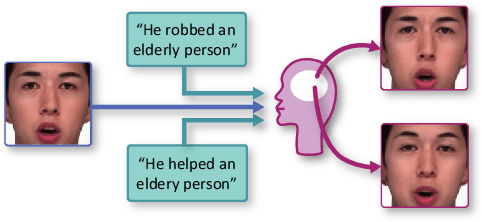

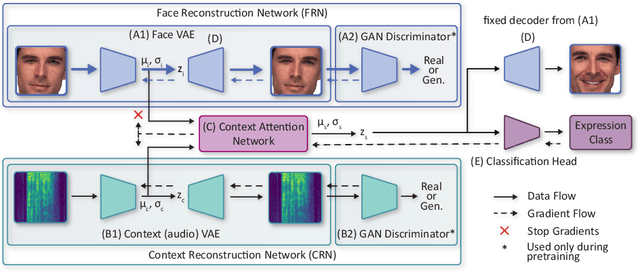
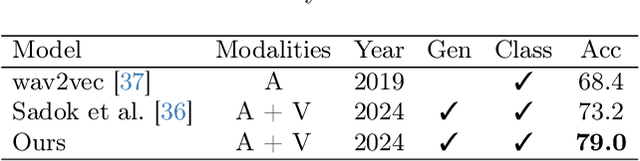
Facial expression perception in humans inherently relies on prior knowledge and contextual cues, contributing to efficient and flexible processing. For instance, multi-modal emotional context (such as voice color, affective text, body pose, etc.) can prompt people to perceive emotional expressions in objectively neutral faces. Drawing inspiration from this, we introduce a novel approach for facial expression classification that goes beyond simple classification tasks. Our model accurately classifies a perceived face and synthesizes the corresponding mental representation perceived by a human when observing a face in context. With this, our model offers visual insights into its internal decision-making process. We achieve this by learning two independent representations of content and context using a VAE-GAN architecture. Subsequently, we propose a novel attention mechanism for context-dependent feature adaptation. The adapted representation is used for classification and to generate a context-augmented expression. We evaluate synthesized expressions in a human study, showing that our model effectively produces approximations of human mental representations. We achieve State-of-the-Art classification accuracies of 81.01% on the RAVDESS dataset and 79.34% on the MEAD dataset. We make our code publicly available.