 Add to Chrome
 Add to Firefox
 Add to Edge
You do not have to train Graph Neural Networks at all on text-attributed graphs
Apr 17, 2024
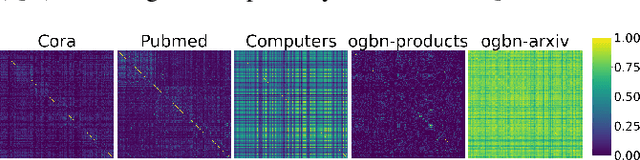
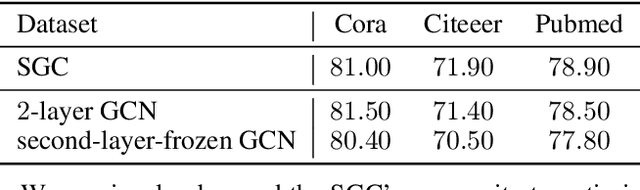
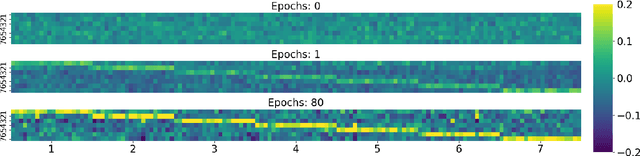

Graph structured data, specifically text-attributed graphs (TAG), effectively represent relationships among varied entities. Such graphs are essential for semi-supervised node classification tasks. Graph Neural Networks (GNNs) have emerged as a powerful tool for handling this graph-structured data. Although gradient descent is commonly utilized for training GNNs for node classification, this study ventures into alternative methods, eliminating the iterative optimization processes. We introduce TrainlessGNN, a linear GNN model capitalizing on the observation that text encodings from the same class often cluster together in a linear subspace. This model constructs a weight matrix to represent each class's node attribute subspace, offering an efficient approach to semi-supervised node classification on TAG. Extensive experiments reveal that our trainless models can either match or even surpass their conventionally trained counterparts, demonstrating the possibility of refraining from gradient descent in certain configurations.

Universal Link Predictor By In-Context Learning on Graphs
Feb 15, 2024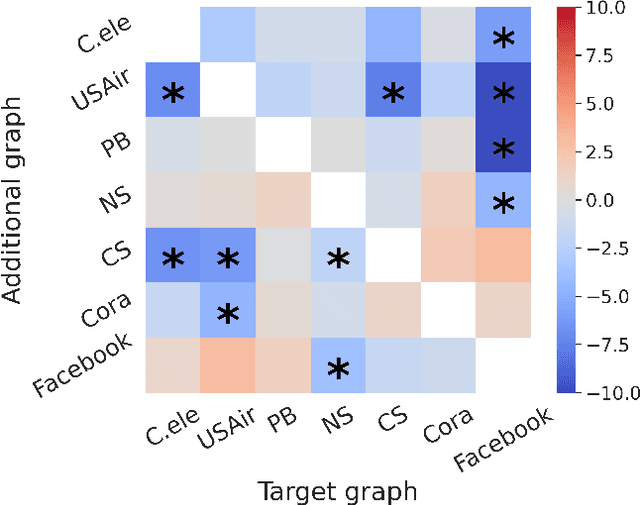
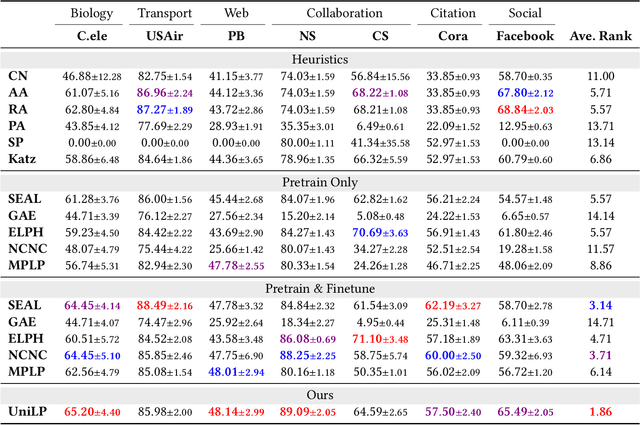
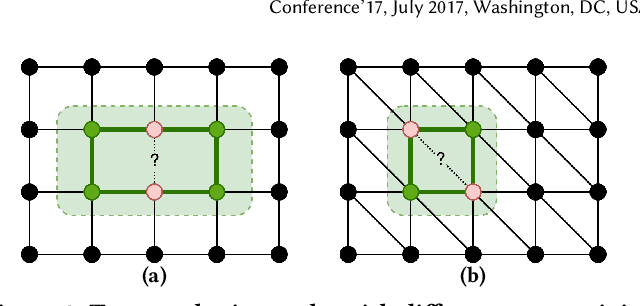

Link prediction is a crucial task in graph machine learning, where the goal is to infer missing or future links within a graph. Traditional approaches leverage heuristic methods based on widely observed connectivity patterns, offering broad applicability and generalizability without the need for model training. Despite their utility, these methods are limited by their reliance on human-derived heuristics and lack the adaptability of data-driven approaches. Conversely, parametric link predictors excel in automatically learning the connectivity patterns from data and achieving state-of-the-art but fail short to directly transfer across different graphs. Instead, it requires the cost of extensive training and hyperparameter optimization to adapt to the target graph. In this work, we introduce the Universal Link Predictor (UniLP), a novel model that combines the generalizability of heuristic approaches with the pattern learning capabilities of parametric models. UniLP is designed to autonomously identify connectivity patterns across diverse graphs, ready for immediate application to any unseen graph dataset without targeted training. We address the challenge of conflicting connectivity patterns-arising from the unique distributions of different graphs-through the implementation of In-context Learning (ICL). This approach allows UniLP to dynamically adjust to various target graphs based on contextual demonstrations, thereby avoiding negative transfer. Through rigorous experimentation, we demonstrate UniLP's effectiveness in adapting to new, unseen graphs at test time, showcasing its ability to perform comparably or even outperform parametric models that have been finetuned for specific datasets. Our findings highlight UniLP's potential to set a new standard in link prediction, combining the strengths of heuristic and parametric methods in a single, versatile framework.
Node Duplication Improves Cold-start Link Prediction
Feb 15, 2024
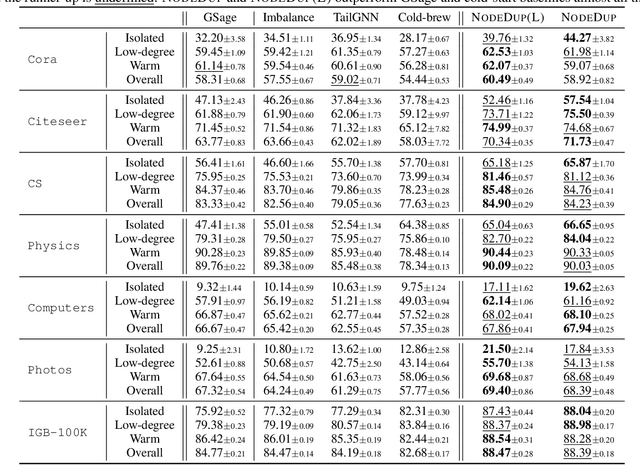

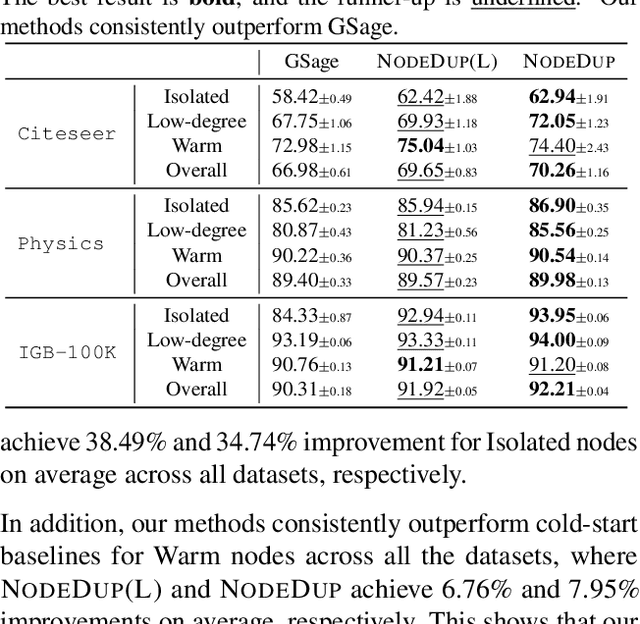
Graph Neural Networks (GNNs) are prominent in graph machine learning and have shown state-of-the-art performance in Link Prediction (LP) tasks. Nonetheless, recent studies show that GNNs struggle to produce good results on low-degree nodes despite their overall strong performance. In practical applications of LP, like recommendation systems, improving performance on low-degree nodes is critical, as it amounts to tackling the cold-start problem of improving the experiences of users with few observed interactions. In this paper, we investigate improving GNNs' LP performance on low-degree nodes while preserving their performance on high-degree nodes and propose a simple yet surprisingly effective augmentation technique called NodeDup. Specifically, NodeDup duplicates low-degree nodes and creates links between nodes and their own duplicates before following the standard supervised LP training scheme. By leveraging a ''multi-view'' perspective for low-degree nodes, NodeDup shows significant LP performance improvements on low-degree nodes without compromising any performance on high-degree nodes. Additionally, as a plug-and-play augmentation module, NodeDup can be easily applied to existing GNNs with very light computational cost. Extensive experiments show that NodeDup achieves 38.49%, 13.34%, and 6.76% improvements on isolated, low-degree, and warm nodes, respectively, on average across all datasets compared to GNNs and state-of-the-art cold-start methods.
Can we soft prompt LLMs for graph learning tasks?
Feb 15, 2024Graph plays an important role in representing complex relationships in real-world applications such as social networks, biological data and citation networks. In recent years, Large Language Models (LLMs) have achieved tremendous success in various domains, which makes applying LLMs to graphs particularly appealing. However, directly applying LLMs to graph modalities presents unique challenges due to the discrepancy and mismatch between the graph and text modalities. Hence, to further investigate LLMs' potential for comprehending graph information, we introduce GraphPrompter, a novel framework designed to align graph information with LLMs via soft prompts. Specifically, GraphPrompter consists of two main components: a graph neural network to encode complex graph information and an LLM that effectively processes textual information. Comprehensive experiments on various benchmark datasets under node classification and link prediction tasks demonstrate the effectiveness of our proposed method. The GraphPrompter framework unveils the substantial capabilities of LLMs as predictors in graph-related tasks, enabling researchers to utilize LLMs across a spectrum of real-world graph scenarios more effectively.
G-Retriever: Retrieval-Augmented Generation for Textual Graph Understanding and Question Answering
Feb 12, 2024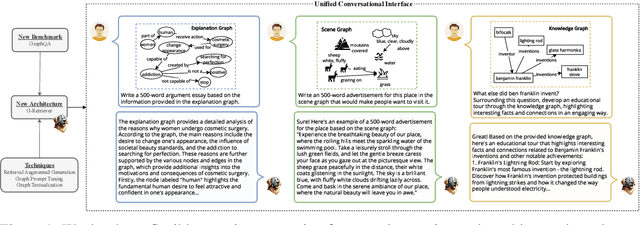
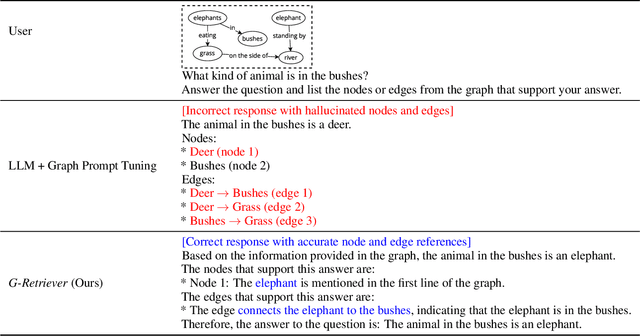
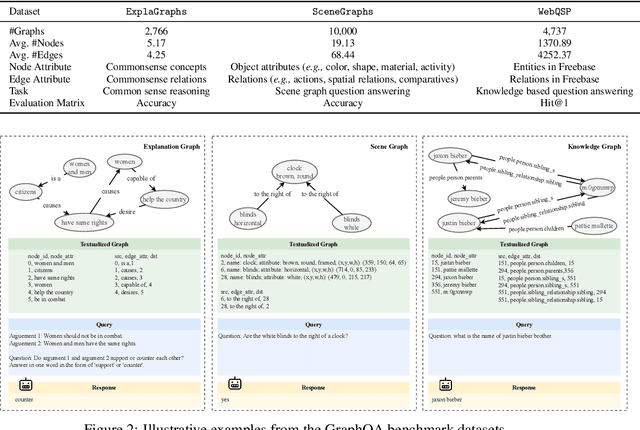
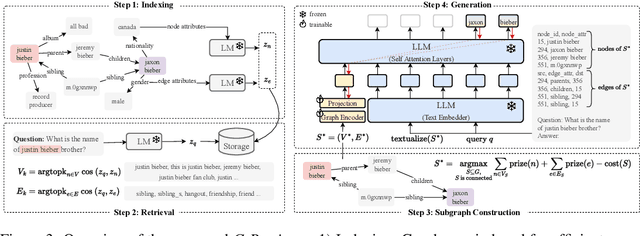
Given a graph with textual attributes, we enable users to `chat with their graph': that is, to ask questions about the graph using a conversational interface. In response to a user's questions, our method provides textual replies and highlights the relevant parts of the graph. While existing works integrate large language models (LLMs) and graph neural networks (GNNs) in various ways, they mostly focus on either conventional graph tasks (such as node, edge, and graph classification), or on answering simple graph queries on small or synthetic graphs. In contrast, we develop a flexible question-answering framework targeting real-world textual graphs, applicable to multiple applications including scene graph understanding, common sense reasoning, and knowledge graph reasoning. Toward this goal, we first develop our Graph Question Answering (GraphQA) benchmark with data collected from different tasks. Then, we propose our G-Retriever approach, which integrates the strengths of GNNs, LLMs, and Retrieval-Augmented Generation (RAG), and can be fine-tuned to enhance graph understanding via soft prompting. To resist hallucination and to allow for textual graphs that greatly exceed the LLM's context window size, G-Retriever performs RAG over a graph by formulating this task as a Prize-Collecting Steiner Tree optimization problem. Empirical evaluations show that our method outperforms baselines on textual graph tasks from multiple domains, scales well with larger graph sizes, and resists hallucination. (Our codes and datasets are available at: https://github.com/XiaoxinHe/G-Retriever.)
UGMAE: A Unified Framework for Graph Masked Autoencoders
Feb 12, 2024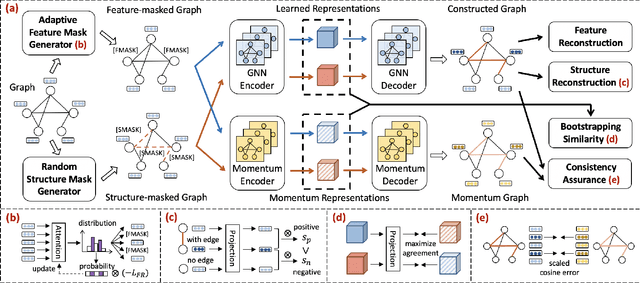
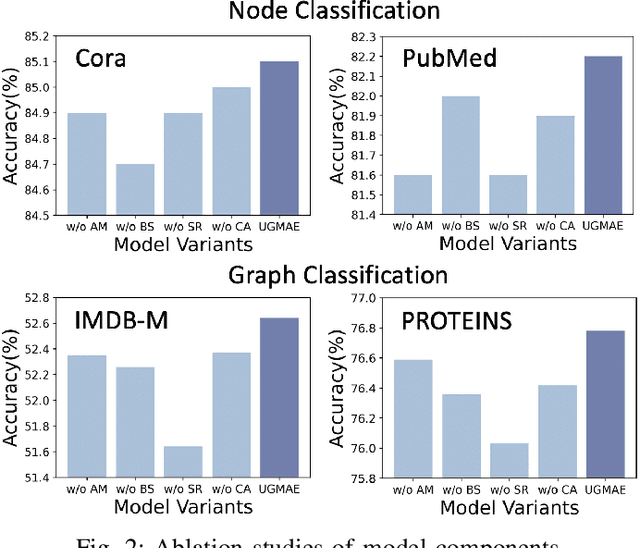
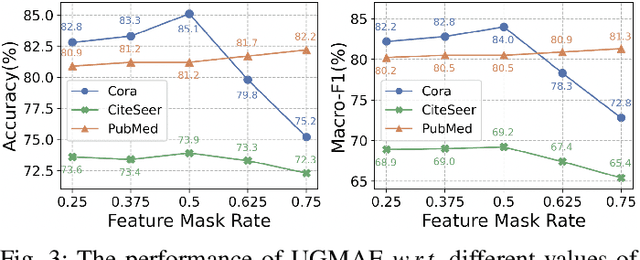
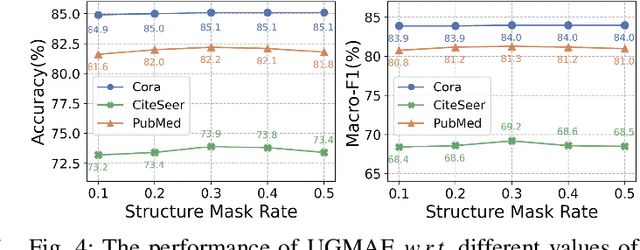
Generative self-supervised learning on graphs, particularly graph masked autoencoders, has emerged as a popular learning paradigm and demonstrated its efficacy in handling non-Euclidean data. However, several remaining issues limit the capability of existing methods: 1) the disregard of uneven node significance in masking, 2) the underutilization of holistic graph information, 3) the ignorance of semantic knowledge in the representation space due to the exclusive use of reconstruction loss in the output space, and 4) the unstable reconstructions caused by the large volume of masked contents. In light of this, we propose UGMAE, a unified framework for graph masked autoencoders to address these issues from the perspectives of adaptivity, integrity, complementarity, and consistency. Specifically, we first develop an adaptive feature mask generator to account for the unique significance of nodes and sample informative masks (adaptivity). We then design a ranking-based structure reconstruction objective joint with feature reconstruction to capture holistic graph information and emphasize the topological proximity between neighbors (integrity). After that, we present a bootstrapping-based similarity module to encode the high-level semantic knowledge in the representation space, complementary to the low-level reconstruction in the output space (complementarity). Finally, we build a consistency assurance module to provide reconstruction objectives with extra stabilized consistency targets (consistency). Extensive experiments demonstrate that UGMAE outperforms both contrastive and generative state-of-the-art baselines on several tasks across multiple datasets.
TinyLLM: Learning a Small Student from Multiple Large Language Models
Feb 07, 2024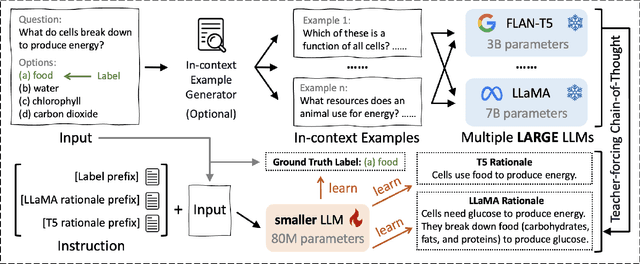
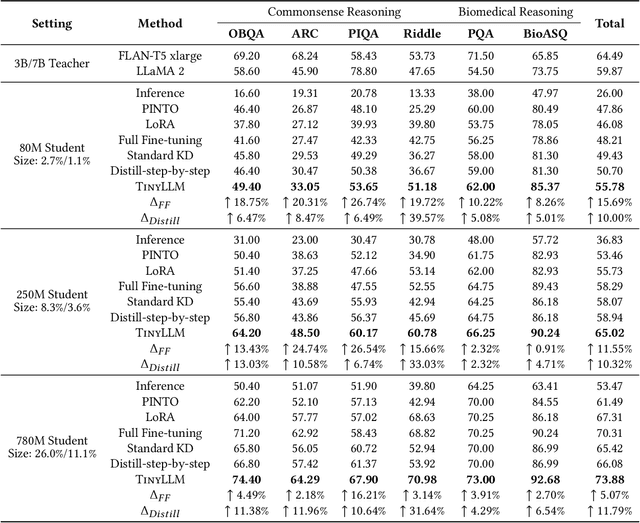
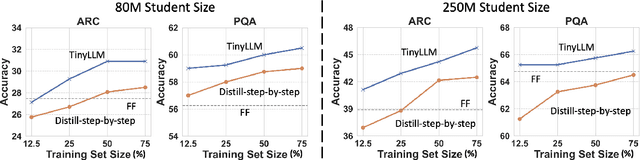
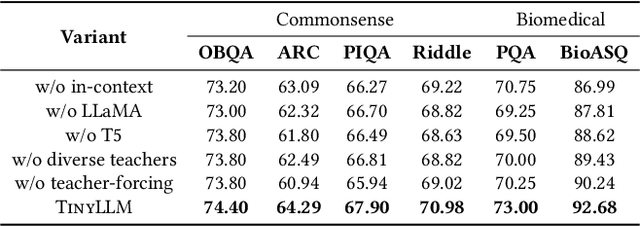
Transferring the reasoning capability from stronger large language models (LLMs) to smaller ones has been quite appealing, as smaller LLMs are more flexible to deploy with less expense. Among the existing solutions, knowledge distillation stands out due to its outstanding efficiency and generalization. However, existing methods suffer from several drawbacks, including limited knowledge diversity and the lack of rich contextual information. To solve the problems and facilitate the learning of compact language models, we propose TinyLLM, a novel knowledge distillation paradigm to learn a small student LLM from multiple large teacher LLMs. In particular, we encourage the student LLM to not only generate the correct answers but also understand the rationales behind these answers. Given that different LLMs possess diverse reasoning skills, we guide the student model to assimilate knowledge from various teacher LLMs. We further introduce an in-context example generator and a teacher-forcing Chain-of-Thought strategy to ensure that the rationales are accurate and grounded in contextually appropriate scenarios. Extensive experiments on six datasets across two reasoning tasks demonstrate the superiority of our method. Results show that TinyLLM can outperform large teacher LLMs significantly, despite having a considerably smaller model size.
Are we making much progress? Revisiting chemical reaction yield prediction from an imbalanced regression perspective
Feb 06, 2024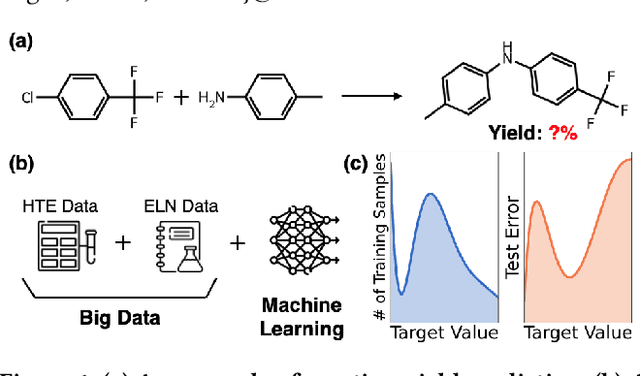
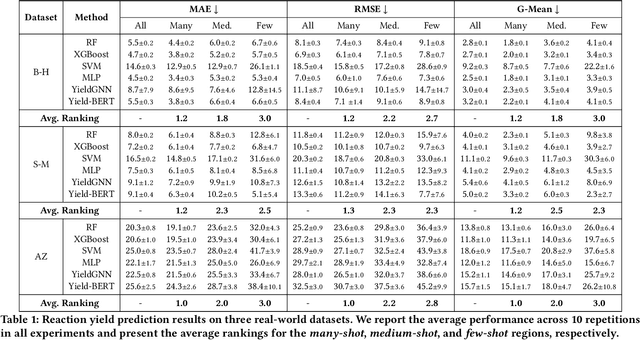
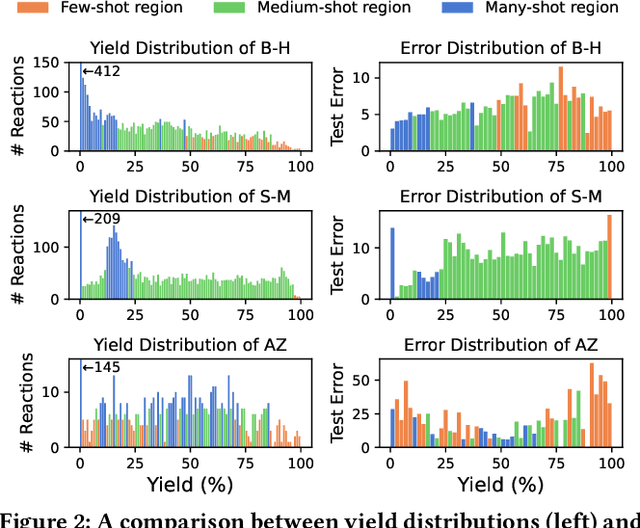
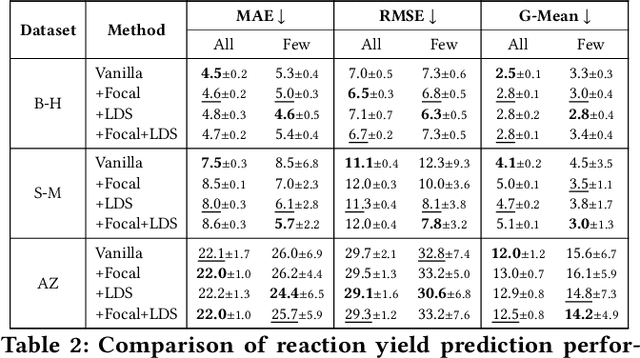
The yield of a chemical reaction quantifies the percentage of the target product formed in relation to the reactants consumed during the chemical reaction. Accurate yield prediction can guide chemists toward selecting high-yield reactions during synthesis planning, offering valuable insights before dedicating time and resources to wet lab experiments. While recent advancements in yield prediction have led to overall performance improvement across the entire yield range, an open challenge remains in enhancing predictions for high-yield reactions, which are of greater concern to chemists. In this paper, we argue that the performance gap in high-yield predictions results from the imbalanced distribution of real-world data skewed towards low-yield reactions, often due to unreacted starting materials and inherent ambiguities in the reaction processes. Despite this data imbalance, existing yield prediction methods continue to treat different yield ranges equally, assuming a balanced training distribution. Through extensive experiments on three real-world yield prediction datasets, we emphasize the urgent need to reframe reaction yield prediction as an imbalanced regression problem. Finally, we demonstrate that incorporating simple cost-sensitive re-weighting methods can significantly enhance the performance of yield prediction models on underrepresented high-yield regions.
Large Language Model based Multi-Agents: A Survey of Progress and Challenges
Jan 21, 2024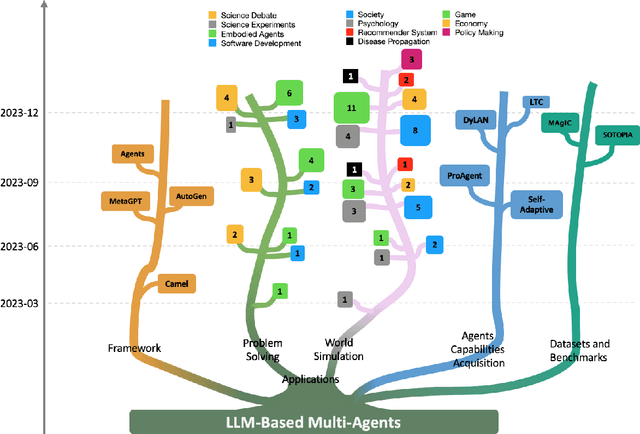

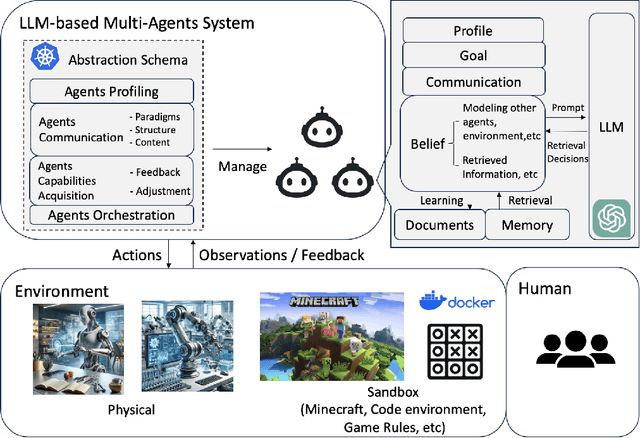
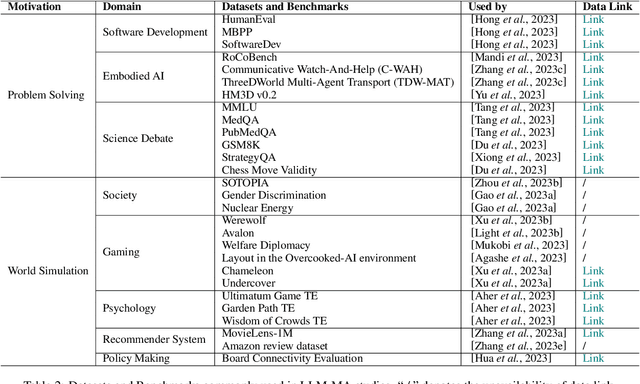
Large Language Models (LLMs) have achieved remarkable success across a wide array of tasks. Due to the impressive planning and reasoning abilities of LLMs, they have been used as autonomous agents to do many tasks automatically. Recently, based on the development of using one LLM as a single planning or decision-making agent, LLM-based multi-agent systems have achieved considerable progress in complex problem-solving and world simulation. To provide the community with an overview of this dynamic field, we present this survey to offer an in-depth discussion on the essential aspects of multi-agent systems based on LLMs, as well as the challenges. Our goal is for readers to gain substantial insights on the following questions: What domains and environments do LLM-based multi-agents simulate? How are these agents profiled and how do they communicate? What mechanisms contribute to the growth of agents' capacities? For those interested in delving into this field of study, we also summarize the commonly used datasets or benchmarks for them to have convenient access. To keep researchers updated on the latest studies, we maintain an open-source GitHub repository, dedicated to outlining the research on LLM-based multi-agent systems.
Representing Outcome-driven Higher-order Dependencies in Graphs of Disease Trajectories
Dec 23, 2023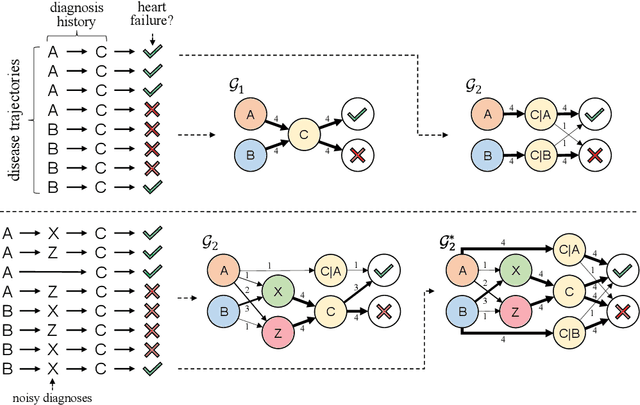
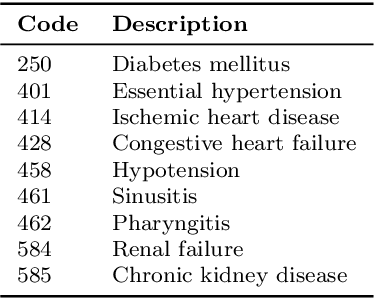
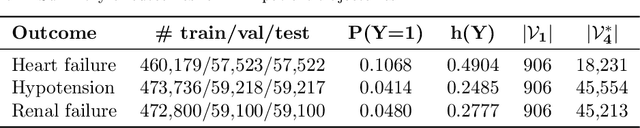
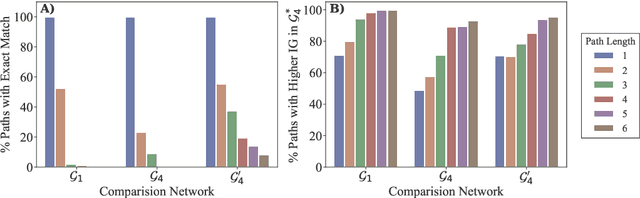
The widespread application of machine learning techniques to biomedical data has produced many new insights into disease progression and improving clinical care. Inspired by the flexibility and interpretability of graphs (networks), as well as the potency of sequence models like transformers and higher-order networks (HONs), we propose a method that identifies combinations of risk factors for a given outcome and accurately encodes these higher-order relationships in a graph. Using historical data from 913,475 type 2 diabetes (T2D) patients, we found that, compared to other approaches, the proposed networks encode significantly more information about the progression of T2D toward a variety of outcomes. We additionally demonstrate how structural information from the proposed graph can be used to augment the performance of transformer-based models on predictive tasks, especially when the data are noisy. By increasing the order, or memory, of the graph, we show how the proposed method illuminates key risk factors while successfully ignoring noisy elements, which facilitates analysis that is simultaneously accurate and interpretable.