 Add to Chrome
 Add to Firefox
 Add to Edge
Toward a Stable and Deployable Adaptive Chirplet Transform: Residual Projection, Hybrid GPU Acceleration, and Multi-Channel Scalability
Jul 18, 2026
The Adaptive Chirplet Transform is a flexible framework that can decompose non-stationary signals into sparse chirplets; it has been applied to signals such as electroencephalography, electromyography and radar. However, the practical deployment of this transform has been hindered by two challenges: algorithmic instability in prior implementations, which can lead to divergent decompositions, and the computational cost of searching over a high-dimensional parameter space. This paper addresses both by a sequence of contributions. Firstly, unit normalization and residual-based projection are introduced to align the decomposition with Matching Pursuit Theory, thereby eliminating divergence and substantially reducing residual error across all signal domains, as demonstrated on three representative signal types. A hybrid CPU-GPU architecture offloads chirplet family generation to the CPU while parallelizing the search on the GPU, removing bottlenecks in CPU-only search and GPU-only generation, achieving speedups of 6.6-7.38 on desktop hardware, with consistent gains observed across laptop and embedded platforms. Multichannel batching enabled simultaneous multi-signal processing, amplifying the speedup, which scaled from 3.94 for a single channel to 8.22 at 10 channels. Finally, a hierarchical coarse-to-fine search, inspired by Logon Expectation Maximization, is introduced. This reduced peak memory usage below 1 GB while maintaining similar reconstruction quality, at the cost of longer runtime. Together, these contributions establish a correct, stable and practically deployable foundation for chirplet-based signal decomposition. Index Terms: Chirplet Transform, GPU Computing, Matching Pursuit, Signal Decomposition, Sparse Representation, Time-Frequency Analysis

Advancing Technology for Humanity and Earth (+Water+Air)
Dec 30, 2024As technology advances, the integration of physical, virtual, and social worlds has led to a complex landscape of ``Realities'' such as Virtual Reality (VR), Augmented Reality (AR), metaverse, spatial computing, and other emerging paradigms. This paper builds upon and refines the concept of eXtended Reality (XR) as the unifying framework that not only interpolates across these diverse realities but also extrapolates (extends) to create entirely new possibilities. XR is the ``physical spatial metaverse,'' bridging the physical world, the virtual world of artificial intelligence, and the social world of human interaction. These three worlds define the Socio-Cyber-Physical Taxonomy of XR that allows us to identify underexplored research areas such as Diminished Reality (DR), and chart future directions to {\bf advance technology for people and planet}. We highlight the six core properties of XR for applications in sustainability, healthcare, frontline work, and daily life. Central to this vision is the development of AI-driven wearable technologies, such as the smart eyeglass, that sustainably extend human capabilities.
Beyond the Metaverse: XV (eXtended meta/uni/Verse)
Dec 15, 2022
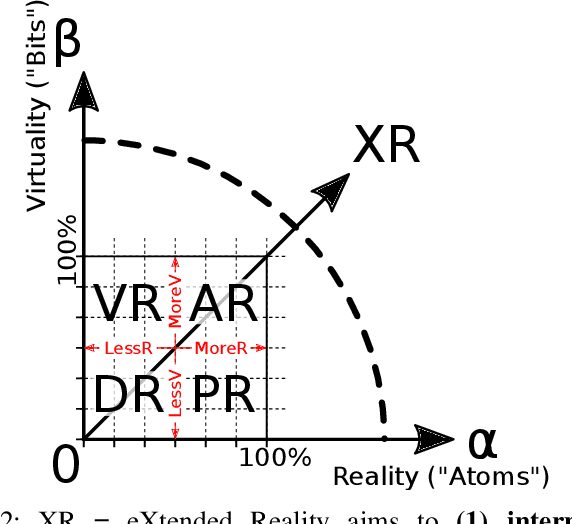


We propose the term and concept XV (eXtended meta/omni/uni/Verse) as an alternative to, and generalization of, the shared/social virtual reality widely known as ``metaverse''. XV is shared/social XR. We, and many others, use XR (eXtended Reality) as a broad umbrella term and concept to encompass all the other realities, where X is an ``anything'' variable, like in mathematics, to denote any reality, X $\in$ \{physical, virtual, augmented, \ldots \} reality. Therefore XV inherits this generality from XR. We begin with a very simple organized taxonomy of all these realities in terms of two simple building blocks: (1) physical reality (PR) as made of ``atoms'', and (2) virtual reality (VR) as made of ``bits''. Next we introduce XV as combining all these realities with extended society as a three-dimensional space and taxonomy of (1) ``atoms'' (physical reality), (2) ``bits'' (virtuality), and (3) ``genes'' (sociality). Thus those working in the liminal space between Virtual Reality (VR), Augmented Reality (AR), metaverse, and their various extensions, can describe their work and research as existing in the new field of XV. XV includes the metaverse along with extensions of reality itself like shared seeing in the infrared, ultraviolet, and shared seeing of electromagnetic radio waves, sound waves, and electric currents in motors. For example, workers in a mechanical room can look at a pump and see a superimposed time-varying waveform of the actual rotating magnetic field inside its motor, in real time, while sharing this vision across multiple sites. Presented at IEEE Standards Association, Behind and Beyond the Metaverse: XV (eXtended meta/uni/Verse), Thurs. Dec. 8, 2022, 2:15-3:30pm, EST.