 Add to Chrome
 Add to Firefox
 Add to Edge
No Shortcuts to Culture: Indonesian Multi-hop Question Answering for Complex Cultural Understanding
Feb 03, 2026
Understanding culture requires reasoning across context, tradition, and implicit social knowledge, far beyond recalling isolated facts. Yet most culturally focused question answering (QA) benchmarks rely on single-hop questions, which may allow models to exploit shallow cues rather than demonstrate genuine cultural reasoning. In this work, we introduce ID-MoCQA, the first large-scale multi-hop QA dataset for assessing the cultural understanding of large language models (LLMs), grounded in Indonesian traditions and available in both English and Indonesian. We present a new framework that systematically transforms single-hop cultural questions into multi-hop reasoning chains spanning six clue types (e.g., commonsense, temporal, geographical). Our multi-stage validation pipeline, combining expert review and LLM-as-a-judge filtering, ensures high-quality question-answer pairs. Our evaluation across state-of-the-art models reveals substantial gaps in cultural reasoning, particularly in tasks requiring nuanced inference. ID-MoCQA provides a challenging and essential benchmark for advancing the cultural competency of LLMs.

A Comprehensive Survey of Self-Evolving AI Agents: A New Paradigm Bridging Foundation Models and Lifelong Agentic Systems
Aug 10, 2025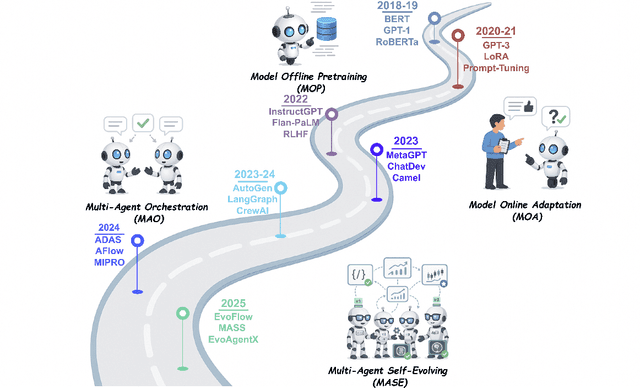
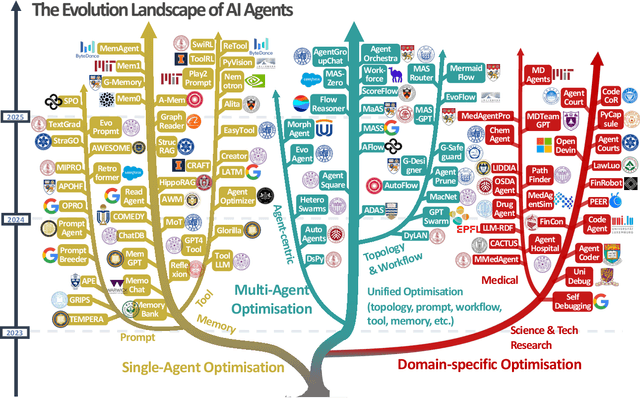
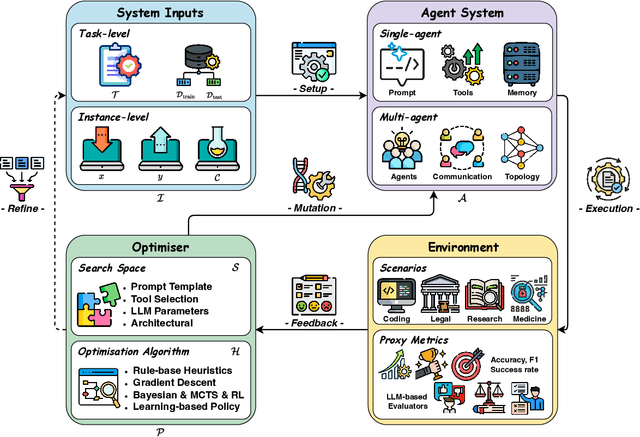
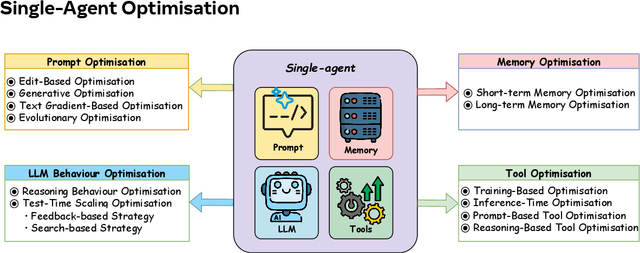
Recent advances in large language models have sparked growing interest in AI agents capable of solving complex, real-world tasks. However, most existing agent systems rely on manually crafted configurations that remain static after deployment, limiting their ability to adapt to dynamic and evolving environments. To this end, recent research has explored agent evolution techniques that aim to automatically enhance agent systems based on interaction data and environmental feedback. This emerging direction lays the foundation for self-evolving AI agents, which bridge the static capabilities of foundation models with the continuous adaptability required by lifelong agentic systems. In this survey, we provide a comprehensive review of existing techniques for self-evolving agentic systems. Specifically, we first introduce a unified conceptual framework that abstracts the feedback loop underlying the design of self-evolving agentic systems. The framework highlights four key components: System Inputs, Agent System, Environment, and Optimisers, serving as a foundation for understanding and comparing different strategies. Based on this framework, we systematically review a wide range of self-evolving techniques that target different components of the agent system. We also investigate domain-specific evolution strategies developed for specialised fields such as biomedicine, programming, and finance, where optimisation objectives are tightly coupled with domain constraints. In addition, we provide a dedicated discussion on the evaluation, safety, and ethical considerations for self-evolving agentic systems, which are critical to ensuring their effectiveness and reliability. This survey aims to provide researchers and practitioners with a systematic understanding of self-evolving AI agents, laying the foundation for the development of more adaptive, autonomous, and lifelong agentic systems.