 Add to Chrome
 Add to Firefox
 Add to Edge
Contrastive Energy Fields for Inference-Time Procedure Planning in Instructional Videos
Aug 17, 2026
Procedure planning seeks to estimate a sequence of actions to transition from an observed initial state to a given goal state. Current procedure planning approaches directly predict action sequences from latent representations using feed-forward neural networks or diffusion-based inference. These paradigms treat every action as plausible, lacking the ability to enforce task-specific logical constraints that render certain actions irrelevant or not plausible. We propose CEFITO, a procedure planning approach that learns a predictor to express an action-conditioned representation space. Based on this representation space, we formulate procedure planning as a task-constrained optimization problem. Unlike prior methods, CEFITO explicitly reasons over the action space by omitting irrelevant actions during inference-time planning. This reformulation enables effective procedure planning and achieves state-of-the-art accuracy on two established procedure planning benchmarks.

MAGneT-3D: Monocular and Domain-Generalizable Temporal 3D Detection
Aug 14, 2026Monocular temporal 3D detection aims to detect objects in 3D, given a monocular video. Query-based 3D detectors unify detection and cross-view association, but their learnable queries fit the spatial distribution of the training data (e.g., field-of-view). We show that this issue is especially severe when these models are applied to monocular video, hindering generalization to unseen datasets and environments. To address this limitation, we introduce MAGneT-3D, the first method for domain-generalized monocular temporal 3D object detection. Instead of relying on static learnable queries, we propose a Domain-Robust Anchor Generator (DRAG) approach that adaptively derives 3D proposals during inference. To further enable domain generalization, we propose a Temporal Refinement and Identity Merging (TRIM) strategy, reducing dependence on specific 3D proposals. To enable comprehensive domain-generalization evaluation, we establish a cross-dataset benchmark spanning nuScenes, Waymo, Lyft, and ONCE. Under zero-shot domain shifts, MAGneT-3D outperforms all baselines, improving NDS from 12.1% to 18.6% while also increasing in-domain accuracy.
Scene-Centric Unsupervised Video Panoptic Segmentation
Jun 03, 2026Video panoptic segmentation (VPS) aims to jointly detect, segment, and track all objects while partitioning the video into semantically consistent regions. We introduce the task setting of unsupervised VPS, omitting any human supervision. Existing unsupervised scene understanding works mainly focused on image segmentation tasks; the video domain remains underexplored. We propose VideoCUPS, the first unsupervised VPS approach. VideoCUPS generates temporally consistent panoptic video pseudo-labels from scene-centric videos by exploiting unsupervised depth, motion, and visual cues. Training on these pseudo-labels using a novel Video DropLoss yields an accurate, unsupervised VPS model. To benchmark progress, we introduce a comprehensive evaluation protocol and four competitive baselines, extending state-of-the-art unsupervised panoptic image and instance video segmentation models to VPS. VideoCUPS outperforms all baselines and demonstrates strong label-efficient learning. With VideoCUPS, our evaluation protocol, and baselines, we provide a strong foundation for future research on unsupervised VPS.
INSID3: Training-Free In-Context Segmentation with DINOv3
Mar 30, 2026In-context segmentation (ICS) aims to segment arbitrary concepts, e.g., objects, parts, or personalized instances, given one annotated visual examples. Existing work relies on (i) fine-tuning vision foundation models (VFMs), which improves in-domain results but harms generalization, or (ii) combines multiple frozen VFMs, which preserves generalization but yields architectural complexity and fixed segmentation granularities. We revisit ICS from a minimalist perspective and ask: Can a single self-supervised backbone support both semantic matching and segmentation, without any supervision or auxiliary models? We show that scaled-up dense self-supervised features from DINOv3 exhibit strong spatial structure and semantic correspondence. We introduce INSID3, a training-free approach that segments concepts at varying granularities only from frozen DINOv3 features, given an in-context example. INSID3 achieves state-of-the-art results across one-shot semantic, part, and personalized segmentation, outperforming previous work by +7.5 % mIoU, while using 3x fewer parameters and without any mask or category-level supervision. Code is available at https://github.com/visinf/INSID3 .
Feed-Forward SceneDINO for Unsupervised Semantic Scene Completion
Jul 08, 2025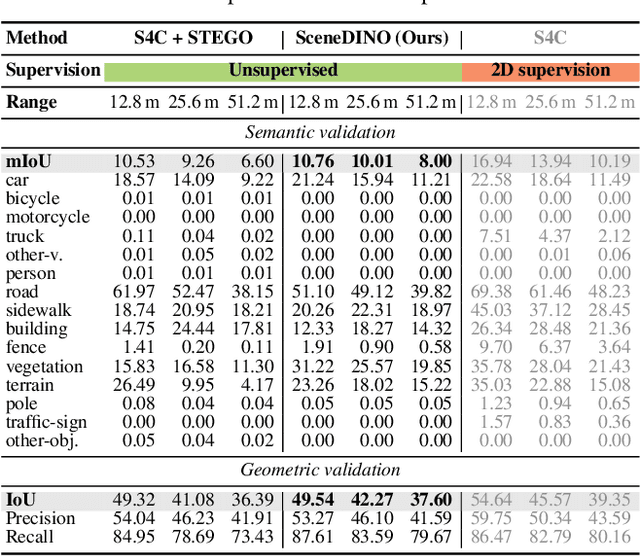
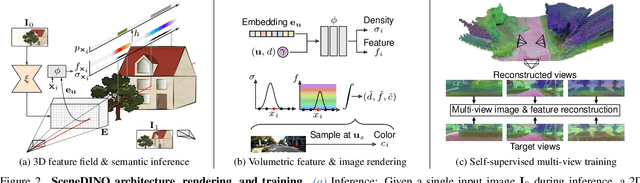
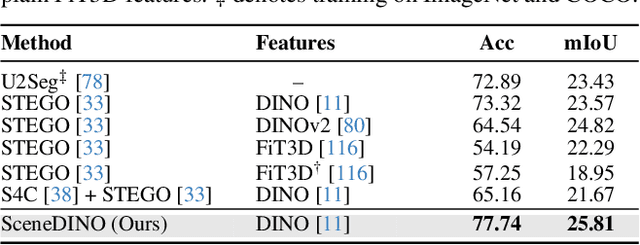
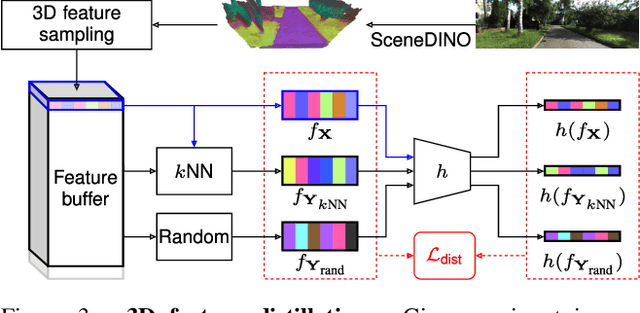
Semantic scene completion (SSC) aims to infer both the 3D geometry and semantics of a scene from single images. In contrast to prior work on SSC that heavily relies on expensive ground-truth annotations, we approach SSC in an unsupervised setting. Our novel method, SceneDINO, adapts techniques from self-supervised representation learning and 2D unsupervised scene understanding to SSC. Our training exclusively utilizes multi-view consistency self-supervision without any form of semantic or geometric ground truth. Given a single input image, SceneDINO infers the 3D geometry and expressive 3D DINO features in a feed-forward manner. Through a novel 3D feature distillation approach, we obtain unsupervised 3D semantics. In both 3D and 2D unsupervised scene understanding, SceneDINO reaches state-of-the-art segmentation accuracy. Linear probing our 3D features matches the segmentation accuracy of a current supervised SSC approach. Additionally, we showcase the domain generalization and multi-view consistency of SceneDINO, taking the first steps towards a strong foundation for single image 3D scene understanding.
Scene-Centric Unsupervised Panoptic Segmentation
Apr 02, 2025Unsupervised panoptic segmentation aims to partition an image into semantically meaningful regions and distinct object instances without training on manually annotated data. In contrast to prior work on unsupervised panoptic scene understanding, we eliminate the need for object-centric training data, enabling the unsupervised understanding of complex scenes. To that end, we present the first unsupervised panoptic method that directly trains on scene-centric imagery. In particular, we propose an approach to obtain high-resolution panoptic pseudo labels on complex scene-centric data, combining visual representations, depth, and motion cues. Utilizing both pseudo-label training and a panoptic self-training strategy yields a novel approach that accurately predicts panoptic segmentation of complex scenes without requiring any human annotations. Our approach significantly improves panoptic quality, e.g., surpassing the recent state of the art in unsupervised panoptic segmentation on Cityscapes by 9.4% points in PQ.
Arbitrary Data as Images: Fusion of Patient Data Across Modalities and Irregular Intervals with Vision Transformers
Jan 30, 2025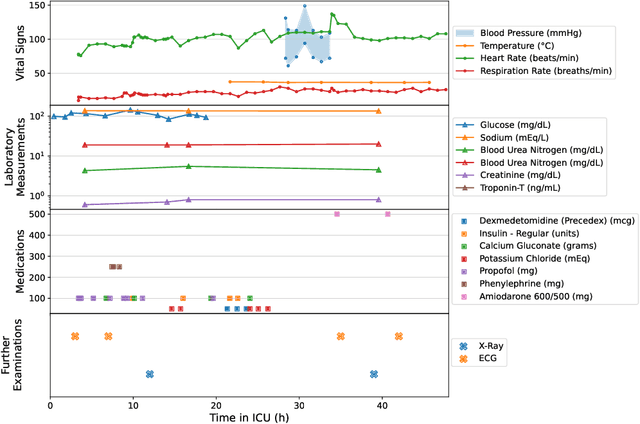
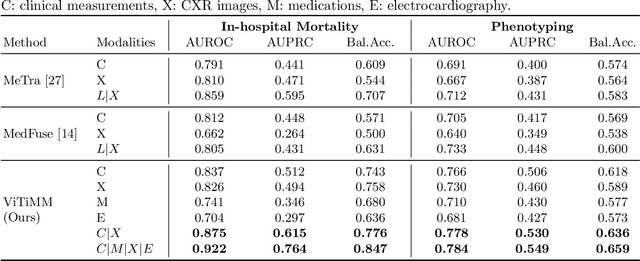
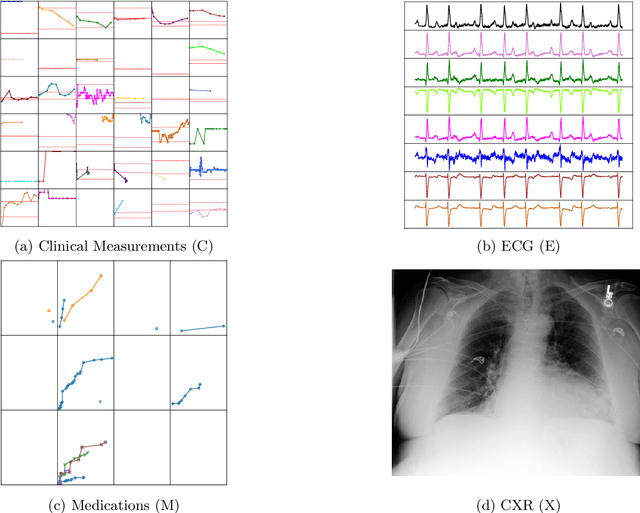

A patient undergoes multiple examinations in each hospital stay, where each provides different facets of the health status. These assessments include temporal data with varying sampling rates, discrete single-point measurements, therapeutic interventions such as medication administration, and images. While physicians are able to process and integrate diverse modalities intuitively, neural networks need specific modeling for each modality complicating the training procedure. We demonstrate that this complexity can be significantly reduced by visualizing all information as images along with unstructured text and subsequently training a conventional vision-text transformer. Our approach, Vision Transformer for irregular sampled Multi-modal Measurements (ViTiMM), not only simplifies data preprocessing and modeling but also outperforms current state-of-the-art methods in predicting in-hospital mortality and phenotyping, as evaluated on 6,175 patients from the MIMIC-IV dataset. The modalities include patient's clinical measurements, medications, X-ray images, and electrocardiography scans. We hope our work inspires advancements in multi-modal medical AI by reducing the training complexity to (visual) prompt engineering, thus lowering entry barriers and enabling no-code solutions for training. The source code will be made publicly available.
A Perspective on Deep Vision Performance with Standard Image and Video Codecs
Apr 18, 2024


Resource-constrained hardware, such as edge devices or cell phones, often rely on cloud servers to provide the required computational resources for inference in deep vision models. However, transferring image and video data from an edge or mobile device to a cloud server requires coding to deal with network constraints. The use of standardized codecs, such as JPEG or H.264, is prevalent and required to ensure interoperability. This paper aims to examine the implications of employing standardized codecs within deep vision pipelines. We find that using JPEG and H.264 coding significantly deteriorates the accuracy across a broad range of vision tasks and models. For instance, strong compression rates reduce semantic segmentation accuracy by more than 80% in mIoU. In contrast to previous findings, our analysis extends beyond image and action classification to localization and dense prediction tasks, thus providing a more comprehensive perspective.
Deep Video Codec Control
Sep 16, 2023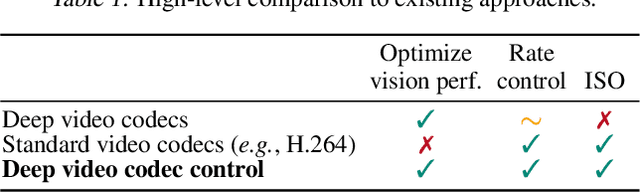
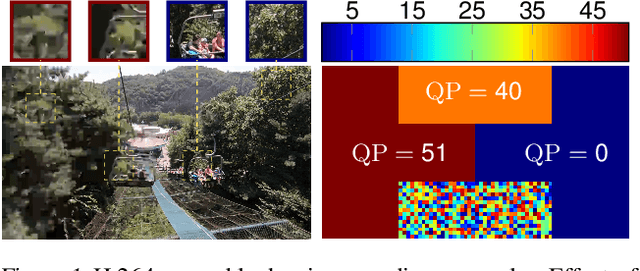
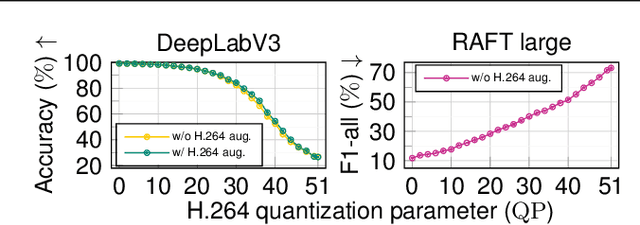
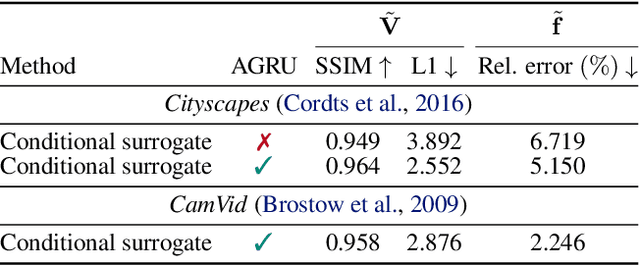
Lossy video compression is commonly used when transmitting and storing video data. Unified video codecs (e.g., H.264 or H.265) remain the de facto standard, despite the availability of advanced (neural) compression approaches. Transmitting videos in the face of dynamic network bandwidth conditions requires video codecs to adapt to vastly different compression strengths. Rate control modules augment the codec's compression such that bandwidth constraints are satisfied and video distortion is minimized. While, both standard video codes and their rate control modules are developed to minimize video distortion w.r.t. human quality assessment, preserving the downstream performance of deep vision models is not considered. In this paper, we present the first end-to-end learnable deep video codec control considering both bandwidth constraints and downstream vision performance, while not breaking existing standardization. We demonstrate for two common vision tasks (semantic segmentation and optical flow estimation) and on two different datasets that our deep codec control better preserves downstream performance than using 2-pass average bit rate control while meeting dynamic bandwidth constraints and adhering to standardizations.
Differentiable JPEG: The Devil is in the Details
Sep 13, 2023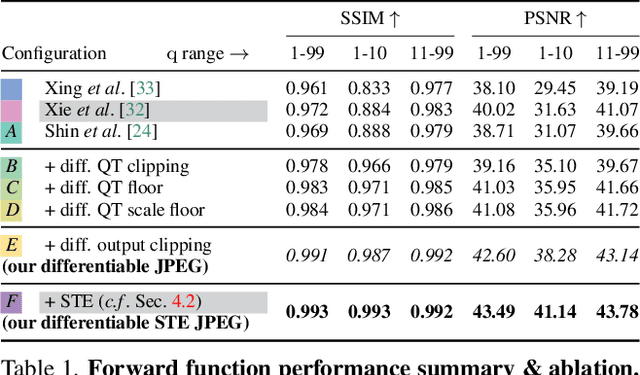
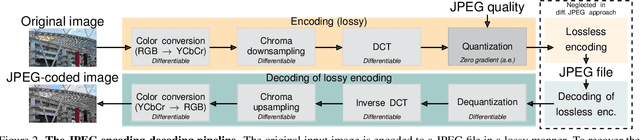
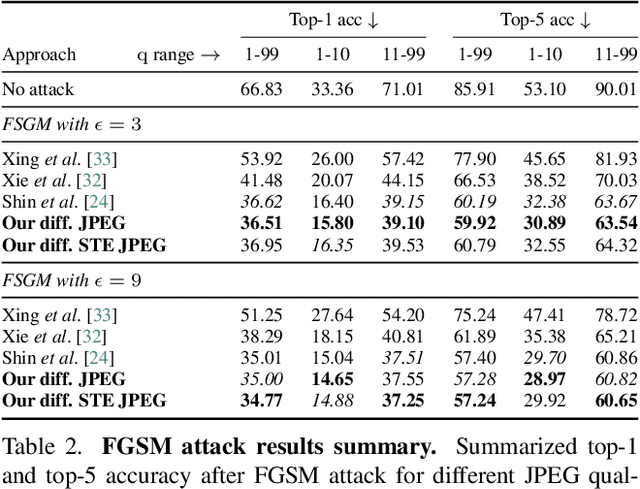
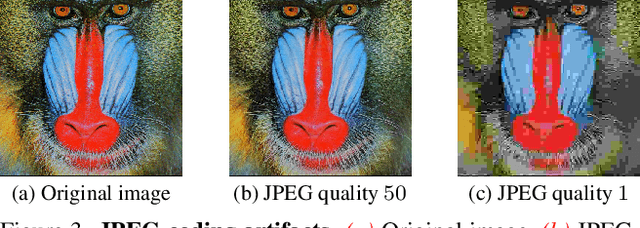
JPEG remains one of the most widespread lossy image coding methods. However, the non-differentiable nature of JPEG restricts the application in deep learning pipelines. Several differentiable approximations of JPEG have recently been proposed to address this issue. This paper conducts a comprehensive review of existing diff. JPEG approaches and identifies critical details that have been missed by previous methods. To this end, we propose a novel diff. JPEG approach, overcoming previous limitations. Our approach is differentiable w.r.t. the input image, the JPEG quality, the quantization tables, and the color conversion parameters. We evaluate the forward and backward performance of our diff. JPEG approach against existing methods. Additionally, extensive ablations are performed to evaluate crucial design choices. Our proposed diff. JPEG resembles the (non-diff.) reference implementation best, significantly surpassing the recent-best diff. approach by $3.47$dB (PSNR) on average. For strong compression rates, we can even improve PSNR by $9.51$dB. Strong adversarial attack results are yielded by our diff. JPEG, demonstrating the effective gradient approximation. Our code is available at https://github.com/necla-ml/Diff-JPEG.