 Add to Chrome
 Add to Firefox
 Add to Edge
Generative Shape Reconstruction with Geometry-Guided Langevin Dynamics
Mar 27, 2026
Reconstructing complete 3D shapes from incomplete or noisy observations is a fundamentally ill-posed problem that requires balancing measurement consistency with shape plausibility. Existing methods for shape reconstruction can achieve strong geometric fidelity in ideal conditions but fail under realistic conditions with incomplete measurements or noise. At the same time, recent generative models for 3D shapes can synthesize highly realistic and detailed shapes but fail to be consistent with observed measurements. In this work, we introduce GG-Langevin: Geometry-Guided Langevin dynamics, a probabilistic approach that unifies these complementary perspectives. By traversing the trajectories of Langevin dynamics induced by a diffusion model, while preserving measurement consistency at every step, we generatively reconstruct shapes that fit both the measurements and the data-informed prior. We demonstrate through extensive experiments that GG-Langevin achieves higher geometric accuracy and greater robustness to missing data than existing methods for surface reconstruction.

To Stay or Not to Stay in the Pre-train Basin: Insights on Ensembling in Transfer Learning
Mar 06, 2023
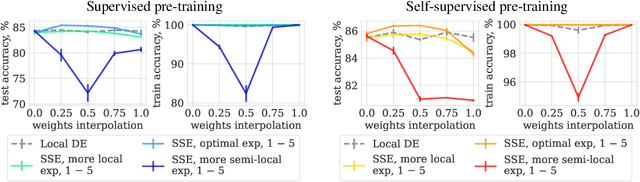
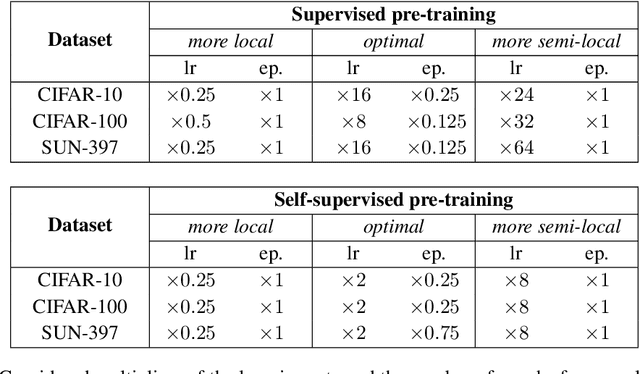
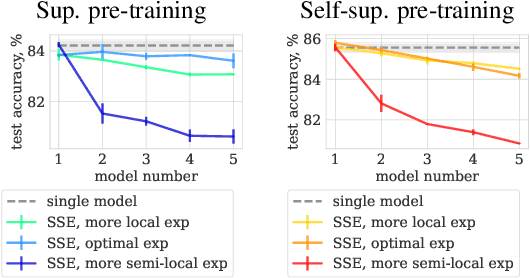
Transfer learning and ensembling are two popular techniques for improving the performance and robustness of neural networks. Due to the high cost of pre-training, ensembles of models fine-tuned from a single pre-trained checkpoint are often used in practice. Such models end up in the same basin of the loss landscape and thus have limited diversity. In this work, we study if it is possible to improve ensembles trained from a single pre-trained checkpoint by better exploring the pre-train basin or a close vicinity outside of it. We show that while exploration of the pre-train basin may be beneficial for the ensemble, leaving the basin results in losing the benefits of transfer learning and degradation of the ensemble quality.