 Add to Chrome
 Add to Firefox
 Add to Edge
The Next Challenge for Agentic Cybersecurity: A Realistic, Contamination-Free Reverse Engineering Benchmark
Aug 11, 2026
AI agents are rapidly improving in cybersecurity capabilities when the source code is available for analysis, yet much of the software most consequential to cybersecurity, including malware, firmware, and proprietary applications, is available only as binaries. Analyzing such software requires reverse engineering(RE): recovering program semantics before the analysis can be meaningfully performed. However, evaluating agentic RE poses a fundamental challenge: benchmark instances must be unseen as source code in the LLMs' training data to prevent models from taking shortcuts by recognizing them rather than really analyzing them, while also matching the scale and anti-analysis protections of real software. Unfortunately, however, existing benchmarks do not jointly satisfy these requirements. To this end, we introduce SRE-Bench, the first realistic, contamination-free RE benchmark. Built entirely from scratch by RE experts with over 5,000 hours, SRE-Bench comprises 19 private, real-world-scale programs averaging 16.9K lines of code. We further developed 44 in-house anti-analysis primitives, yielding 262 binary instances and 1572 deterministically graded tasks. Our evaluation across five frontier LLMs (GPT-5.6-sol,Claude-Opus-5,GPT-5.5,Grok-4.5, and GLM-5.2) shows that RE remains largely unsolved: the strongest model, GPT-5.6-sol, scores 61.4% per instance, and fully solves only 31.5% of the instances. Our analysis further reveals that agents behave differently from human engineers, where agents are relatively insensitive to compiler optimization and static linking. Controlled ablations also confirm that both contamination control and realistic scale are essential. These results indicate that strong source-code security capabilities do not yet transfer to binary analysis, highlighting RE as an important frontier for agentic cybersecurity and SRE-Bench as a rigorous testbed to measure progress.

FormalProofBench: Can Models Write Graduate Level Math Proofs That Are Formally Verified?
Mar 27, 2026We present FormalProofBench, a private benchmark designed to evaluate whether AI models can produce formally verified mathematical proofs at the graduate level. Each task pairs a natural-language problem with a Lean~4 formal statement, and a model must output a Lean proof accepted by the Lean 4 checker. FormalProofBench targets advanced undergraduate and graduate mathematics, with problems drawn from qualifying exams and standard textbooks across topics including analysis, algebra, probability, and logic. We evaluate a range of frontier models with an agentic harness, and find that the best-performing foundation model achieves 33.5% accuracy, with performance dropping rapidly after that. In addition to the accuracy numbers, we also provide empirical analysis of tool-use, failure modes, cost and latency, thereby providing a thorough evaluation of the formal-theorem proving abilities of frontier models.
REAL: Benchmarking Autonomous Agents on Deterministic Simulations of Real Websites
Apr 15, 2025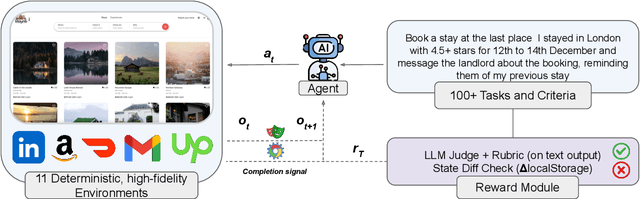
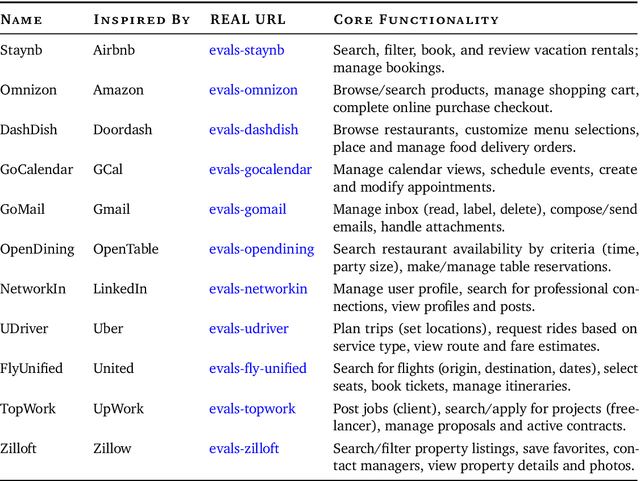
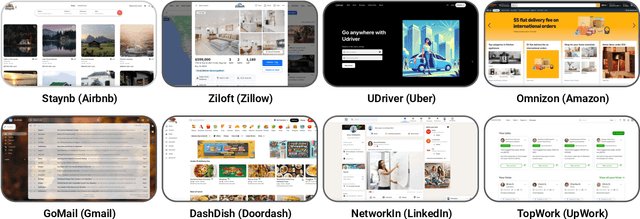
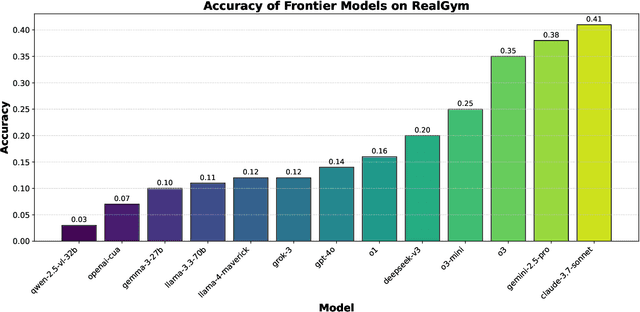
We introduce REAL, a benchmark and framework for multi-turn agent evaluations on deterministic simulations of real-world websites. REAL comprises high-fidelity, deterministic replicas of 11 widely-used websites across domains such as e-commerce, travel, communication, and professional networking. We also release a benchmark consisting of 112 practical tasks that mirror everyday complex user interactions requiring both accurate information retrieval and state-changing actions. All interactions occur within this fully controlled setting, eliminating safety risks and enabling robust, reproducible evaluation of agent capability and reliability. Our novel evaluation framework combines programmatic checks of website state for action-based tasks with rubric-guided LLM-based judgments for information retrieval. The framework supports both open-source and proprietary agent systems through a flexible evaluation harness that accommodates black-box commands within browser environments, allowing research labs to test agentic systems without modification. Our empirical results show that frontier language models achieve at most a 41% success rate on REAL, highlighting critical gaps in autonomous web navigation and task completion capabilities. Our framework supports easy integration of new tasks, reproducible evaluation, and scalable data generation for training web agents. The websites, framework, and leaderboard are available at https://realevals.xyz and https://github.com/agi-inc/REAL.
FAIR principles for AI models, with a practical application for accelerated high energy diffraction microscopy
Jul 14, 2022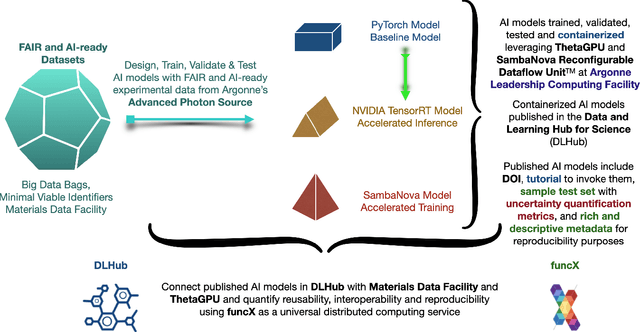
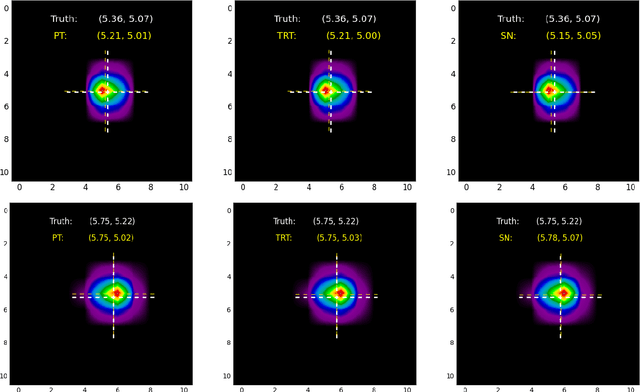
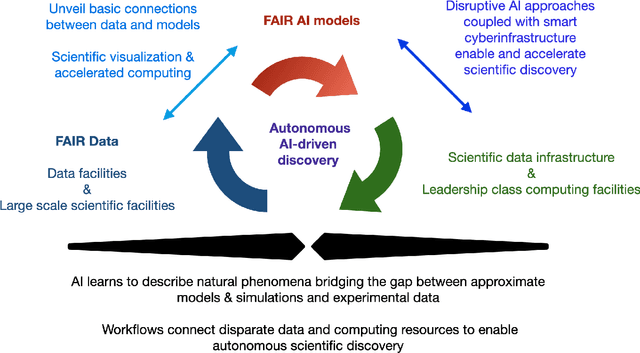
A concise and measurable set of FAIR (Findable, Accessible, Interoperable and Reusable) principles for scientific data is transforming the state-of-practice for data management and stewardship, supporting and enabling discovery and innovation. Learning from this initiative, and acknowledging the impact of artificial intelligence (AI) in the practice of science and engineering, we introduce a set of practical, concise, and measurable FAIR principles for AI models. We showcase how to create and share FAIR data and AI models within a unified computational framework combining the following elements: the Advanced Photon Source at Argonne National Laboratory, the Materials Data Facility, the Data and Learning Hub for Science, and funcX, and the Argonne Leadership Computing Facility (ALCF), in particular the ThetaGPU supercomputer and the SambaNova DataScale system at the ALCF AI Testbed. We describe how this domain-agnostic computational framework may be harnessed to enable autonomous AI-driven discovery.