 Add to Chrome
 Add to Firefox
 Add to Edge
Web Agents Should Adopt the Plan-Then-Execute Paradigm
May 14, 2026
ReAct has become the default architecture across LLM agents, and many existing web agents follow this paradigm. We argue that it is the wrong default for web agents. Instead, web agents should default to plan-then-execute: commit to a task-specific program before observing runtime web content, then execute it. The reason is that web content mixes inputs from many parties. An e-commerce product page may combine a seller's listing, customer reviews and sponsored advertisements. Under ReAct, all of this content flows into the model when deciding on the next action, creating a direct path for prompt injections to steer the agent's control flow. Plan-then-execute changes this boundary: untrusted data may influence values or branches inside a predefined execution graph, but it cannot redefine the user task or cause the model to synthesize new actions at runtime. We analyze WebArena, a popular web agent benchmark, and find that all tasks are compatible with plan-then-execute, while 80% can be completed with a purely programmatic plan, without any runtime LLM subroutine. We identify the main barrier to adopting plan-then-execute on the web: For it to work well, tools must map cleanly to semantic actions, with effects known before execution, so agents have enough information to plan. The web does not naturally expose that interface. Browser tools such as click, type, and scroll have page-dependent meanings. Planning at this layer is near-sighted: the agent can only see actions on the current page, and later actions appear only after it acts. Closing this gap requires typed interfaces that turn website interactions from clicks and keystrokes to task-level operations. This is an infrastructure problem, not a modeling problem. Web tasks do not need reactivity by default; they need typed, complete, auditable website APIs.

Opal: Private Memory for Personal AI
Apr 02, 2026Personal AI systems increasingly retain long-term memory of user activity, including documents, emails, messages, meetings, and ambient recordings. Trusted hardware can keep this data private, but struggles to scale with a growing datastore. This pushes the data to external storage, which exposes retrieval access patterns that leak private information to the application provider. Oblivious RAM (ORAM) is a cryptographic primitive that can hide these patterns, but it requires a fixed access budget, precluding the query-dependent traversals that agentic memory systems rely on for accuracy. We present Opal, a private memory system for personal AI. Our key insight is to decouple all data-dependent reasoning from the bulk of personal data, confining it to the trusted enclave. Untrusted disk then sees only fixed, oblivious memory accesses. This enclave-resident component uses a lightweight knowledge graph to capture personal context that semantic search alone misses and handles continuous ingestion by piggybacking reindexing and capacity management on every ORAM access. Evaluated on a comprehensive synthetic personal-data pipeline driven by stochastic communication models, Opal improves retrieval accuracy by 13 percentage points over semantic search and achieves 29x higher throughput with 15x lower infrastructure cost than a secure baseline. Opal is under consideration for deployment to millions of users at a major AI provider.
MiniScope: A Least Privilege Framework for Authorizing Tool Calling Agents
Dec 11, 2025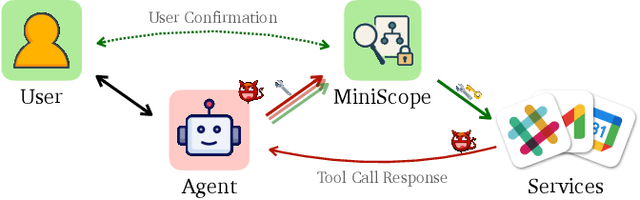

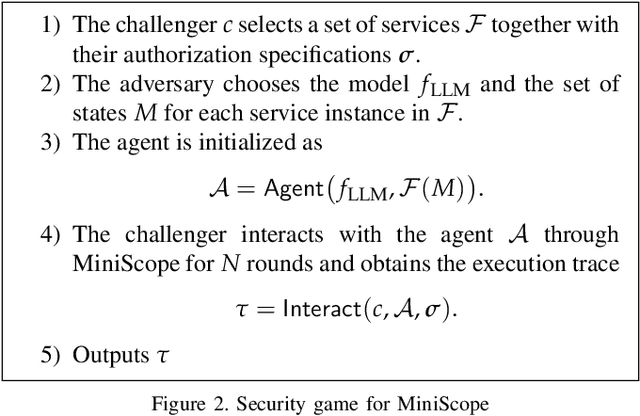

Tool calling agents are an emerging paradigm in LLM deployment, with major platforms such as ChatGPT, Claude, and Gemini adding connectors and autonomous capabilities. However, the inherent unreliability of LLMs introduces fundamental security risks when these agents operate over sensitive user services. Prior approaches either rely on manually written policies that require security expertise, or place LLMs in the confinement loop, which lacks rigorous security guarantees. We present MiniScope, a framework that enables tool calling agents to operate on user accounts while confining potential damage from unreliable LLMs. MiniScope introduces a novel way to automatically and rigorously enforce least privilege principles by reconstructing permission hierarchies that reflect relationships among tool calls and combining them with a mobile-style permission model to balance security and ease of use. To evaluate MiniScope, we create a synthetic dataset derived from ten popular real-world applications, capturing the complexity of realistic agentic tasks beyond existing simplified benchmarks. Our evaluation shows that MiniScope incurs only 1-6% latency overhead compared to vanilla tool calling agents, while significantly outperforming the LLM based baseline in minimizing permissions as well as computational and operational costs.
Zero-Shot Enhancement of Low-Light Image Based on Retinex Decomposition
Nov 06, 2023Two difficulties here make low-light image enhancement a challenging task; firstly, it needs to consider not only luminance restoration but also image contrast, image denoising and color distortion issues simultaneously. Second, the effectiveness of existing low-light enhancement methods depends on paired or unpaired training data with poor generalization performance. To solve these difficult problems, we propose in this paper a new learning-based Retinex decomposition of zero-shot low-light enhancement method, called ZERRINNet. To this end, we first designed the N-Net network, together with the noise loss term, to be used for denoising the original low-light image by estimating the noise of the low-light image. Moreover, RI-Net is used to estimate the reflection component and illumination component, and in order to solve the color distortion and contrast, we use the texture loss term and segmented smoothing loss to constrain the reflection component and illumination component. Finally, our method is a zero-reference enhancement method that is not affected by the training data of paired and unpaired datasets, so our generalization performance is greatly improved, and in the paper, we have effectively validated it with a homemade real-life low-light dataset and additionally with advanced vision tasks, such as face detection, target recognition, and instance segmentation. We conducted comparative experiments on a large number of public datasets and the results show that the performance of our method is competitive compared to the current state-of-the-art methods. The code is available at:https://github.com/liwenchao0615/ZERRINNet