 Add to Chrome
 Add to Firefox
 Add to Edge
The Next Challenge for Agentic Cybersecurity: A Realistic, Contamination-Free Reverse Engineering Benchmark
Aug 11, 2026
AI agents are rapidly improving in cybersecurity capabilities when the source code is available for analysis, yet much of the software most consequential to cybersecurity, including malware, firmware, and proprietary applications, is available only as binaries. Analyzing such software requires reverse engineering(RE): recovering program semantics before the analysis can be meaningfully performed. However, evaluating agentic RE poses a fundamental challenge: benchmark instances must be unseen as source code in the LLMs' training data to prevent models from taking shortcuts by recognizing them rather than really analyzing them, while also matching the scale and anti-analysis protections of real software. Unfortunately, however, existing benchmarks do not jointly satisfy these requirements. To this end, we introduce SRE-Bench, the first realistic, contamination-free RE benchmark. Built entirely from scratch by RE experts with over 5,000 hours, SRE-Bench comprises 19 private, real-world-scale programs averaging 16.9K lines of code. We further developed 44 in-house anti-analysis primitives, yielding 262 binary instances and 1572 deterministically graded tasks. Our evaluation across five frontier LLMs (GPT-5.6-sol,Claude-Opus-5,GPT-5.5,Grok-4.5, and GLM-5.2) shows that RE remains largely unsolved: the strongest model, GPT-5.6-sol, scores 61.4% per instance, and fully solves only 31.5% of the instances. Our analysis further reveals that agents behave differently from human engineers, where agents are relatively insensitive to compiler optimization and static linking. Controlled ablations also confirm that both contamination control and realistic scale are essential. These results indicate that strong source-code security capabilities do not yet transfer to binary analysis, highlighting RE as an important frontier for agentic cybersecurity and SRE-Bench as a rigorous testbed to measure progress.

Graph Neural Reasoning for 2-Quantified Boolean Formula Solvers
Apr 27, 2019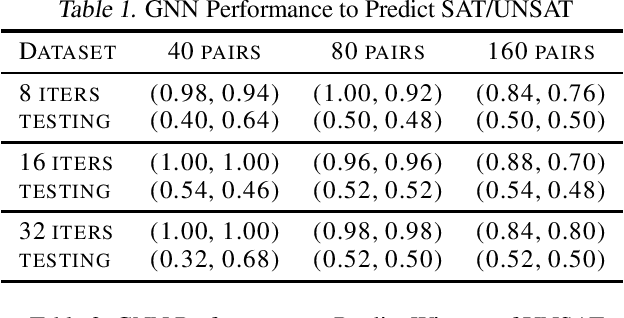
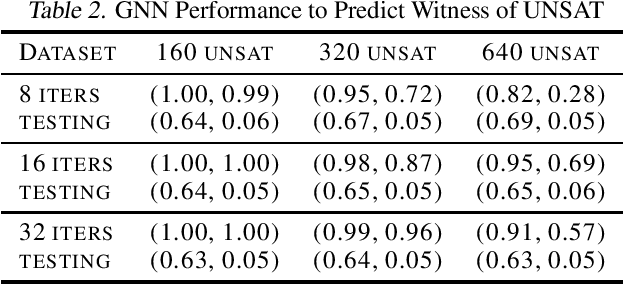
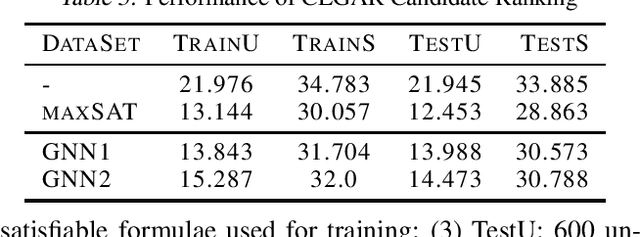
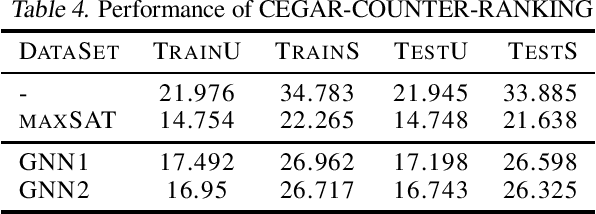
In this paper, we investigate the feasibility of learning GNN (Graph Neural Network) based solvers and GNN-based heuristics for specified QBF (Quantified Boolean Formula) problems. We design and evaluate several GNN architectures for 2QBF formulae, and conjecture that GNN has limitations in learning 2QBF solvers. Then we show how to learn a heuristic CEGAR 2QBF solver. We further explore generalizing GNN-based heuristics to larger unseen instances, and uncover some interesting challenges. In summary, this paper provides a comprehensive surveying view of applying GNN-embeddings to specified QBF solvers, and aims to offer guidance in applying ML to more complicated symbolic reasoning problems.