 Add to Chrome
 Add to Firefox
 Add to Edge
Inverting Foundation Models of Brain Function with Simulation-Based Inference
Apr 26, 2026
Foundation models of brain activity promise a new frontier for in silico neuroscience by emulating neural responses to complex stimuli across tasks and modalities. A natural next step is to ask whether these models can also be used in reverse. Can we recover a stimulus or its properties from synthetic brain activity? We study this question in a proof-of-concept setting using TRIBEv2. We pair the brain emulator with large language models (LLMs) that generate news headlines from linguistic parameters such as valence, arousal, and dominance. We then use simulation-based inference to learn a probabilistic mapping from brain maps to latent stimulus parameters. Our results show that these parameters can be recovered from predicted brain maps, validating the quality of neural encodings. They also show that LLMs can serve as controllable stimulus generators for simulated experiments. Together, these findings provide a step toward decoding and inverse design with foundation brain models.

BayesFlow 2.0: Multi-Backend Amortized Bayesian Inference in Python
Feb 06, 2026Modern Bayesian inference involves a mixture of computational methods for estimating, validating, and drawing conclusions from probabilistic models as part of principled workflows. An overarching motif of many Bayesian methods is that they are relatively slow, which often becomes prohibitive when fitting complex models to large data sets. Amortized Bayesian inference (ABI) offers a path to solving the computational challenges of Bayes. ABI trains neural networks on model simulations, rewarding users with rapid inference of any model-implied quantity, such as point estimates, likelihoods, or full posterior distributions. In this work, we present the Python library BayesFlow, Version 2.0, for general-purpose ABI. Along with direct posterior, likelihood, and ratio estimation, the software includes support for multiple popular deep learning backends, a rich collection of generative networks for sampling and density estimation, complete customization and high-level interfaces, as well as new capabilities for hyperparameter optimization, design optimization, and hierarchical modeling. Using a case study on dynamical system parameter estimation, combined with comparisons to similar software, we show that our streamlined, user-friendly workflow has strong potential to support broad adoption.
JADAI: Jointly Amortizing Adaptive Design and Bayesian Inference
Dec 28, 2025We consider problems of parameter estimation where design variables can be actively optimized to maximize information gain. To this end, we introduce JADAI, a framework that jointly amortizes Bayesian adaptive design and inference by training a policy, a history network, and an inference network end-to-end. The networks minimize a generic loss that aggregates incremental reductions in posterior error along experimental sequences. Inference networks are instantiated with diffusion-based posterior estimators that can approximate high-dimensional and multimodal posteriors at every experimental step. Across standard adaptive design benchmarks, JADAI achieves superior or competitive performance.
Diffusion Models in Simulation-Based Inference: A Tutorial Review
Dec 22, 2025

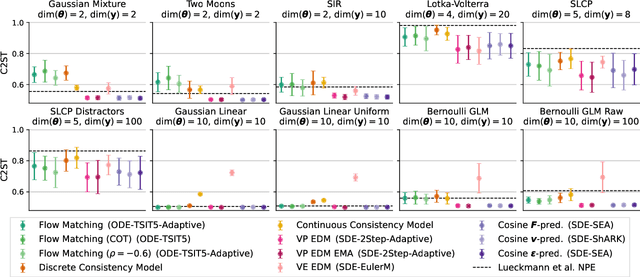
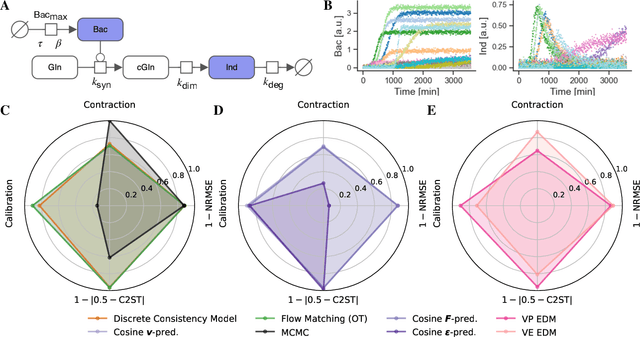
Diffusion models have recently emerged as powerful learners for simulation-based inference (SBI), enabling fast and accurate estimation of latent parameters from simulated and real data. Their score-based formulation offers a flexible way to learn conditional or joint distributions over parameters and observations, thereby providing a versatile solution to various modeling problems. In this tutorial review, we synthesize recent developments on diffusion models for SBI, covering design choices for training, inference, and evaluation. We highlight opportunities created by various concepts such as guidance, score composition, flow matching, consistency models, and joint modeling. Furthermore, we discuss how efficiency and statistical accuracy are affected by noise schedules, parameterizations, and samplers. Finally, we illustrate these concepts with case studies across parameter dimensionalities, simulation budgets, and model types, and outline open questions for future research.
Conditional Invertible Neural Networks for Diverse Image-to-Image Translation
May 05, 2021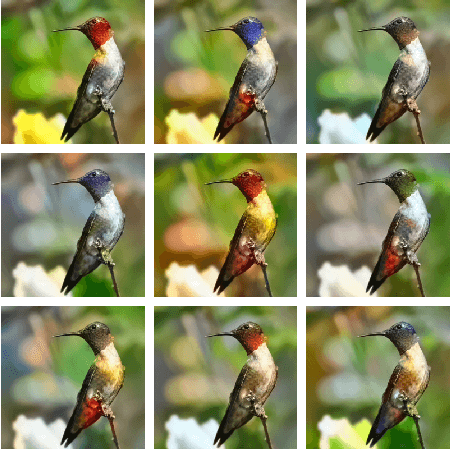

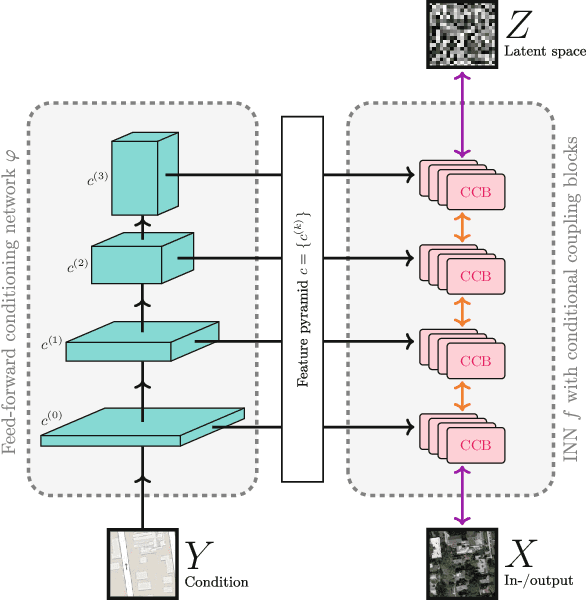
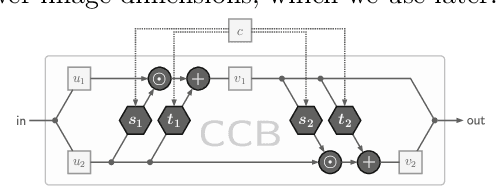
We introduce a new architecture called a conditional invertible neural network (cINN), and use it to address the task of diverse image-to-image translation for natural images. This is not easily possible with existing INN models due to some fundamental limitations. The cINN combines the purely generative INN model with an unconstrained feed-forward network, which efficiently preprocesses the conditioning image into maximally informative features. All parameters of a cINN are jointly optimized with a stable, maximum likelihood-based training procedure. Even though INN-based models have received far less attention in the literature than GANs, they have been shown to have some remarkable properties absent in GANs, e.g. apparent immunity to mode collapse. We find that our cINNs leverage these properties for image-to-image translation, demonstrated on day to night translation and image colorization. Furthermore, we take advantage of our bidirectional cINN architecture to explore and manipulate emergent properties of the latent space, such as changing the image style in an intuitive way.