 Add to Chrome
 Add to Firefox
 Add to Edge
NoLimits.jl: Flexible and Composable Nonlinear Mixed-Effects Modeling in Julia
Jun 23, 2026
Nonlinear mixed-effects models are widely used to analyze longitudinal data, but existing open-source software often supports only a limited subset of the model structures, inference methods, machine-learning components, automatic differentiation techniques, and random-effects distributions required in modern applications. We introduce NoLimits.jl, an open-source Julia package for flexible and composable nonlinear mixed-effects modeling. Its macro-based modeling language enables observation and latent-state models to be constructed from diverse building blocks, including ordinary differential equations, Markov models, and neural networks. NoLimits.jl supports flexible, covariate-dependent observation and random-effects distributions and provides a unified interface to frequentist inference through Laplace approximation, stochastic expectation maximization, and Bayesian Markov chain Monte Carlo methods. We demonstrate the package on three case studies showcasing its workflows, integration of differentiable machine-learning components, and data-driven estimation of random-effects distributions using normalizing flows. Together, these capabilities substantially expand the range of nonlinear mixed-effects models that can be specified, estimated, and compared within a single open-source framework.

Overcoming Selection Bias in Statistical Studies With Amortized Bayesian Inference
Apr 20, 2026Selection bias arises when the probability that an observation enters a dataset depends on variables related to the quantities of interest, leading to systematic distortions in estimation and uncertainty quantification. For example, in epidemiological or survey settings, individuals with certain outcomes may be more likely to be included, resulting in biased prevalence estimates with potentially substantial downstream impact. Classical corrections, such as inverse-probability weighting or explicit likelihood-based models of the selection process, rely on tractable likelihoods, which limits their applicability in complex stochastic models with latent dynamics or high-dimensional structure. Simulation-based inference enables Bayesian analysis without tractable likelihoods but typically assumes missingness at random and thus fails when selection depends on unobserved outcomes or covariates. Here, we develop a bias-aware simulation-based inference framework that explicitly incorporates selection into neural posterior estimation. By embedding the selection mechanism directly into the generative simulator, the approach enables amortized Bayesian inference without requiring tractable likelihoods. This recasting of selection bias as part of the simulation process allows us to both obtain debiased estimates and explicitly test for the presence of bias. The framework integrates diagnostics to detect discrepancies between simulated and observed data and to assess posterior calibration. The method recovers well-calibrated posterior distributions across three statistical applications with diverse selection mechanisms, including settings in which likelihood-based approaches yield biased estimates. These results recast the correction of selection bias as a simulation problem and establish simulation-based inference as a practical and testable strategy for parameter estimation under selection bias.
BayesFlow 2.0: Multi-Backend Amortized Bayesian Inference in Python
Feb 06, 2026Modern Bayesian inference involves a mixture of computational methods for estimating, validating, and drawing conclusions from probabilistic models as part of principled workflows. An overarching motif of many Bayesian methods is that they are relatively slow, which often becomes prohibitive when fitting complex models to large data sets. Amortized Bayesian inference (ABI) offers a path to solving the computational challenges of Bayes. ABI trains neural networks on model simulations, rewarding users with rapid inference of any model-implied quantity, such as point estimates, likelihoods, or full posterior distributions. In this work, we present the Python library BayesFlow, Version 2.0, for general-purpose ABI. Along with direct posterior, likelihood, and ratio estimation, the software includes support for multiple popular deep learning backends, a rich collection of generative networks for sampling and density estimation, complete customization and high-level interfaces, as well as new capabilities for hyperparameter optimization, design optimization, and hierarchical modeling. Using a case study on dynamical system parameter estimation, combined with comparisons to similar software, we show that our streamlined, user-friendly workflow has strong potential to support broad adoption.
Diffusion Models in Simulation-Based Inference: A Tutorial Review
Dec 22, 2025

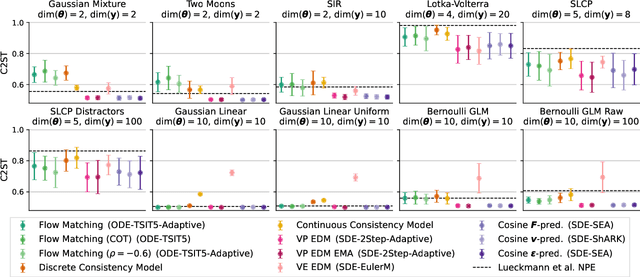
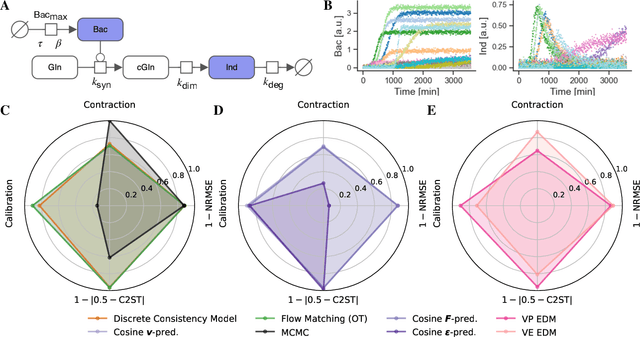
Diffusion models have recently emerged as powerful learners for simulation-based inference (SBI), enabling fast and accurate estimation of latent parameters from simulated and real data. Their score-based formulation offers a flexible way to learn conditional or joint distributions over parameters and observations, thereby providing a versatile solution to various modeling problems. In this tutorial review, we synthesize recent developments on diffusion models for SBI, covering design choices for training, inference, and evaluation. We highlight opportunities created by various concepts such as guidance, score composition, flow matching, consistency models, and joint modeling. Furthermore, we discuss how efficiency and statistical accuracy are affected by noise schedules, parameterizations, and samplers. Finally, we illustrate these concepts with case studies across parameter dimensionalities, simulation budgets, and model types, and outline open questions for future research.