 Add to Chrome
 Add to Firefox
 Add to Edge
Unsupervised Continual Learning for Amortized Bayesian Inference
Feb 26, 2026
Amortized Bayesian Inference (ABI) enables efficient posterior estimation using generative neural networks trained on simulated data, but often suffers from performance degradation under model misspecification. While self-consistency (SC) training on unlabeled empirical data can enhance network robustness, current approaches are limited to static, single-task settings and fail to handle sequentially arriving data or distribution shifts. We propose a continual learning framework for ABI that decouples simulation-based pre-training from unsupervised sequential SC fine-tuning on real-world data. To address the challenge of catastrophic forgetting, we introduce two adaptation strategies: (1) SC with episodic replay, utilizing a memory buffer of past observations, and (2) SC with elastic weight consolidation, which regularizes updates to preserve task-critical parameters. Across three diverse case studies, our methods significantly mitigate forgetting and yield posterior estimates that outperform standard simulation-based training, achieving estimates closer to MCMC reference, providing a viable path for trustworthy ABI across a range of different tasks.

BayesFlow 2.0: Multi-Backend Amortized Bayesian Inference in Python
Feb 06, 2026Modern Bayesian inference involves a mixture of computational methods for estimating, validating, and drawing conclusions from probabilistic models as part of principled workflows. An overarching motif of many Bayesian methods is that they are relatively slow, which often becomes prohibitive when fitting complex models to large data sets. Amortized Bayesian inference (ABI) offers a path to solving the computational challenges of Bayes. ABI trains neural networks on model simulations, rewarding users with rapid inference of any model-implied quantity, such as point estimates, likelihoods, or full posterior distributions. In this work, we present the Python library BayesFlow, Version 2.0, for general-purpose ABI. Along with direct posterior, likelihood, and ratio estimation, the software includes support for multiple popular deep learning backends, a rich collection of generative networks for sampling and density estimation, complete customization and high-level interfaces, as well as new capabilities for hyperparameter optimization, design optimization, and hierarchical modeling. Using a case study on dynamical system parameter estimation, combined with comparisons to similar software, we show that our streamlined, user-friendly workflow has strong potential to support broad adoption.
From Mice to Trains: Amortized Bayesian Inference on Graph Data
Jan 05, 2026Graphs arise across diverse domains, from biology and chemistry to social and information networks, as well as in transportation and logistics. Inference on graph-structured data requires methods that are permutation-invariant, scalable across varying sizes and sparsities, and capable of capturing complex long-range dependencies, making posterior estimation on graph parameters particularly challenging. Amortized Bayesian Inference (ABI) is a simulation-based framework that employs generative neural networks to enable fast, likelihood-free posterior inference. We adapt ABI to graph data to address these challenges to perform inference on node-, edge-, and graph-level parameters. Our approach couples permutation-invariant graph encoders with flexible neural posterior estimators in a two-module pipeline: a summary network maps attributed graphs to fixed-length representations, and an inference network approximates the posterior over parameters. In this setting, several neural architectures can serve as the summary network. In this work we evaluate multiple architectures and assess their performance on controlled synthetic settings and two real-world domains - biology and logistics - in terms of recovery and calibration.
JADAI: Jointly Amortizing Adaptive Design and Bayesian Inference
Dec 28, 2025We consider problems of parameter estimation where design variables can be actively optimized to maximize information gain. To this end, we introduce JADAI, a framework that jointly amortizes Bayesian adaptive design and inference by training a policy, a history network, and an inference network end-to-end. The networks minimize a generic loss that aggregates incremental reductions in posterior error along experimental sequences. Inference networks are instantiated with diffusion-based posterior estimators that can approximate high-dimensional and multimodal posteriors at every experimental step. Across standard adaptive design benchmarks, JADAI achieves superior or competitive performance.
Improving the Accuracy of Amortized Model Comparison with Self-Consistency
Dec 16, 2025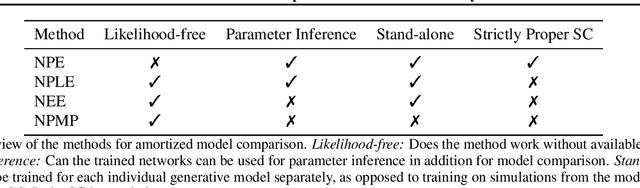
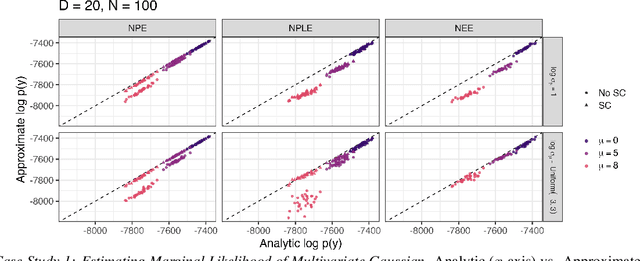
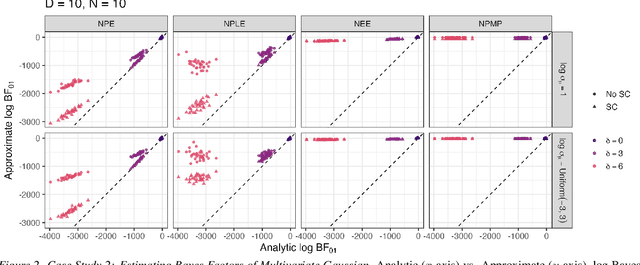
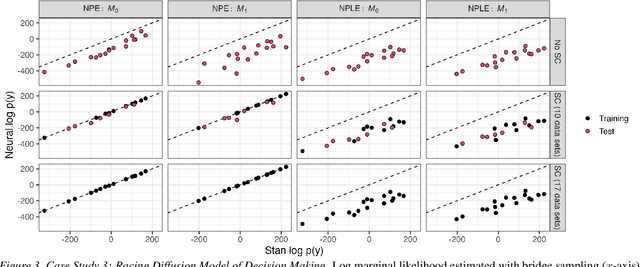
Amortized Bayesian inference (ABI) offers fast, scalable approximations to posterior densities by training neural surrogates on data simulated from the statistical model. However, ABI methods are highly sensitive to model misspecification: when observed data fall outside the training distribution (generative scope of the statistical models), neural surrogates can behave unpredictably. This makes it a challenge in a model comparison setting, where multiple statistical models are considered, of which at least some are misspecified. Recent work on self-consistency (SC) provides a promising remedy to this issue, accessible even for empirical data (without ground-truth labels). In this work, we investigate how SC can improve amortized model comparison conceptualized in four different ways. Across two synthetic and two real-world case studies, we find that approaches for model comparison that estimate marginal likelihoods through approximate parameter posteriors consistently outperform methods that directly approximate model evidence or posterior model probabilities. SC training improves robustness when the likelihood is available, even under severe model misspecification. The benefits of SC for methods without access of analytic likelihoods are more limited and inconsistent. Our results suggest practical guidance for reliable amortized Bayesian model comparison: prefer parameter posterior-based methods and augment them with SC training on empirical datasets to mitigate extrapolation bias under model misspecification.
Uncertainty-Aware Surrogate-based Amortized Bayesian Inference for Computationally Expensive Models
May 13, 2025Bayesian inference typically relies on a large number of model evaluations to estimate posterior distributions. Established methods like Markov Chain Monte Carlo (MCMC) and Amortized Bayesian Inference (ABI) can become computationally challenging. While ABI enables fast inference after training, generating sufficient training data still requires thousands of model simulations, which is infeasible for expensive models. Surrogate models offer a solution by providing approximate simulations at a lower computational cost, allowing the generation of large data sets for training. However, the introduced approximation errors and uncertainties can lead to overconfident posterior estimates. To address this, we propose Uncertainty-Aware Surrogate-based Amortized Bayesian Inference (UA-SABI) - a framework that combines surrogate modeling and ABI while explicitly quantifying and propagating surrogate uncertainties through the inference pipeline. Our experiments show that this approach enables reliable, fast, and repeated Bayesian inference for computationally expensive models, even under tight time constraints.
Does Unsupervised Domain Adaptation Improve the Robustness of Amortized Bayesian Inference? A Systematic Evaluation
Feb 07, 2025


Neural networks are fragile when confronted with data that significantly deviates from their training distribution. This is true in particular for simulation-based inference methods, such as neural amortized Bayesian inference (ABI), where models trained on simulated data are deployed on noisy real-world observations. Recent robust approaches employ unsupervised domain adaptation (UDA) to match the embedding spaces of simulated and observed data. However, the lack of comprehensive evaluations across different domain mismatches raises concerns about the reliability in high-stakes applications. We address this gap by systematically testing UDA approaches across a wide range of misspecification scenarios in both a controlled and a high-dimensional benchmark. We demonstrate that aligning summary spaces between domains effectively mitigates the impact of unmodeled phenomena or noise. However, the same alignment mechanism can lead to failures under prior misspecifications - a critical finding with practical consequences. Our results underscore the need for careful consideration of misspecification types when using UDA techniques to increase the robustness of ABI in practice.
Bayesian Surrogate Training on Multiple Data Sources: A Hybrid Modeling Strategy
Dec 16, 2024
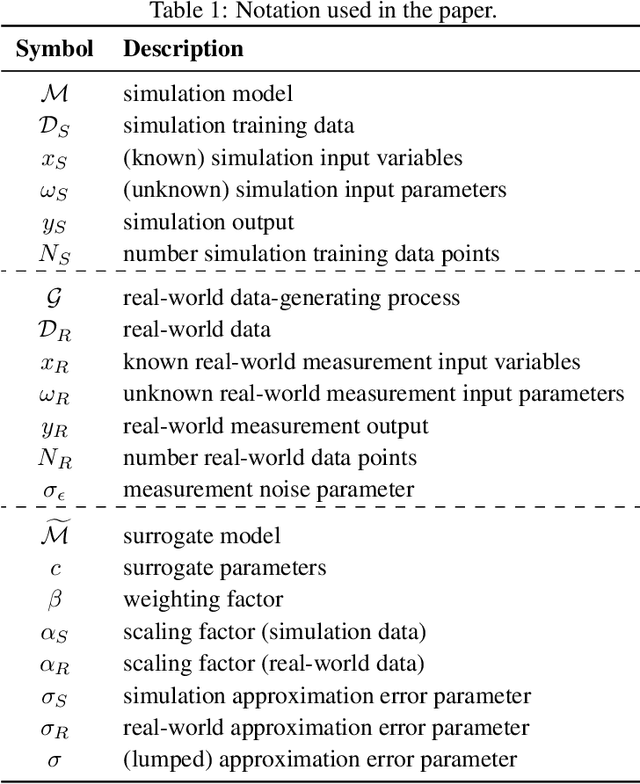
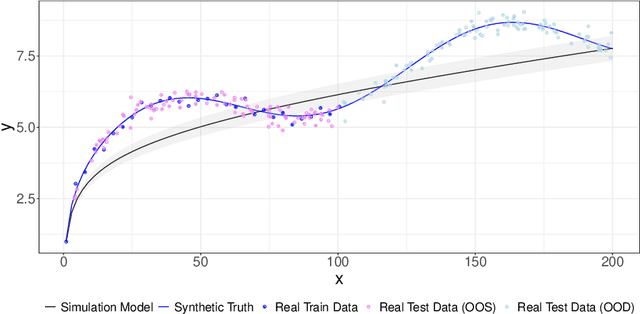
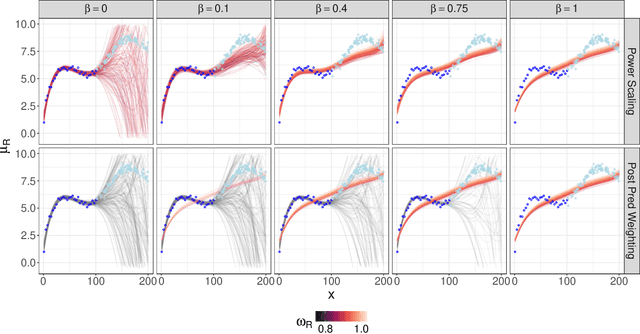
Surrogate models are often used as computationally efficient approximations to complex simulation models, enabling tasks such as solving inverse problems, sensitivity analysis, and probabilistic forward predictions, which would otherwise be computationally infeasible. During training, surrogate parameters are fitted such that the surrogate reproduces the simulation model's outputs as closely as possible. However, the simulation model itself is merely a simplification of the real-world system, often missing relevant processes or suffering from misspecifications e.g., in inputs or boundary conditions. Hints about these might be captured in real-world measurement data, and yet, we typically ignore those hints during surrogate building. In this paper, we propose two novel probabilistic approaches to integrate simulation data and real-world measurement data during surrogate training. The first method trains separate surrogate models for each data source and combines their predictive distributions, while the second incorporates both data sources by training a single surrogate. We show the conceptual differences and benefits of the two approaches through both synthetic and real-world case studies. The results demonstrate the potential of these methods to improve predictive accuracy, predictive coverage, and to diagnose problems in the underlying simulation model. These insights can improve system understanding and future model development.
Expert-elicitation method for non-parametric joint priors using normalizing flows
Nov 24, 2024We propose an expert-elicitation method for learning non-parametric joint prior distributions using normalizing flows. Normalizing flows are a class of generative models that enable exact, single-step density evaluation and can capture complex density functions through specialized deep neural networks. Building on our previously introduced simulation-based framework, we adapt and extend the methodology to accommodate non-parametric joint priors. Our framework thus supports the development of elicitation methods for learning both parametric and non-parametric priors, as well as independent or joint priors for model parameters. To evaluate the performance of the proposed method, we perform four simulation studies and present an evaluation pipeline that incorporates diagnostics and additional evaluation tools to support decision-making at each stage of the elicitation process.
Amortized Bayesian Workflow (Extended Abstract)
Sep 06, 2024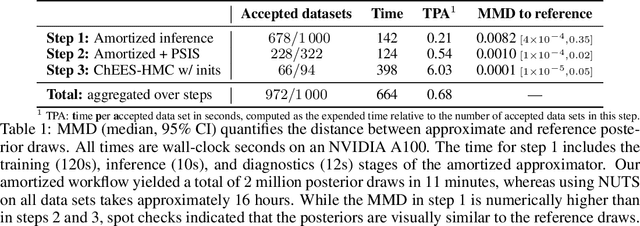
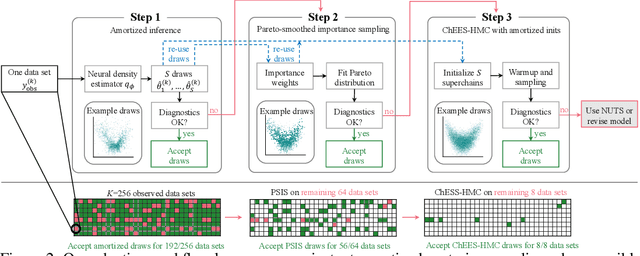
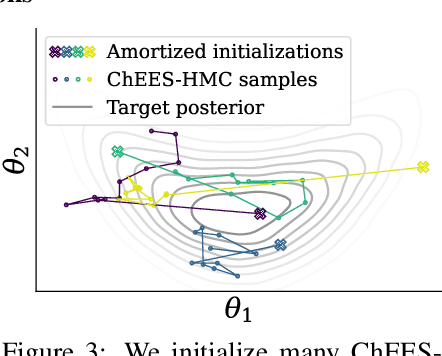
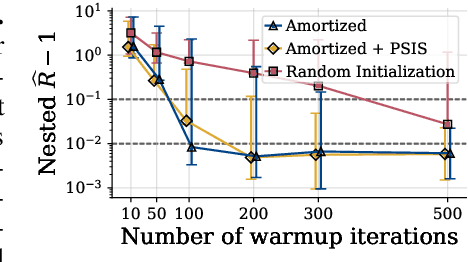
Bayesian inference often faces a trade-off between computational speed and sampling accuracy. We propose an adaptive workflow that integrates rapid amortized inference with gold-standard MCMC techniques to achieve both speed and accuracy when performing inference on many observed datasets. Our approach uses principled diagnostics to guide the choice of inference method for each dataset, moving along the Pareto front from fast amortized sampling to slower but guaranteed-accurate MCMC when necessary. By reusing computations across steps, our workflow creates synergies between amortized and MCMC-based inference. We demonstrate the effectiveness of this integrated approach on a generalized extreme value task with 1000 observed data sets, showing 90x time efficiency gains while maintaining high posterior quality.