 Add to Chrome
 Add to Firefox
 Add to Edge
Large language models as synthetic clinical experts to inform longitudinal rare-disease modeling
Aug 17, 2026
Due to the limited amount of information, modeling longitudinal rare-disease data can benefit from integrating clinical knowledge. Yet, elicitation of expert knowledge and formalization for model fitting is challenging, in particular due to limited time of clinical experts. To nevertheless make domain knowledge accessible during model fitting, we use large language models (LLMs) as synthetic clinical experts to supervise a variational-autoencoder-based approach that learns low-dimensional latent summaries of visit-level observations. Specifically, LLMs are queried offline on textual descriptions of patient observations to obtain judgments, e.g., the suspected clinical category. To improve the variational autoencoder fit, we train a differentiable surrogate model on these judgments and augment the loss function to encourage reconstructions that preserve the clinical-label distribution of their corresponding input profile. In an application to longitudinal motor-function assessments from children with spinal muscular atrophy, we map visit-level clinical profiles to low-dimensional representations that are linked by a multivariate mixed-effects model. The synthetic expert loss discourages reconstructions that remain numerically close in data space but alter the clinical interpretation of the reconstructed motor function profile, such as by crossing a disease-type boundary. We thus reduced disagreement between original and reconstructed SMA type labels from about 11 to 7 percent. Furthermore, informing the latent representation by the synthetic expert improved prediction of motor function milestones compared with unsupervised latent representations and a data-level baseline. These results suggest that incorporating LLMs into model fitting can make clinical knowledge available to representation learning and improve clinical faithfulness for longitudinal rare-disease data.

NoLimits.jl: Flexible and Composable Nonlinear Mixed-Effects Modeling in Julia
Jun 23, 2026Nonlinear mixed-effects models are widely used to analyze longitudinal data, but existing open-source software often supports only a limited subset of the model structures, inference methods, machine-learning components, automatic differentiation techniques, and random-effects distributions required in modern applications. We introduce NoLimits.jl, an open-source Julia package for flexible and composable nonlinear mixed-effects modeling. Its macro-based modeling language enables observation and latent-state models to be constructed from diverse building blocks, including ordinary differential equations, Markov models, and neural networks. NoLimits.jl supports flexible, covariate-dependent observation and random-effects distributions and provides a unified interface to frequentist inference through Laplace approximation, stochastic expectation maximization, and Bayesian Markov chain Monte Carlo methods. We demonstrate the package on three case studies showcasing its workflows, integration of differentiable machine-learning components, and data-driven estimation of random-effects distributions using normalizing flows. Together, these capabilities substantially expand the range of nonlinear mixed-effects models that can be specified, estimated, and compared within a single open-source framework.
Overcoming Selection Bias in Statistical Studies With Amortized Bayesian Inference
Apr 20, 2026Selection bias arises when the probability that an observation enters a dataset depends on variables related to the quantities of interest, leading to systematic distortions in estimation and uncertainty quantification. For example, in epidemiological or survey settings, individuals with certain outcomes may be more likely to be included, resulting in biased prevalence estimates with potentially substantial downstream impact. Classical corrections, such as inverse-probability weighting or explicit likelihood-based models of the selection process, rely on tractable likelihoods, which limits their applicability in complex stochastic models with latent dynamics or high-dimensional structure. Simulation-based inference enables Bayesian analysis without tractable likelihoods but typically assumes missingness at random and thus fails when selection depends on unobserved outcomes or covariates. Here, we develop a bias-aware simulation-based inference framework that explicitly incorporates selection into neural posterior estimation. By embedding the selection mechanism directly into the generative simulator, the approach enables amortized Bayesian inference without requiring tractable likelihoods. This recasting of selection bias as part of the simulation process allows us to both obtain debiased estimates and explicitly test for the presence of bias. The framework integrates diagnostics to detect discrepancies between simulated and observed data and to assess posterior calibration. The method recovers well-calibrated posterior distributions across three statistical applications with diverse selection mechanisms, including settings in which likelihood-based approaches yield biased estimates. These results recast the correction of selection bias as a simulation problem and establish simulation-based inference as a practical and testable strategy for parameter estimation under selection bias.
Diffusion Models in Simulation-Based Inference: A Tutorial Review
Dec 22, 2025

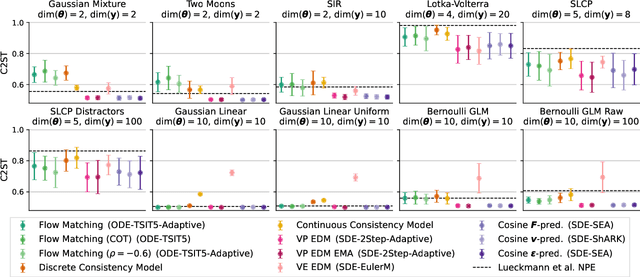
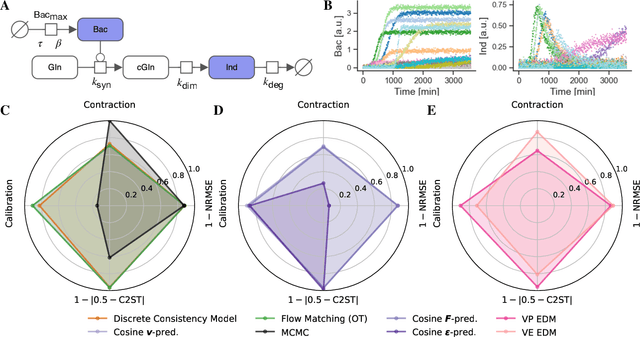
Diffusion models have recently emerged as powerful learners for simulation-based inference (SBI), enabling fast and accurate estimation of latent parameters from simulated and real data. Their score-based formulation offers a flexible way to learn conditional or joint distributions over parameters and observations, thereby providing a versatile solution to various modeling problems. In this tutorial review, we synthesize recent developments on diffusion models for SBI, covering design choices for training, inference, and evaluation. We highlight opportunities created by various concepts such as guidance, score composition, flow matching, consistency models, and joint modeling. Furthermore, we discuss how efficiency and statistical accuracy are affected by noise schedules, parameterizations, and samplers. Finally, we illustrate these concepts with case studies across parameter dimensionalities, simulation budgets, and model types, and outline open questions for future research.
Scalable branch-and-bound model selection with non-monotonic criteria including AIC, BIC and Mallows's $\mathit{C_p}$
Dec 13, 2025Model selection is a pivotal process in the quantitative sciences, where researchers must navigate between numerous candidate models of varying complexity. Traditional information criteria, such as the corrected Akaike Information Criterion (AICc), Bayesian Information Criterion (BIC), and Mallows's $\mathit{C_p}$, are valuable tools for identifying optimal models. However, the exponential increase in candidate models with each additional model parameter renders the evaluation of these criteria for all models -- a strategy known as exhaustive, or brute-force, searches -- computationally prohibitive. Consequently, heuristic approaches like stepwise regression are commonly employed, albeit without guarantees of finding the globally-optimal model. In this study, we challenge the prevailing notion that non-monotonicity in information criteria precludes bounds on the search space. We introduce a simple but novel bound that enables the development of branch-and-bound algorithms tailored for these non-monotonic functions. We demonstrate that our approach guarantees identification of the optimal model(s) across diverse model classes, sizes, and applications, often with orders of magnitude computational speedups. For instance, in one previously-published model selection task involving $2^{32}$ (approximately 4 billion) candidate models, our method achieves a computational speedup exceeding 6,000. These findings have broad implications for the scalability and effectiveness of model selection in complex scientific domains.
Non-Negative Universal Differential Equations With Applications in Systems Biology
Jun 20, 2024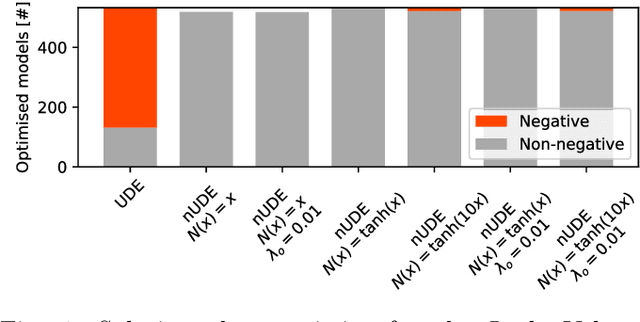
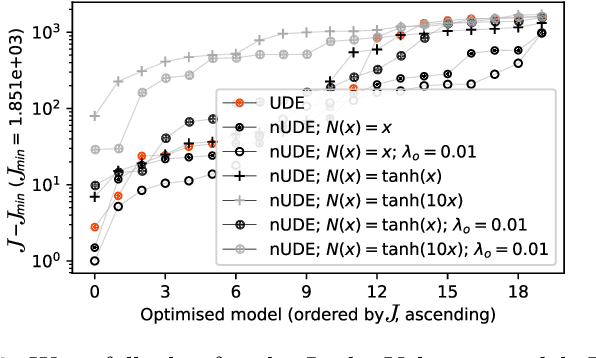
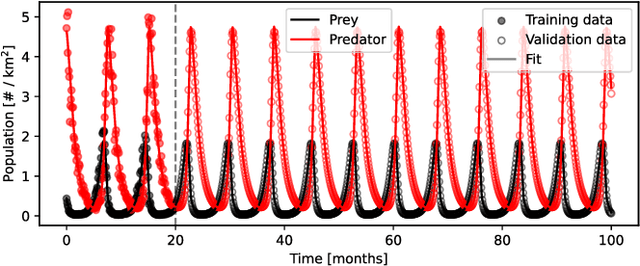
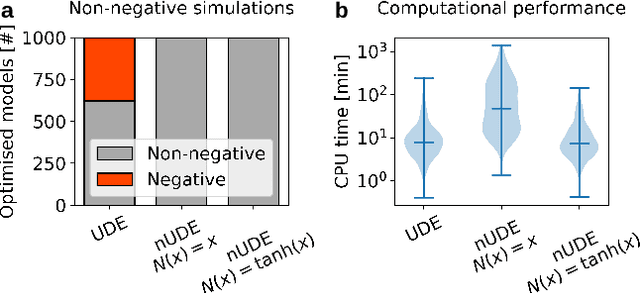
Universal differential equations (UDEs) leverage the respective advantages of mechanistic models and artificial neural networks and combine them into one dynamic model. However, these hybrid models can suffer from unrealistic solutions, such as negative values for biochemical quantities. We present non-negative UDE (nUDEs), a constrained UDE variant that guarantees non-negative values. Furthermore, we explore regularisation techniques to improve generalisation and interpretability of UDEs.
Assessment of Uncertainty Quantification in Universal Differential Equations
Jun 13, 2024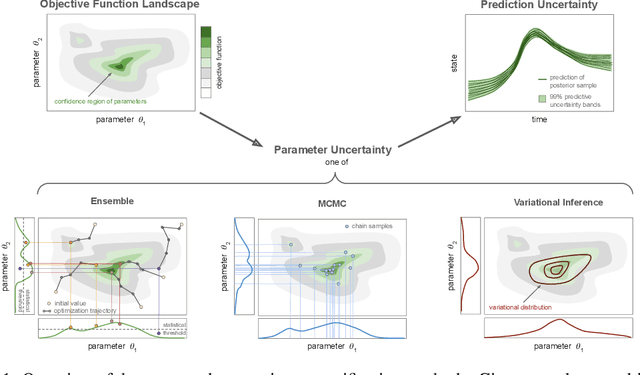
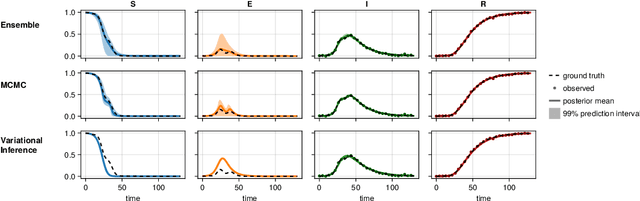
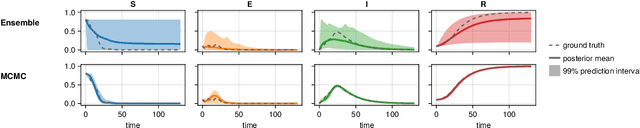
Scientific Machine Learning is a new class of approaches that integrate physical knowledge and mechanistic models with data-driven techniques for uncovering governing equations of complex processes. Among the available approaches, Universal Differential Equations (UDEs) are used to combine prior knowledge in the form of mechanistic formulations with universal function approximators, like neural networks. Integral to the efficacy of UDEs is the joint estimation of parameters within mechanistic formulations and the universal function approximators using empirical data. The robustness and applicability of resultant models, however, hinge upon the rigorous quantification of uncertainties associated with these parameters, as well as the predictive capabilities of the overall model or its constituent components. With this work, we provide a formalisation of uncertainty quantification (UQ) for UDEs and investigate important frequentist and Bayesian methods. By analysing three synthetic examples of varying complexity, we evaluate the validity and efficiency of ensembles, variational inference and Markov chain Monte Carlo sampling as epistemic UQ methods for UDEs.