 Add to Chrome
 Add to Firefox
 Add to Edge
On the Convergence of Jacobian-Free Backpropagation for Optimal Control Problems with Implicit Hamiltonians
Jan 31, 2026
Optimal feedback control with implicit Hamiltonians poses a fundamental challenge for learning-based value function methods due to the absence of closed-form optimal control laws. Recent work~\cite{gelphman2025end} introduced an implicit deep learning approach using Jacobian-Free Backpropagation (JFB) to address this setting, but only established sample-wise descent guarantees. In this paper, we establish convergence guarantees for JFB in the stochastic minibatch setting, showing that the resulting updates converge to stationary points of the expected optimal control objective. We further demonstrate scalability on substantially higher-dimensional problems, including multi-agent optimal consumption and swarm-based quadrotor and bicycle control. Together, our results provide both theoretical justification and empirical evidence for using JFB in high-dimensional optimal control with implicit Hamiltonians.

Pathwise Learning of Stochastic Dynamical Systems with Partial Observations
Jan 29, 2026The reconstruction and inference of stochastic dynamical systems from data is a fundamental task in inverse problems and statistical learning. While surrogate modeling advances computational methods to approximate these dynamics, standard approaches typically require high-fidelity training data. In many practical settings, the data are indirectly observed through noisy and nonlinear measurement. The challenge lies not only in approximating the coefficients of the SDEs, but in simultaneously inferring the posterior updates given the observations. In this work, we present a neural path estimation approach to solve stochastic dynamical systems based on variational inference. We first derive a stochastic control problem that solve filtering posterior path measure corresponding to a pathwise Zakai equation. We then construct a generative model that maps the prior path measure to posterior measure through the controlled diffusion and the associated Randon-Nykodym derivative. Through an amortization of sample paths of the observation process, the control is learned by an embedding of the noisy observation paths. Thus, we learn the unknown prior SDE and the control can recover the conditional path measure given the observation sample paths and we learn an associated SDE which induces the same path measure. In the end, we perform experiments on nonlinear dynamical systems, demonstrating the model's ability to learn multimodal, chaotic, or high dimensional systems.
Reflected Schrödinger Bridge for Constrained Generative Modeling
Jan 06, 2024


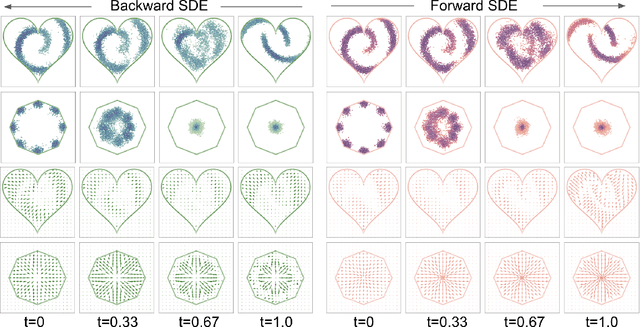
Diffusion models have become the go-to method for large-scale generative models in real-world applications. These applications often involve data distributions confined within bounded domains, typically requiring ad-hoc thresholding techniques for boundary enforcement. Reflected diffusion models (Lou23) aim to enhance generalizability by generating the data distribution through a backward process governed by reflected Brownian motion. However, reflected diffusion models may not easily adapt to diverse domains without the derivation of proper diffeomorphic mappings and do not guarantee optimal transport properties. To overcome these limitations, we introduce the Reflected Schrodinger Bridge algorithm: an entropy-regularized optimal transport approach tailored for generating data within diverse bounded domains. We derive elegant reflected forward-backward stochastic differential equations with Neumann and Robin boundary conditions, extend divergence-based likelihood training to bounded domains, and explore natural connections to entropic optimal transport for the study of approximate linear convergence - a valuable insight for practical training. Our algorithm yields robust generative modeling in diverse domains, and its scalability is demonstrated in real-world constrained generative modeling through standard image benchmarks.
Provably Convergent Schrödinger Bridge with Applications to Probabilistic Time Series Imputation
May 12, 2023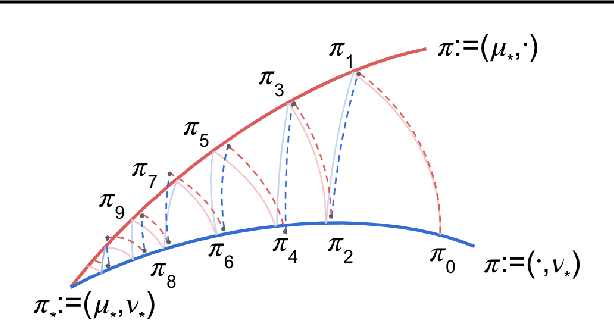
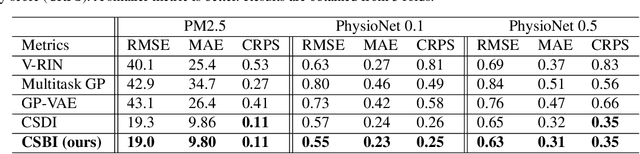
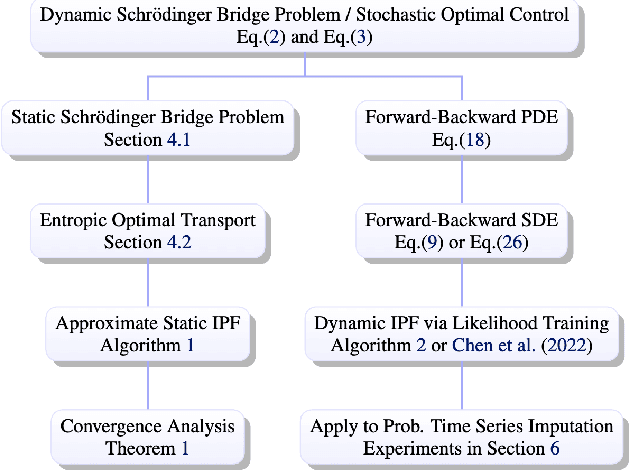
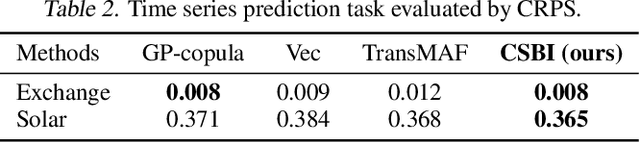
The Schr\"odinger bridge problem (SBP) is gaining increasing attention in generative modeling and showing promising potential even in comparison with the score-based generative models (SGMs). SBP can be interpreted as an entropy-regularized optimal transport problem, which conducts projections onto every other marginal alternatingly. However, in practice, only approximated projections are accessible and their convergence is not well understood. To fill this gap, we present a first convergence analysis of the Schr\"odinger bridge algorithm based on approximated projections. As for its practical applications, we apply SBP to probabilistic time series imputation by generating missing values conditioned on observed data. We show that optimizing the transport cost improves the performance and the proposed algorithm achieves the state-of-the-art result in healthcare and environmental data while exhibiting the advantage of exploring both temporal and feature patterns in probabilistic time series imputation.
Multilevel Diffusion: Infinite Dimensional Score-Based Diffusion Models for Image Generation
Mar 08, 2023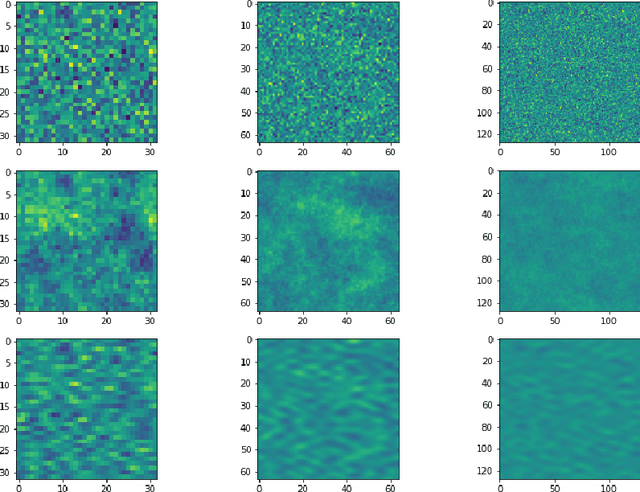
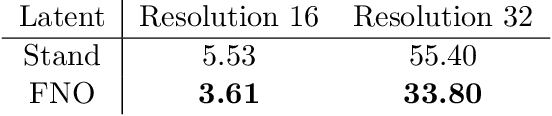

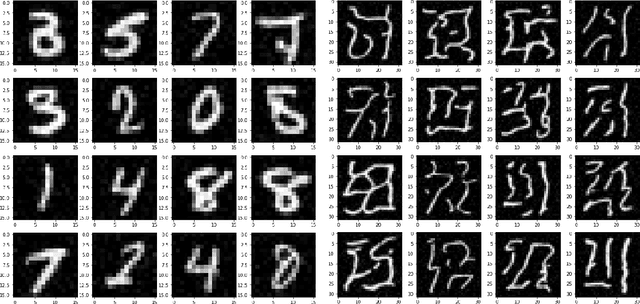
Score-based diffusion models (SBDM) have recently emerged as state-of-the-art approaches for image generation. Existing SBDMs are typically formulated in a finite-dimensional setting, where images are considered as tensors of a finite size. This papers develops SBDMs in the infinite-dimensional setting, that is, we model the training data as functions supported on a rectangular domain. Besides the quest for generating images at ever higher resolution our primary motivation is to create a well-posed infinite-dimensional learning problem so that we can discretize it consistently on multiple resolution levels. We thereby hope to obtain diffusion models that generalize across different resolution levels and improve the efficiency of the training process. We demonstrate how to overcome two shortcomings of current SBDM approaches in the infinite-dimensional setting. First, we modify the forward process to ensure that the latent distribution is well-defined in the infinite-dimensional setting using the notion of trace class operators. Second, we illustrate that approximating the score function with an operator network, in our case Fourier neural operators (FNOs), is beneficial for multilevel training. After deriving the forward and reverse process in the infinite-dimensional setting, we show their well-posedness, derive adequate discretizations, and investigate the role of the latent distributions. We provide first promising numerical results on two datasets, MNIST and material structures. In particular, we show that multilevel training is feasible within this framework.