 Add to Chrome
 Add to Firefox
 Add to Edge
FrameTwin: Curve-Anchored Gaussian Alignment from Sparse Views for Adaptive Wireframe 3D Printing
May 10, 2026
We present FrameTwin, a curve-anchored Gaussian alignment framework that uses sparse-view images to close the control loop for adaptive wireframe 3D printing. Our key idea is to capture the deformation of thin wireframe structures from sparse-view images using Gaussian kernels anchored to parametric curves, yielding a compact and geometry-aware encoding that explicitly captures strut topology. Driven by a differentiable rendering pipeline, FrameTwin estimates a neural deformation field that aligns the partially printed target model with the deformed structure observed during fabrication, where the optimized curve-Gaussian representation serves as a digital twin of the evolving wireframe. Unlike general Gaussian-splatting approaches, our formulation constrains kernel placement along parametric curves, substantially reducing the ambiguity inherent in sparse-view observations of thin structures. The resultant deformation-field alignment enforces global consistency across all struts. By using the estimated deformation field to blend the distorted printed geometry with the remaining unprinted geometry, FrameTwin enables adaptive updates to future printing trajectories. We demonstrate that FrameTwin can robustly capture and compensate for deformation in wireframe models fabricated using a robotized 3D printing system.

Support Generation for Robot-Assisted 3D Printing with Curved Layers
Feb 10, 2023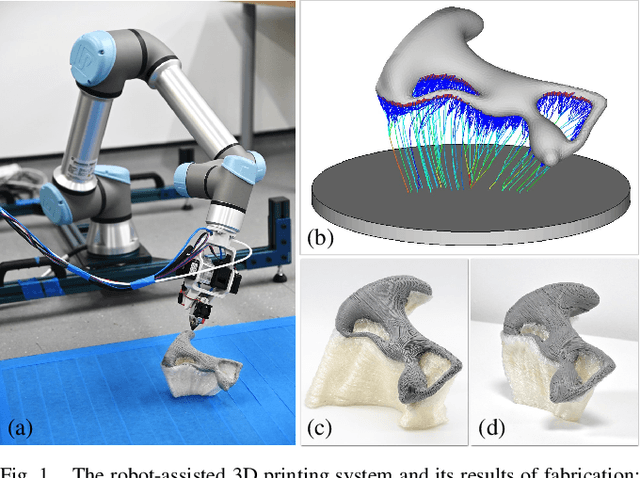
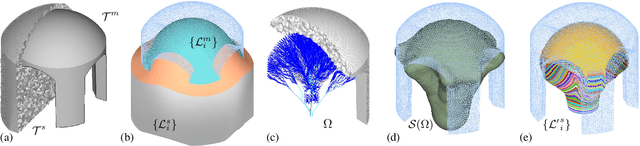
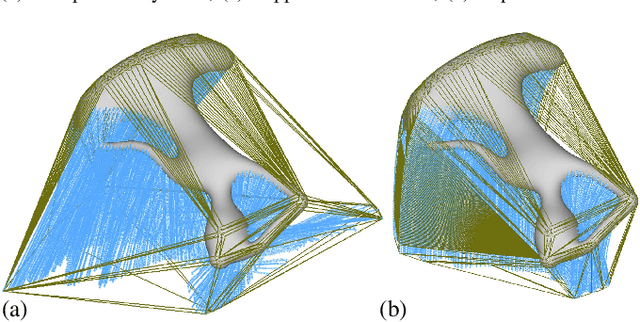
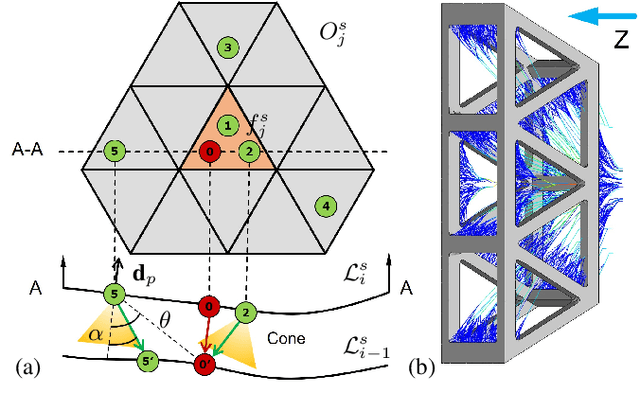
Robot-assisted 3D printing has drawn a lot of attention by its capability to fabricate curved layers that are optimized according to different objectives. However, the support generation algorithm based on a fixed printing direction for planar layers cannot be directly applied for curved layers as the orientation of material accumulation is dynamically varied. In this paper, we propose a skeleton-based support generation method for robot-assisted 3D printing with curved layers. The support is represented as an implicit solid so that the problems of numerical robustness can be effectively avoided. The effectiveness of our algorithm is verified on a dual-material printing platform that consists of a robotic arm and a newly designed dual-material extruder. Experiments have been successfully conducted on our system to fabricate a variety of freeform models.