 Add to Chrome
 Add to Firefox
 Add to Edge
FOUND-AF: Benchmarking ECG Foundation Models for Atrial Fibrillation Detection
Aug 04, 2026
Atrial fibrillation (AF) is the most common sustained cardiac arrhythmia and is associated with increased risks of stroke, heart failure, and mortality. Recent ECG foundation models offer transferable representations for automated AF detection. However, their relative effectiveness remains unclear because existing studies use different datasets, preprocessing procedures, classifiers, and validation protocols. This study presents FOUND-AF, a unified, leakage-controlled, and deployment-oriented benchmarking framework that evaluates the quality of pretrained ECG representations under identical experimental conditions. Nine publicly available foundation models from five families, including HuBERT-ECG, CLEF, ST-MEM, ECG-JEPA, and ECGFounder, were evaluated across four heterogeneous ECG datasets, namely AFDB, CinC2017, CPSC2021, and LTAFDB. All models were used as frozen feature extractors with standardized preprocessing, model-native resampling, a fixed XGBoost classifier, and recording-level grouped cross-validation. The evaluation included classification metrics, receiver operating characteristic analysis, paired recording-level bootstrap comparisons with Holm correction, embedding-space visualization, and computational efficiency profiling. The ECGFounder model consistently achieved the strongest overall performance across datasets while offering a favorable trade-off between accuracy, model size, inference time, and memory usage. FOUND-AF therefore provides a reproducible framework for selecting ECG foundation models and demonstrates that compact, clinically pretrained encoders can support robust and computationally efficient AF detection across heterogeneous acquisition settings.

Enabling Cloud-Level Accuracy in Edge AI through IoT Data Preprocessing
Jun 21, 2026Large language models (LLMs) offer a natural-language interface for interpreting Internet of Things (IoT) sensor data in smart environments; however, cloud deployment introduces latency, privacy, and connectivity concerns. Local LLMs can reduce these limitations, but compact edge-deployable models often show weaker numerical reasoning when raw sensor readings are provided directly. This paper investigates whether prompt-side preprocessing can improve the accuracy-latency trade-off of local LLMs for environmental monitoring. We propose a structured prompt construction framework that transforms raw air-quality and thermal-comfort measurements into progressively enriched textual representations: raw sensor values, threshold-aware descriptions, and compact environmental summary flags. The approach is evaluated using indoor Raspberry Pi/BME680 datasets from Tampere University and outdoor air-quality datasets from Helsinki, Katowice, and Warsaw. We construct a binary LLM query dataset covering air quality, thermal comfort, and joint environmental conditions, and evaluate five local and five cloud LLMs across three prompt variants and two inference modes, with and without chain-of-thought prompting. Results show that prompt enrichment substantially improves local-model accuracy. In No-CoT mode, local accuracy increases from 50.9% to 81.7% indoors and from 63.7% to 89.3% outdoors from the raw to the most enriched prompt. Local No-CoT inference is the fastest configuration, with mean latency close to 0.22 s, while CoT substantially increases inference time. These findings suggest that lightweight prompt-side preprocessing can narrow the local--cloud performance gap and support low-latency IoT analytics in smart environments.
Neural Router: Semantic Content Matching for Agentic AI
May 25, 2026Large language models (LLMs) can serve as the semantic-matching engine of a content-based publish/subscribe broker for agentic AI across the edge-cloud computing continuum, bridging the vocabulary and modality gaps that defeat keyword and embedding filters. Framed as offline multi-label retrieval over three public datasets spanning social-media, legal, and smart-home sensor domains (six LLMs, seven baselines), our central contribution is a two-crossover cost-accuracy characterisation: an analytical context-window crossover below which a CoverAndMerge compression pipeline reduces LLM invocations, and an empirical discrimination-capacity crossover above which matching accuracy collapses independently of context budget, by a model-dependent factor of parameter count and training generation. Two findings carry practical weight: above the discrimination crossover, compression cannot recover accuracy and only frontier-scale models clear large subscription sets; and there backend choice dominates configuration choice, so model selection, not pipeline tuning, is the primary operator lever. We accompany this with three composable algorithms and a per-cluster Quality-of-Experience framework for autonomic LLM-tier selection.
UserCentrix: An Agentic Memory-augmented AI Framework for Smart Spaces
May 01, 2025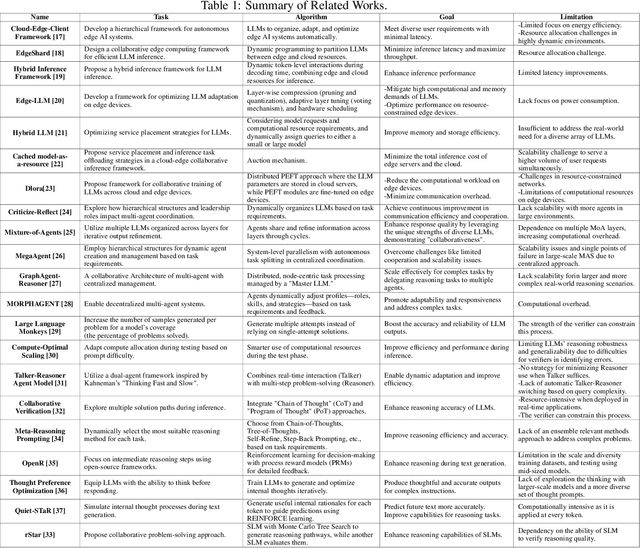


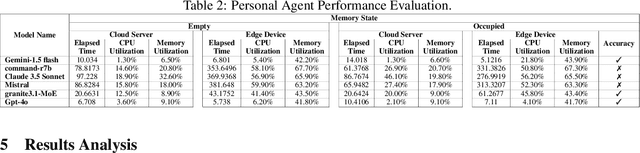
Agentic AI, with its autonomous and proactive decision-making, has transformed smart environments. By integrating Generative AI (GenAI) and multi-agent systems, modern AI frameworks can dynamically adapt to user preferences, optimize data management, and improve resource allocation. This paper introduces UserCentrix, an agentic memory-augmented AI framework designed to enhance smart spaces through dynamic, context-aware decision-making. This framework integrates personalized Large Language Model (LLM) agents that leverage user preferences and LLM memory management to deliver proactive and adaptive assistance. Furthermore, it incorporates a hybrid hierarchical control system, balancing centralized and distributed processing to optimize real-time responsiveness while maintaining global situational awareness. UserCentrix achieves resource-efficient AI interactions by embedding memory-augmented reasoning, cooperative agent negotiation, and adaptive orchestration strategies. Our key contributions include (i) a self-organizing framework with proactive scaling based on task urgency, (ii) a Value of Information (VoI)-driven decision-making process, (iii) a meta-reasoning personal LLM agent, and (iv) an intelligent multi-agent coordination system for seamless environment adaptation. Experimental results across various models confirm the effectiveness of our approach in enhancing response accuracy, system efficiency, and computational resource management in real-world application.
Creation of AI-driven Smart Spaces for Enhanced Indoor Environments -- A Survey
Dec 19, 2024Smart spaces are ubiquitous computing environments that integrate diverse sensing and communication technologies to enhance space functionality, optimize energy utilization, and improve user comfort and well-being. The integration of emerging AI methodologies into these environments facilitates the formation of AI-driven smart spaces, which further enhance functionalities of the spaces by enabling advanced applications such as personalized comfort settings, interactive living spaces, and automatization of the space systems, all resulting in enhanced indoor experiences of the users. In this paper, we present a systematic survey of existing research on the foundational components of AI-driven smart spaces, including sensor technologies, data communication protocols, sensor network management and maintenance strategies, as well as the data collection, processing and analytics. Given the pivotal role of AI in establishing AI-powered smart spaces, we explore the opportunities and challenges associated with traditional machine learning (ML) approaches, such as deep learning (DL), and emerging methodologies including large language models (LLMs). Finally, we provide key insights necessary for the development of AI-driven smart spaces, propose future research directions, and sheds light on the path forward.
Follow-Me AI: Energy-Efficient User Interaction with Smart Environments
Apr 18, 2024
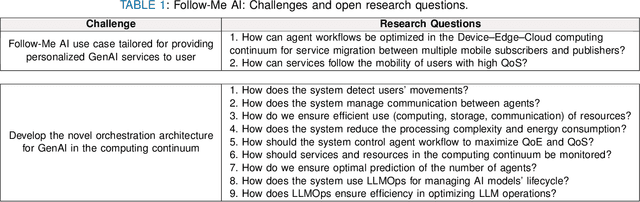
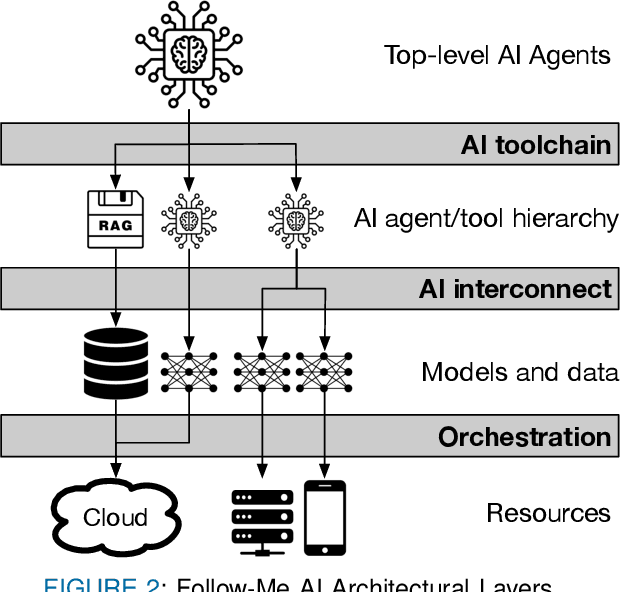
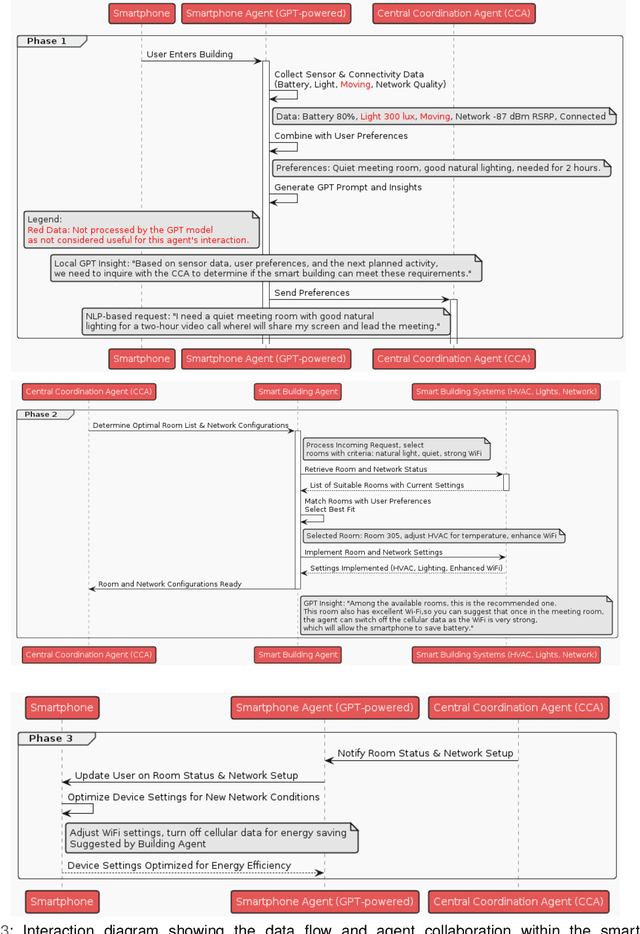
This article introduces Follow-Me AI, a concept designed to enhance user interactions with smart environments, optimize energy use, and provide better control over data captured by these environments. Through AI agents that accompany users, Follow-Me AI negotiates data management based on user consent, aligns environmental controls as well as user communication and computes resources available in the environment with user preferences, and predicts user behavior to proactively adjust the smart environment. The manuscript illustrates this concept with a detailed example of Follow-Me AI in a smart campus setting, detailing the interactions with the building's management system for optimal comfort and efficiency. Finally, this article looks into the challenges and opportunities related to Follow-Me AI.
Autonomy and Intelligence in the Computing Continuum: Challenges, Enablers, and Future Directions for Orchestration
May 03, 2022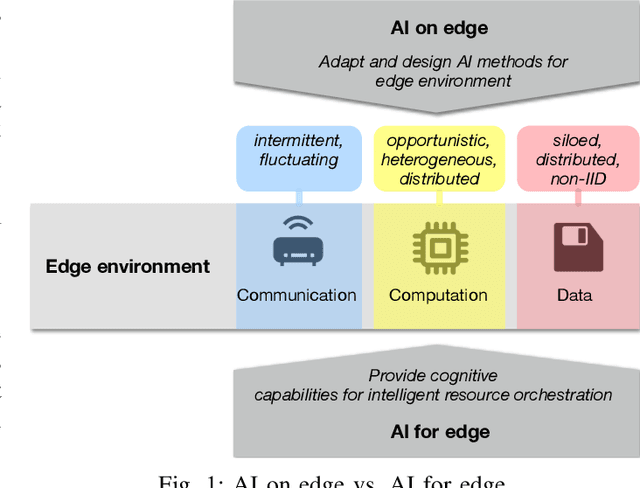
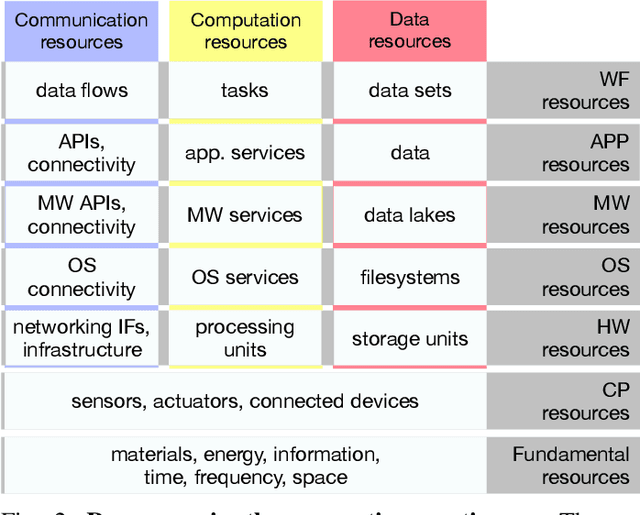
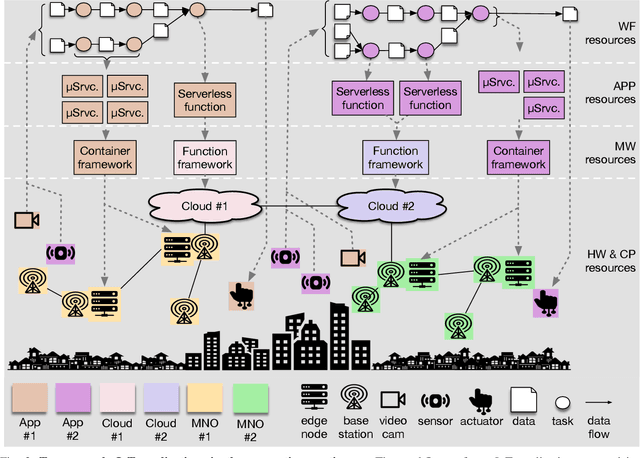
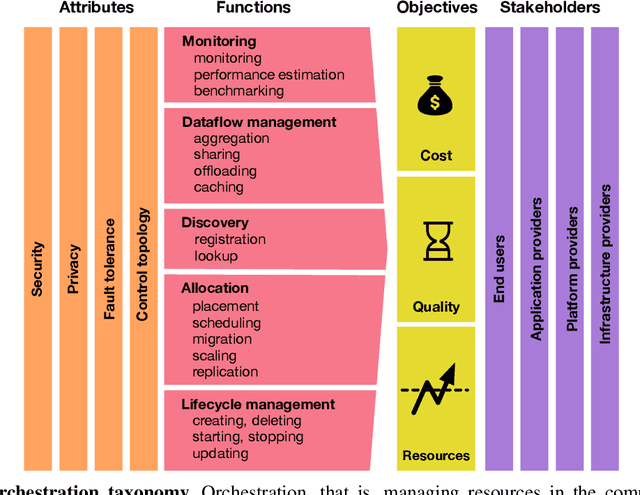
Future AI applications require performance, reliability and privacy that the existing, cloud-dependant system architectures cannot provide. In this article, we study orchestration in the device-edge-cloud continuum, and focus on AI for edge, that is, the AI methods used in resource orchestration. We claim that to support the constantly growing requirements of intelligent applications in the device-edge-cloud computing continuum, resource orchestration needs to embrace edge AI and emphasize local autonomy and intelligence. To justify the claim, we provide a general definition for continuum orchestration, and look at how current and emerging orchestration paradigms are suitable for the computing continuum. We describe certain major emerging research themes that may affect future orchestration, and provide an early vision of an orchestration paradigm that embraces those research themes. Finally, we survey current key edge AI methods and look at how they may contribute into fulfilling the vision of future continuum orchestration.