 Add to Chrome
 Add to Firefox
 Add to Edge
Toward Seasonal Guidelines for Robust Deep-Learning Sentinel-2 Building Detection in Different Area Types
Jul 23, 2026
Sentinel-2 imagery offers open access, global coverage, and frequent revisit times, making it attractive for practical building mapping at scale; however, its native 10m resolution makes building vs non-building classification challenging, particularly for small or sub-pixel buildings, and performance can vary with both seasonality and the heterogeneity of built-up environments. This paper introduces a Sentinel-2 building-detection framework designed to systematically quantify these effects and to support more formalised, practice-oriented model selection. We construct a dedicated multi-temporal Sentinel-2 dataset over the Warsaw region and derive binary ground-truth masks by rasterising official Polish topographic database (BDOT10k) building footprints onto the Sentinel-2 pixel grid. Using two established convolutional segmentation backbones (U-Net and DeepLabV3+), we first perform scene-specific fine-tuning to select a robust architecture and identify the best monthly models for L1C and L2A products separately. We then conduct cross-temporal inference by applying each best monthly model to all scenes, enabling an assessment of (i) which months provide favourable training and inference conditions, (ii) how performance transfers between seasons, (iii) the impact of processing level, and (iv) how these effects differ across built-up typologies. Based on these results, we provide practical guidance for routine Sentinel-2 building classification under varying acquisition periods and settlement characteristics.

Enabling Cloud-Level Accuracy in Edge AI through IoT Data Preprocessing
Jun 21, 2026Large language models (LLMs) offer a natural-language interface for interpreting Internet of Things (IoT) sensor data in smart environments; however, cloud deployment introduces latency, privacy, and connectivity concerns. Local LLMs can reduce these limitations, but compact edge-deployable models often show weaker numerical reasoning when raw sensor readings are provided directly. This paper investigates whether prompt-side preprocessing can improve the accuracy-latency trade-off of local LLMs for environmental monitoring. We propose a structured prompt construction framework that transforms raw air-quality and thermal-comfort measurements into progressively enriched textual representations: raw sensor values, threshold-aware descriptions, and compact environmental summary flags. The approach is evaluated using indoor Raspberry Pi/BME680 datasets from Tampere University and outdoor air-quality datasets from Helsinki, Katowice, and Warsaw. We construct a binary LLM query dataset covering air quality, thermal comfort, and joint environmental conditions, and evaluate five local and five cloud LLMs across three prompt variants and two inference modes, with and without chain-of-thought prompting. Results show that prompt enrichment substantially improves local-model accuracy. In No-CoT mode, local accuracy increases from 50.9% to 81.7% indoors and from 63.7% to 89.3% outdoors from the raw to the most enriched prompt. Local No-CoT inference is the fastest configuration, with mean latency close to 0.22 s, while CoT substantially increases inference time. These findings suggest that lightweight prompt-side preprocessing can narrow the local--cloud performance gap and support low-latency IoT analytics in smart environments.
Semantic Depth Matters: Explaining Errors of Deep Vision Networks through Perceived Class Similarities
Apr 14, 2025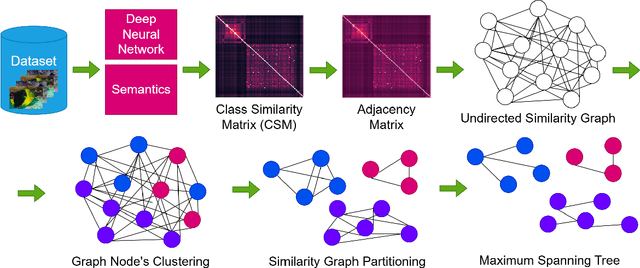
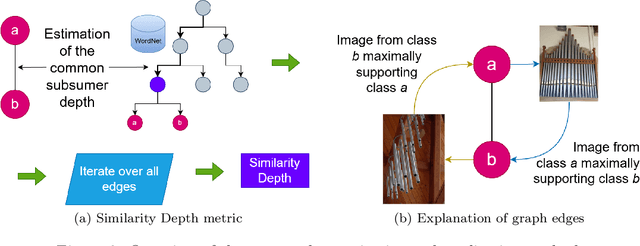
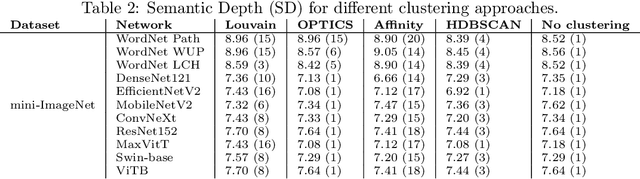
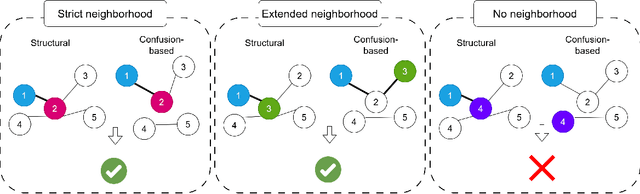
Understanding deep neural network (DNN) behavior requires more than evaluating classification accuracy alone; analyzing errors and their predictability is equally crucial. Current evaluation methodologies lack transparency, particularly in explaining the underlying causes of network misclassifications. To address this, we introduce a novel framework that investigates the relationship between the semantic hierarchy depth perceived by a network and its real-data misclassification patterns. Central to our framework is the Similarity Depth (SD) metric, which quantifies the semantic hierarchy depth perceived by a network along with a method of evaluation of how closely the network's errors align with its internally perceived similarity structure. We also propose a graph-based visualization of model semantic relationships and misperceptions. A key advantage of our approach is that leveraging class templates -- representations derived from classifier layer weights -- is applicable to already trained networks without requiring additional data or experiments. Our approach reveals that deep vision networks encode specific semantic hierarchies and that high semantic depth improves the compliance between perceived class similarities and actual errors.
Quantum-aware Transformer model for state classification
Feb 28, 2025


Entanglement is a fundamental feature of quantum mechanics, playing a crucial role in quantum information processing. However, classifying entangled states, particularly in the mixed-state regime, remains a challenging problem, especially as system dimensions increase. In this work, we focus on bipartite quantum states and present a data-driven approach to entanglement classification using transformer-based neural networks. Our dataset consists of a diverse set of bipartite states, including pure separable states, Werner entangled states, general entangled states, and maximally entangled states. We pretrain the transformer in an unsupervised fashion by masking elements of vectorized Hermitian matrix representations of quantum states, allowing the model to learn structural properties of quantum density matrices. This approach enables the model to generalize entanglement characteristics across different classes of states. Once trained, our method achieves near-perfect classification accuracy, effectively distinguishing between separable and entangled states. Compared to previous Machine Learning, our method successfully adapts transformers for quantum state analysis, demonstrating their ability to systematically identify entanglement in bipartite systems. These results highlight the potential of modern machine learning techniques in automating entanglement detection and classification, bridging the gap between quantum information theory and artificial intelligence.
`Just One More Sensor is Enough' -- Iterative Water Leak Localization with Physical Simulation and a Small Number of Pressure Sensors
Jun 28, 2024In this article, we propose an approach to leak localisation in a complex water delivery grid with the use of data from physical simulation (e.g. EPANET software). This task is usually achieved by a network of multiple water pressure sensors and analysis of the so-called sensitivity matrix of pressure differences between the network's simulated data and actual data of the network affected by the leak. However, most algorithms using this approach require a significant number of pressure sensors -- a condition that is not easy to fulfil in the case of many less equipped networks. Therefore, we answer the question of whether leak localisation is possible by utilising very few sensors but having the ability to relocate one of them. Our algorithm is based on physical simulations (EPANET software) and an iterative scheme for mobile sensor relocation. The experiments show that the proposed system can equalise the low number of sensors with adjustments made for their positioning, giving a very good approximation of leak's position both in simulated cases and real-life example taken from BattLeDIM competition L-Town data.
Through the Thicket: A Study of Number-Oriented LLMs derived from Random Forest Models
Jun 07, 2024Large Language Models (LLMs) have shown exceptional performance in text processing. Notably, LLMs can synthesize information from large datasets and explain their decisions similarly to human reasoning through a chain of thought (CoT). An emerging application of LLMs is the handling and interpreting of numerical data, where fine-tuning enhances their performance over basic inference methods. This paper proposes a novel approach to training LLMs using knowledge transfer from a random forest (RF) ensemble, leveraging its efficiency and accuracy. By converting RF decision paths into natural language statements, we generate outputs for LLM fine-tuning, enhancing the model's ability to classify and explain its decisions. Our method includes verifying these rules through established classification metrics, ensuring their correctness. We also examine the impact of preprocessing techniques on the representation of numerical data and their influence on classification accuracy and rule correctness
Heuristical choice of SVM parameters
Nov 03, 2021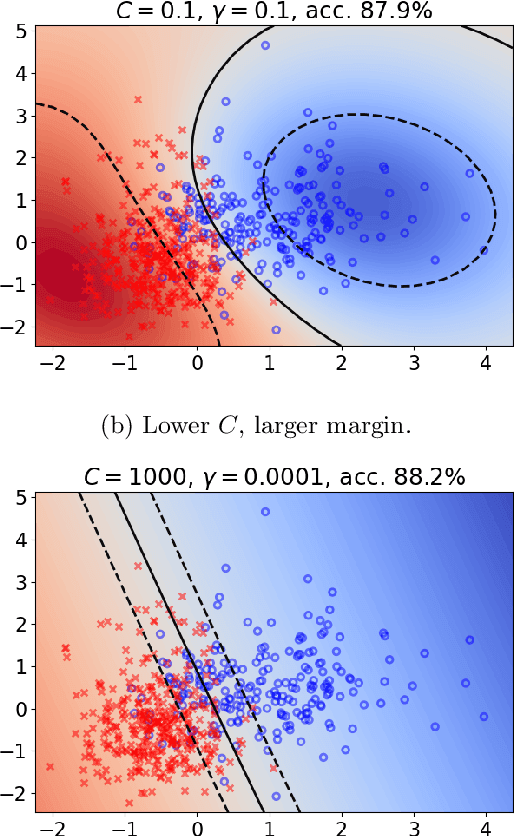
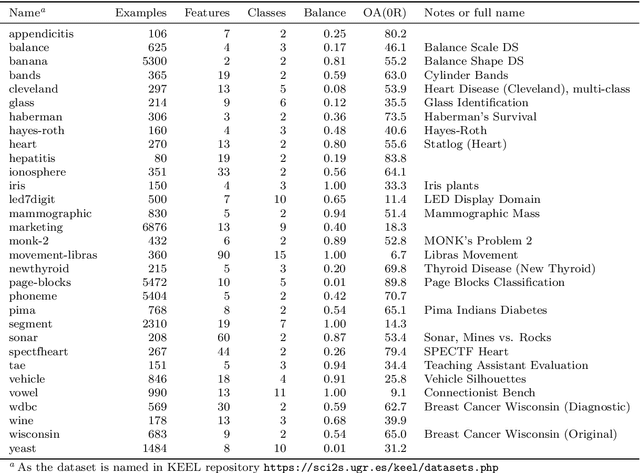
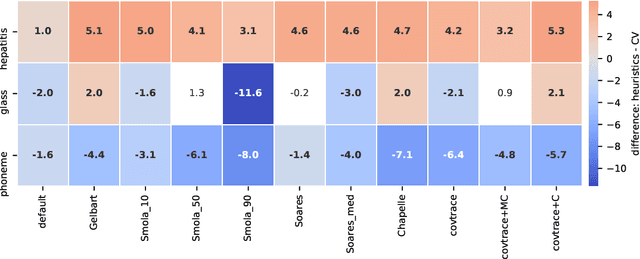
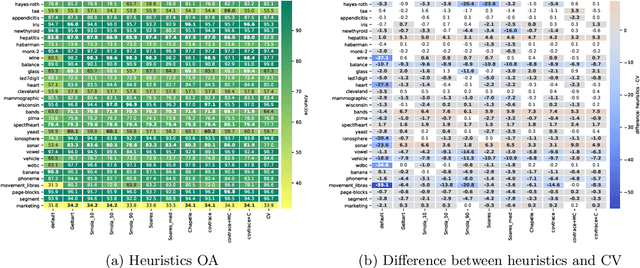
Support Vector Machine (SVM) is one of the most popular classification methods, and a de-facto reference for many Machine Learning approaches. Its performance is determined by parameter selection, which is usually achieved by a time-consuming grid search cross-validation procedure. There exist, however, several unsupervised heuristics that take advantage of the characteristics of the dataset for selecting parameters instead of using class label information. Unsupervised heuristics, while an order of magnitude faster, are scarcely used under the assumption that their results are significantly worse than those of grid search. To challenge that assumption we have conducted a wide study of various heuristics for SVM parameter selection on over thirty datasets, in both supervised and semi-supervised scenarios. In most cases, the cross-validation grid search did not achieve a significant advantage over the heuristics. In particular, heuristical parameter selection may be preferable for high dimensional and unbalanced datasets or when a small number of examples is available. Our results also show that using a heuristic to determine the starting point of further cross-validation does not yield significantly better results than the default start.
Stable training of autoencoders for hyperspectral unmixing
Sep 28, 2021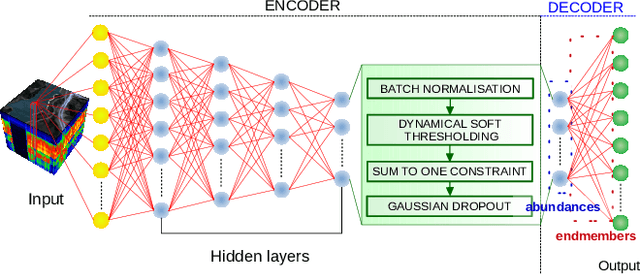
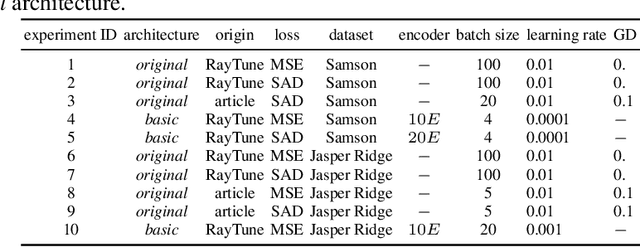
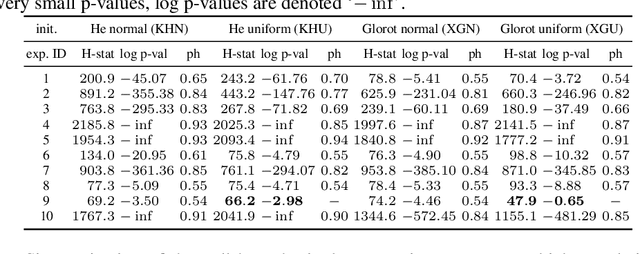
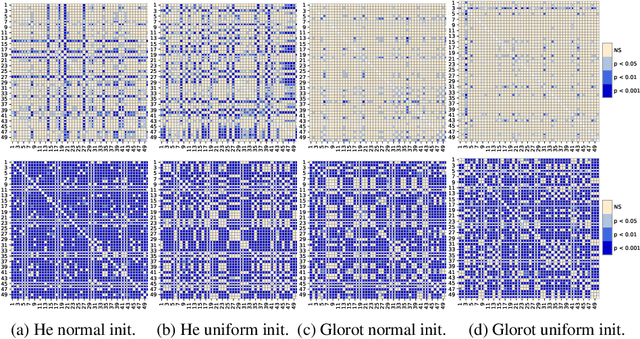
Neural networks, autoencoders in particular, are one of the most promising solutions for unmixing hyperspectral data, i.e. reconstructing the spectra of observed substances (endmembers) and their relative mixing fractions (abundances). Unmixing is needed for effective hyperspectral analysis and classification. However, as we show in this paper, the training of autoencoders for unmixing is highly dependent on weights initialisation. Some sets of weights lead to degenerate or low performance solutions, introducing negative bias in expected performance. In this work we present the results of experiments investigating autoencoders' stability, verifying the dependence of reconstruction error on initial weights and exploring conditions needed for successful optimisation of autoencoder parameters.
Hyperspectral classification of blood-like substances using machine learning methods combined with genetic algorithms in transductive and inductive scenarios
Nov 04, 2020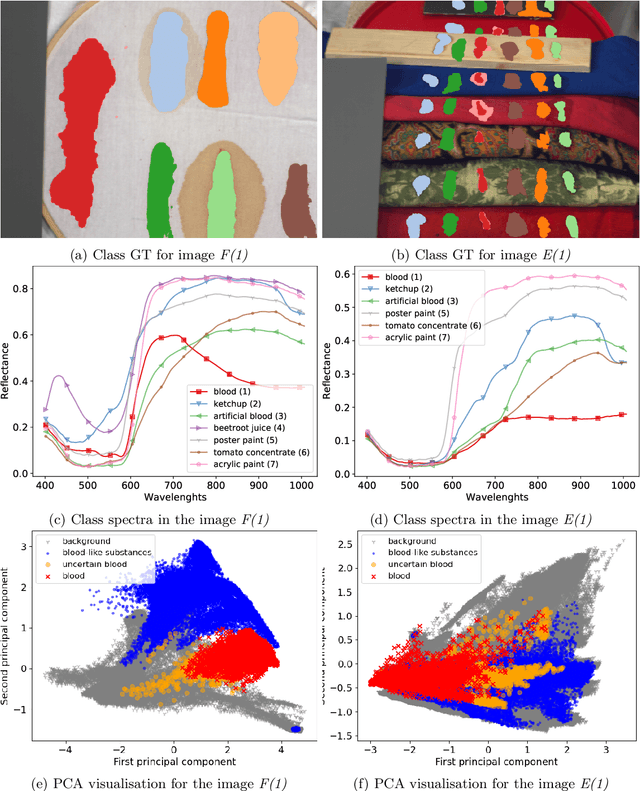
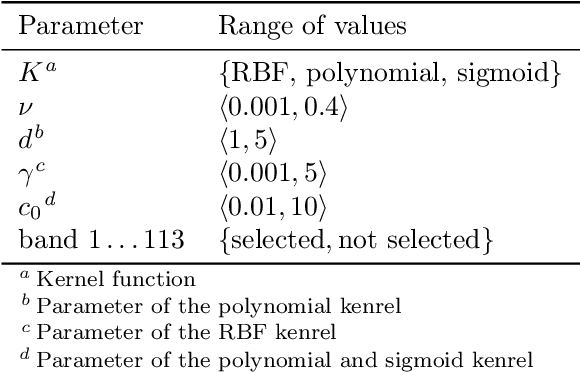
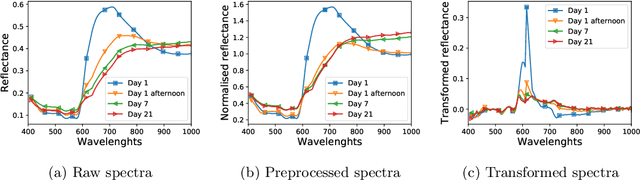
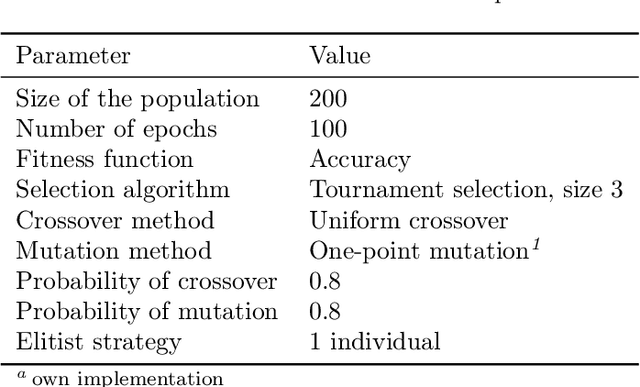
This study is focused on applying genetic algorithms (GA) to model and band selection in hyperspectral image classification. We use a forensic-inspired data set of seven hyperspectral images with blood and five visually similar substances to test GA-optimised classifiers in two scenarios: when the training and test data come from the same image and when they come from different images, which is a more challenging task due to significant spectra differences. In our experiments we compare GA with a classic model optimisation through grid search. Our results show that GA-based model optimisation can reduce the number of bands and create an accurate classifier that outperforms the GS-based reference models, provided that during model optimisation it has access to examples similar to test data. We illustrate this with experiment highlighting the importance of a validation set.
A Dataset for Evaluating Blood Detection in Hyperspectral Images
Aug 24, 2020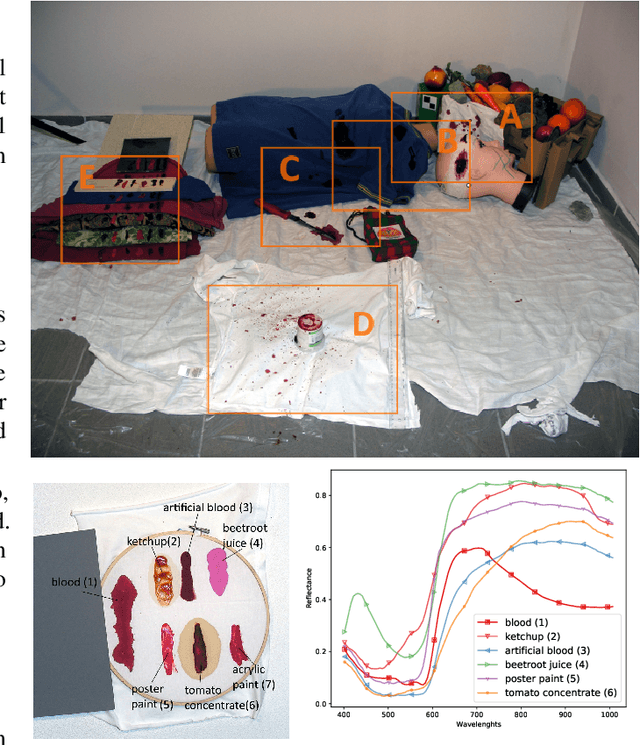
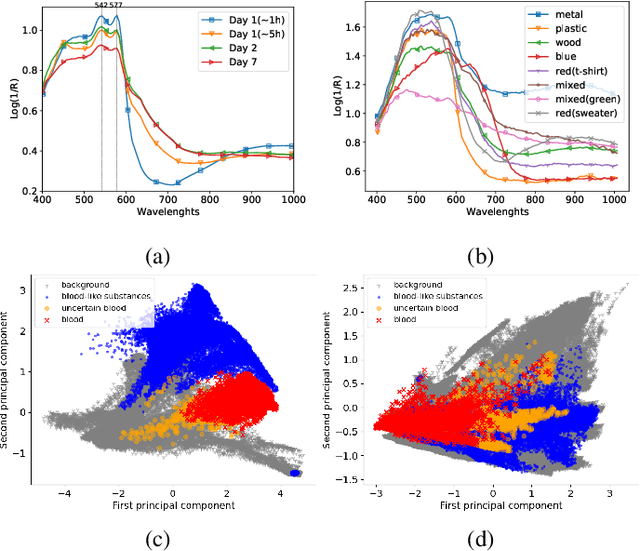
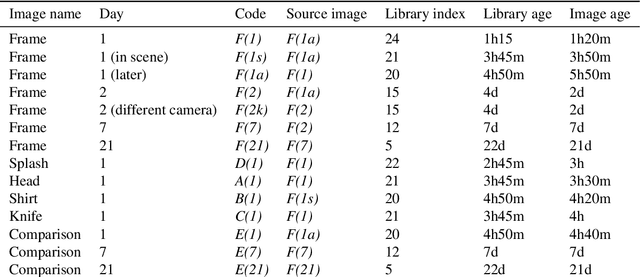
The sensitivity of imaging spectroscopy to hemoglobin derivatives makes it a promising tool for detecting blood. However, due to complexity and high dimensionality of hyperspectral images, the development of hyperspectral blood detection algorithms is challenging. To facilitate their development, we present a new hyperspectral blood detection dataset. This dataset, published in accordance to open access mandate, consist of multiple detection scenarios with varying levels of complexity. It allows to test the performance of Machine Learning methods in relation to different acquisition environments, types of background, age of blood and presence of other blood-like substances. We explored the dataset with blood detection experiments. We used hyperspectral target detection algorithm based on the well-known Matched Filter detector. Our results and their discussion highlight the challenges of blood detection in hyperspectral data and form a reference for further works