 Add to Chrome
 Add to Firefox
 Add to Edge
Learning to Think in Physics: Breaking Shortcut Learning in Scientific Diffusion via Representation Alignment
May 20, 2026
Physics-informed diffusion models typically enforce PDE constraints only on final outputs, leaving intermediate representations unconstrained and prone to shortcut learning under shifted boundary conditions. We introduce **REPA-P**, a teacher-free, architecture-agnostic framework that aligns intermediate features with physical states using first-principles residuals. REPA-P attaches lightweight $1{\times}1$ projection heads to selected layers, decodes hidden activations into physical quantities, and applies PDE residual losses during training. These heads are discarded at inference, introducing **zero overhead**. Across four PDE tasks, including Darcy flow, topology optimization, electrostatic potential, and turbulent channel flow, REPA-P accelerates convergence by up to $2{\times}$, reduces physics residuals by up to $66.4\%$, and improves out-of-distribution robustness by up to $49.3\%$, with consistent gains on both U-Net and Diffusion Transformer backbones. Ablations show that supervising a small set of intermediate layers captures most benefits and complements output-level physics losses. Code is available at [https://github.com/Hxxxz0/REPA-P](https://github.com/Hxxxz0/REPA-P).

RMDM: Radio Map Diffusion Model with Physics Informed
Jan 31, 2025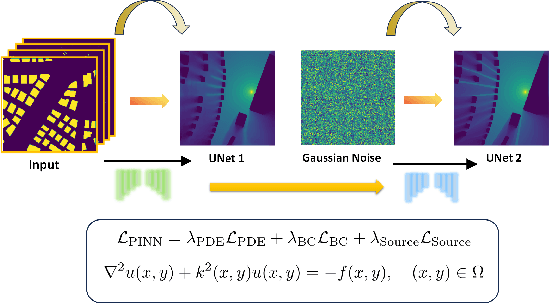
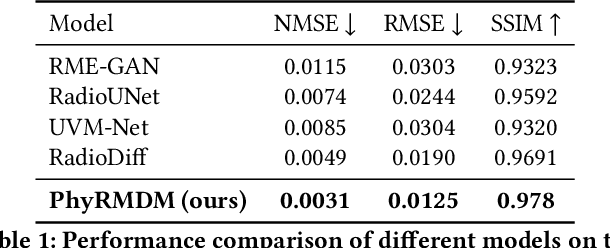
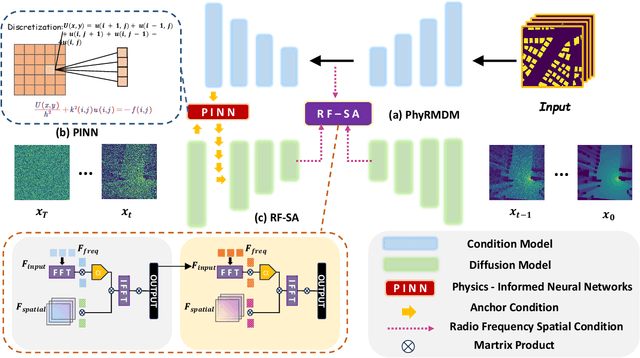
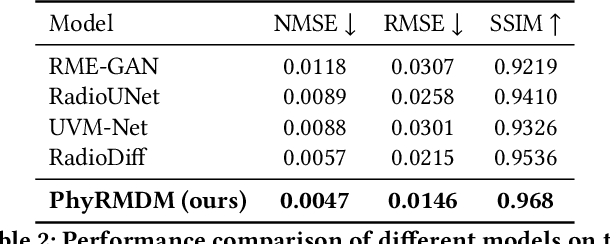
With the rapid development of wireless communication technology, the efficient utilization of spectrum resources, optimization of communication quality, and intelligent communication have become critical. Radio map reconstruction is essential for enabling advanced applications, yet challenges such as complex signal propagation and sparse data hinder accurate reconstruction. To address these issues, we propose the **Radio Map Diffusion Model (RMDM)**, a physics-informed framework that integrates **Physics-Informed Neural Networks (PINNs)** to incorporate constraints like the **Helmholtz equation**. RMDM employs a dual U-Net architecture: the first ensures physical consistency by minimizing PDE residuals, boundary conditions, and source constraints, while the second refines predictions via diffusion-based denoising. By leveraging physical laws, RMDM significantly enhances accuracy, robustness, and generalization. Experiments demonstrate that RMDM outperforms state-of-the-art methods, achieving **NMSE of 0.0031** and **RMSE of 0.0125** under the Static RM (SRM) setting, and **NMSE of 0.0047** and **RMSE of 0.0146** under the Dynamic RM (DRM) setting. These results establish a novel paradigm for integrating physics-informed and data-driven approaches in radio map reconstruction, particularly under sparse data conditions.