 Add to Chrome
 Add to Firefox
 Add to Edge
SurgTEMP: Temporal-Aware Surgical Video Question Answering with Text-guided Visual Memory for Laparoscopic Cholecystectomy
Apr 01, 2026
Surgical procedures are inherently complex and risky, requiring extensive expertise and constant focus to well navigate evolving intraoperative scenes. Computer-assisted systems such as surgical visual question answering (VQA) offer promises for education and intraoperative support. Current surgical VQA research largely focuses on static frame analysis, overlooking rich temporal semantics. Surgical video question answering is further challenged by low visual contrast, its highly knowledge-driven nature, diverse analytical needs spanning scattered temporal windows, and the hierarchy from basic perception to high-level intraoperative assessment. To address these challenges, we propose SurgTEMP, a multimodal LLM framework featuring (i) a query-guided token selection module that builds hierarchical visual memory (spatial and temporal memory banks) and (ii) a Surgical Competency Progression (SCP) training scheme. Together, these components enable effective modeling of variable-length surgical videos while preserving procedure-relevant cues and temporal coherence, and better support diverse downstream assessment tasks. To support model development, we introduce CholeVidQA-32K, a surgical video question answering dataset comprising 32K open-ended QA pairs and 3,855 video segments (approximately 128 h total) from laparoscopic cholecystectomy. The dataset is organized into a three-level hierarchy -- Perception, Assessment, and Reasoning -- spanning 11 tasks from instrument/action/anatomy perception to Critical View of Safety (CVS), intraoperative difficulty, skill proficiency, and adverse event assessment. In comprehensive evaluations against state-of-the-art open-source multimodal and video LLMs (fine-tuned and zero-shot), SurgTEMP achieves substantial performance improvements, advancing the state of video-based surgical VQA.

Expert Consensus-based Video-Based Assessment Tool for Workflow Analysis in Minimally Invasive Colorectal Surgery: Development and Validation of ColoWorkflow
Nov 13, 2025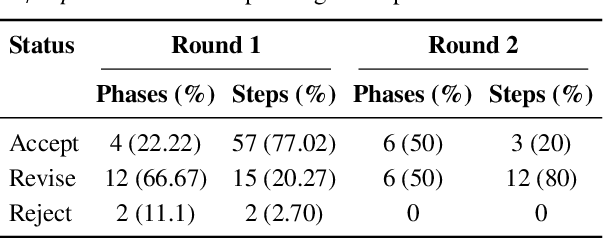
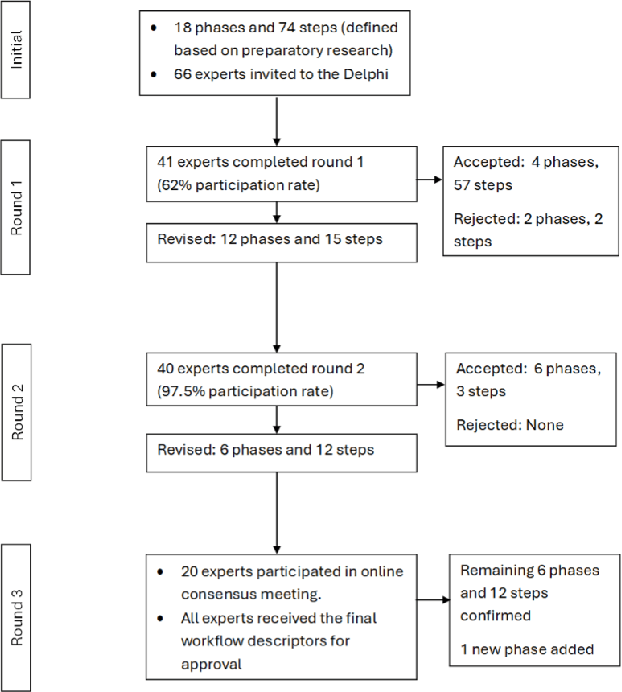
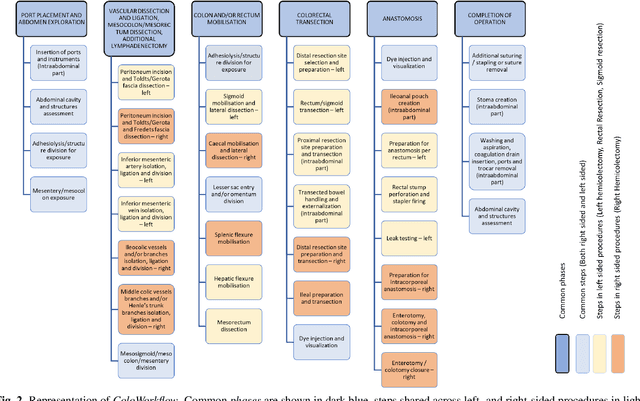
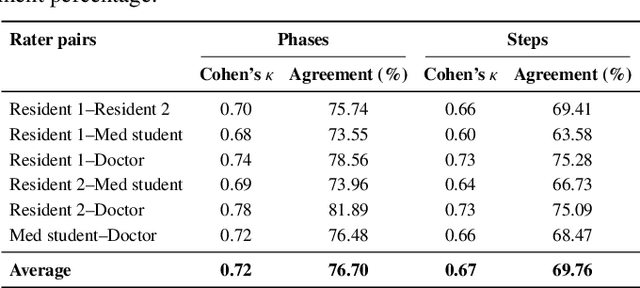
Minimally invasive colorectal surgery is characterized by procedural variability, a difficult learning curve, and complications that impact quality and outcomes. Video-based assessment (VBA) offers an opportunity to generate data-driven insights to reduce variability, optimize training, and improve surgical performance. However, existing tools for workflow analysis remain difficult to standardize and implement. This study aims to develop and validate a VBA tool for workflow analysis across minimally invasive colorectal procedures. A Delphi process was conducted to achieve consensus on generalizable workflow descriptors. The resulting framework informed the development of a new VBA tool, ColoWorkflow. Independent raters then applied ColoWorkflow to a multicentre video dataset of laparoscopic and robotic colorectal surgery (CRS). Applicability and inter-rater reliability were evaluated. Consensus was achieved for 10 procedure-agnostic phases and 34 procedure-specific steps describing CRS workflows. ColoWorkflow was developed and applied to 54 colorectal operative videos (left and right hemicolectomies, sigmoid and rectosigmoid resections, and total proctocolectomies) from five centres. The tool demonstrated broad applicability, with all but one label utilized. Inter-rater reliability was moderate, with mean Cohen's K of 0.71 for phases and 0.66 for steps. Most discrepancies arose at phase transitions and step boundary definitions. ColoWorkflow is the first consensus-based, validated VBA tool for comprehensive workflow analysis in minimally invasive CRS. It establishes a reproducible framework for video-based performance assessment, enabling benchmarking across institutions and supporting the development of artificial intelligence-driven workflow recognition. Its adoption may standardize training, accelerate competency acquisition, and advance data-informed surgical quality improvement.