 Add to Chrome
 Add to Firefox
 Add to Edge
Artificial Intelligence for Workflow Analysis in Colorectal Surgery: A Multicentric, Cross-Procedural Development and Generalization Study
Aug 20, 2026
Minimally invasive colorectal surgeries (MIS-CRS) are characterised by significant variability and inconsistent outcomes. ColoWorkflow, a tool for the video-based assessment (VBA) of MIS-CRS workflow, was recently validated. However, manual VBA is time-consuming, limiting implementation. This study presents AI-ColoWorkflow, a deep learning model for automated surgical workflow analysis across MIS-CRS. Operative videos of MIS-CRS were collected from 4 centres and a publicly available dataset. Phases and steps were manually annotated according to ColoWorkflow. A deep learning model combining a fine-tuned DINOv3 vision transformer for per-frame visual feature extraction with a hierarchical multi-stage temporal convolutional network was jointly optimized for phase and step recognition. The model trained on pooled multicentric data, namely AI-ColoWorkflow was compared against centre-specific and procedure-specific models on a held-out test set. The following metrics were used for evaluation: macro F1 score, balanced accuracy, precision, and recall. AI-ColoWorkflow achieved a macro F1 of 73.01% $\pm$ 10.27 (balanced accuracy 73.43%) for phase recognition and 39.82% $\pm$ 7.06 (balanced accuracy 38.65%) for step recognition. The global model outperformed centre- and procedure-specific models in most experiments except procedure-specific step recognition. In the generalization analysis, mean F1 was 48.42% for phase recognition. AI-ColoWorkflow can reliably recognize MIS-CRS phases. A single model trained on pooled, multicentric, multi-procedural data generalises at least as well as and often better than centre- or procedure-specific models for phase recognition in MIS-CRS, while procedure-specific step models retain advantages for certain procedure types, motivating hybrid training strategies for future surgical AI development.

Expert Consensus-based Video-Based Assessment Tool for Workflow Analysis in Minimally Invasive Colorectal Surgery: Development and Validation of ColoWorkflow
Nov 13, 2025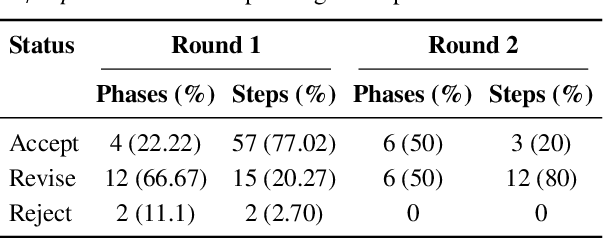
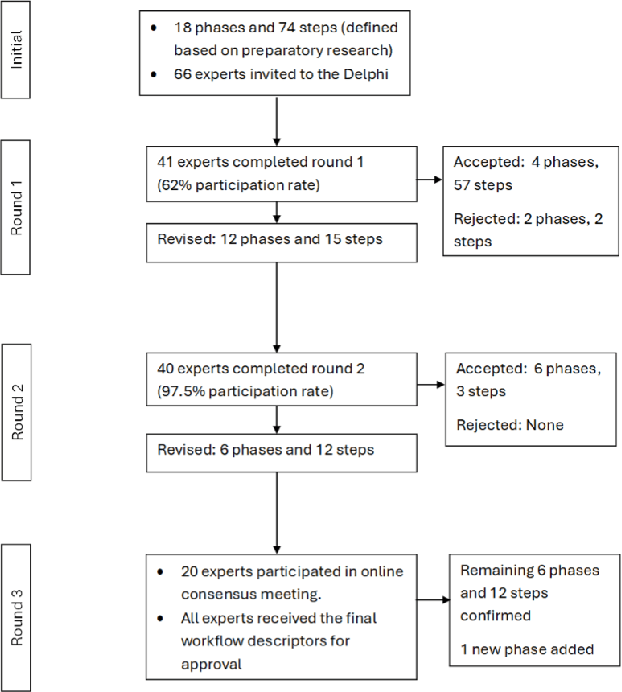
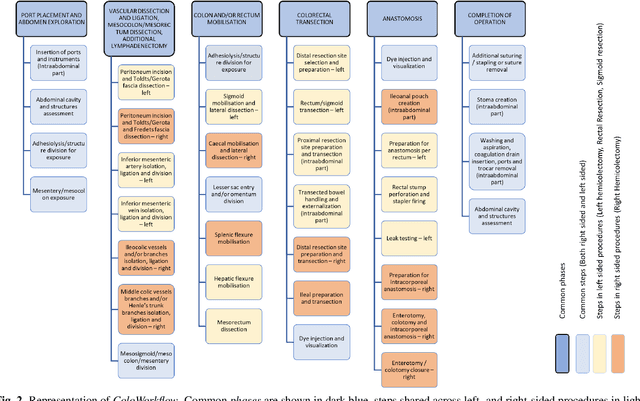
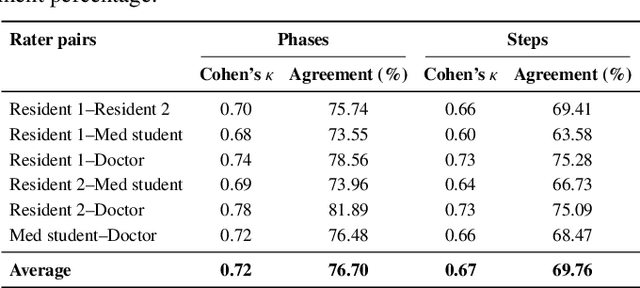
Minimally invasive colorectal surgery is characterized by procedural variability, a difficult learning curve, and complications that impact quality and outcomes. Video-based assessment (VBA) offers an opportunity to generate data-driven insights to reduce variability, optimize training, and improve surgical performance. However, existing tools for workflow analysis remain difficult to standardize and implement. This study aims to develop and validate a VBA tool for workflow analysis across minimally invasive colorectal procedures. A Delphi process was conducted to achieve consensus on generalizable workflow descriptors. The resulting framework informed the development of a new VBA tool, ColoWorkflow. Independent raters then applied ColoWorkflow to a multicentre video dataset of laparoscopic and robotic colorectal surgery (CRS). Applicability and inter-rater reliability were evaluated. Consensus was achieved for 10 procedure-agnostic phases and 34 procedure-specific steps describing CRS workflows. ColoWorkflow was developed and applied to 54 colorectal operative videos (left and right hemicolectomies, sigmoid and rectosigmoid resections, and total proctocolectomies) from five centres. The tool demonstrated broad applicability, with all but one label utilized. Inter-rater reliability was moderate, with mean Cohen's K of 0.71 for phases and 0.66 for steps. Most discrepancies arose at phase transitions and step boundary definitions. ColoWorkflow is the first consensus-based, validated VBA tool for comprehensive workflow analysis in minimally invasive CRS. It establishes a reproducible framework for video-based performance assessment, enabling benchmarking across institutions and supporting the development of artificial intelligence-driven workflow recognition. Its adoption may standardize training, accelerate competency acquisition, and advance data-informed surgical quality improvement.