 Add to Chrome
 Add to Firefox
 Add to Edge
An Automated Radiomics Framework for Postoperative Survival Prediction in Colorectal Liver Metastases using Preoperative MRI
Mar 10, 2026
While colorectal liver metastasis (CRLM) is potentially curable via hepatectomy, patient outcomes remain highly heterogeneous. Postoperative survival prediction is necessary to avoid non-beneficial surgeries and guide personalized therapy. In this study, we present an automated AI-based framework for postoperative CRLM survival prediction using pre- and post-contrast MRI. We performed a retrospective study of 227 CRLM patients who had gadoxetate-enhanced MRI prior to curative-intent hepatectomy between 2013 and 2020. We developed a survival prediction framework comprising an anatomy-aware segmentation pipeline followed by a radiomics pipeline. The segmentation pipeline learns liver, CRLMs, and spleen segmentation from partially-annotated data, leveraging promptable foundation models to generate pseudo-labels. To support this pipeline, we propose SAMONAI, a prompt propagation algorithm that extends Segment Anything Model to 3D point-based segmentation. Predicted pre- and post-contrast segmentations are then fed into our radiomics pipeline, which extracts per-tumor features and predicts survival using SurvAMINN, an autoencoder-based multiple instance neural network for time-to-event survival prediction. SurvAMINN jointly learns dimensionality reduction and survival prediction from right-censored data, emphasizing high-risk metastases. We compared our framework against established methods and biomarkers using univariate and multivariate Cox regression. Our segmentation pipeline achieves median Dice scores of 0.96 (liver) and 0.93 (spleen), driving a CRLM segmentation Dice score of 0.78 and a detection F1-score of 0.79. Accurate segmentation enables our radiomics pipeline to achieve a survival prediction C-index of 0.69. Our results show the potential of integrating segmentation algorithms with radiomics-based survival analysis to deliver accurate and automated CRLM outcome prediction.

The MAMA-MIA Challenge: Advancing Generalizability and Fairness in Breast MRI Tumor Segmentation and Treatment Response Prediction
Mar 01, 2026Breast cancer is the most frequently diagnosed malignancy among women worldwide and a leading cause of cancer-related mortality. Dynamic contrast-enhanced magnetic resonance imaging plays a central role in tumor characterization and treatment monitoring, particularly in patients receiving neoadjuvant chemotherapy. However, existing artificial intelligence models for breast magnetic resonance imaging are often developed using single-center data and evaluated using aggregate performance metrics, limiting their generalizability and obscuring potential performance disparities across demographic subgroups. The MAMA-MIA Challenge was designed to address these limitations by introducing a large-scale benchmark that jointly evaluates primary tumor segmentation and prediction of pathologic complete response using pre-treatment magnetic resonance imaging only. The training cohort comprised 1,506 patients from multiple institutions in the United States, while evaluation was conducted on an external test set of 574 patients from three independent European centers to assess cross-continental and cross-institutional generalization. A unified scoring framework combined predictive performance with subgroup consistency across age, menopausal status, and breast density. Twenty-six international teams participated in the final evaluation phase. Results demonstrate substantial performance variability under external testing and reveal trade-offs between overall accuracy and subgroup fairness. The challenge provides standardized datasets, evaluation protocols, and public resources to promote the development of robust and equitable artificial intelligence systems for breast cancer imaging.
Live(r) Die: Predicting Survival in Colorectal Liver Metastasis
Sep 10, 2025Colorectal cancer frequently metastasizes to the liver, significantly reducing long-term survival. While surgical resection is the only potentially curative treatment for colorectal liver metastasis (CRLM), patient outcomes vary widely depending on tumor characteristics along with clinical and genomic factors. Current prognostic models, often based on limited clinical or molecular features, lack sufficient predictive power, especially in multifocal CRLM cases. We present a fully automated framework for surgical outcome prediction from pre- and post-contrast MRI acquired before surgery. Our framework consists of a segmentation pipeline and a radiomics pipeline. The segmentation pipeline learns to segment the liver, tumors, and spleen from partially annotated data by leveraging promptable foundation models to complete missing labels. Also, we propose SAMONAI, a novel zero-shot 3D prompt propagation algorithm that leverages the Segment Anything Model to segment 3D regions of interest from a single point prompt, significantly improving our segmentation pipeline's accuracy and efficiency. The predicted pre- and post-contrast segmentations are then fed into our radiomics pipeline, which extracts features from each tumor and predicts survival using SurvAMINN, a novel autoencoder-based multiple instance neural network for survival analysis. SurvAMINN jointly learns dimensionality reduction and hazard prediction from right-censored survival data, focusing on the most aggressive tumors. Extensive evaluation on an institutional dataset comprising 227 patients demonstrates that our framework surpasses existing clinical and genomic biomarkers, delivering a C-index improvement exceeding 10%. Our results demonstrate the potential of integrating automated segmentation algorithms and radiomics-based survival analysis to deliver accurate, annotation-efficient, and interpretable outcome prediction in CRLM.
CoMoTo: Unpaired Cross-Modal Lesion Distillation Improves Breast Lesion Detection in Tomosynthesis
Jul 24, 2024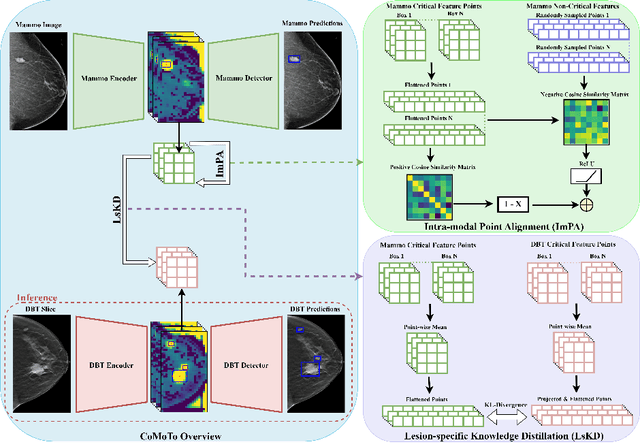


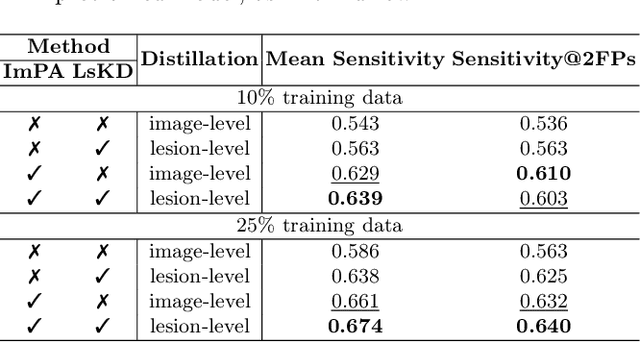
Digital Breast Tomosynthesis (DBT) is an advanced breast imaging modality that offers superior lesion detection accuracy compared to conventional mammography, albeit at the trade-off of longer reading time. Accelerating lesion detection from DBT using deep learning is hindered by limited data availability and huge annotation costs. A possible solution to this issue could be to leverage the information provided by a more widely available modality, such as mammography, to enhance DBT lesion detection. In this paper, we present a novel framework, CoMoTo, for improving lesion detection in DBT. Our framework leverages unpaired mammography data to enhance the training of a DBT model, improving practicality by eliminating the need for mammography during inference. Specifically, we propose two novel components, Lesion-specific Knowledge Distillation (LsKD) and Intra-modal Point Alignment (ImPA). LsKD selectively distills lesion features from a mammography teacher model to a DBT student model, disregarding background features. ImPA further enriches LsKD by ensuring the alignment of lesion features within the teacher before distilling knowledge to the student. Our comprehensive evaluation shows that CoMoTo is superior to traditional pretraining and image-level KD, improving performance by 7% Mean Sensitivity under low-data setting. Our code is available at https://github.com/Muhammad-Al-Barbary/CoMoTo .