 Add to Chrome
 Add to Firefox
 Add to Edge
$μ$PLAN: Summarizing using a Content Plan as Cross-Lingual Bridge
May 23, 2023
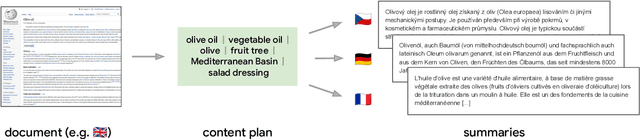
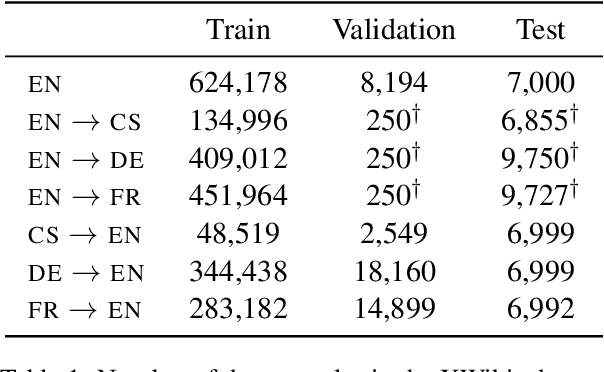

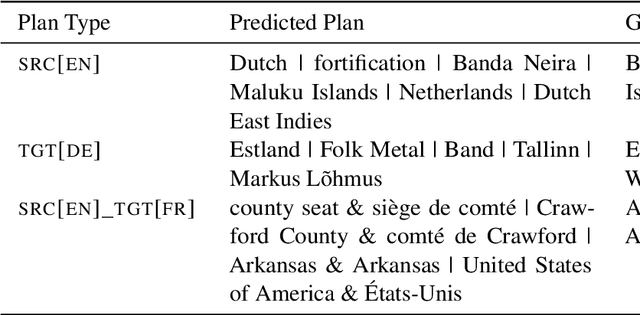
Cross-lingual summarization consists of generating a summary in one language given an input document in a different language, allowing for the dissemination of relevant content across speakers of other languages. However, this task remains challenging, mainly because of the need for cross-lingual datasets and the compounded difficulty of summarizing and translating. This work presents $\mu$PLAN, an approach to cross-lingual summarization that uses an intermediate planning step as a cross-lingual bridge. We formulate the plan as a sequence of entities that captures the conceptualization of the summary, i.e. identifying the salient content and expressing in which order to present the information, separate from the surface form. Using a multilingual knowledge base, we align the entities to their canonical designation across languages. $\mu$PLAN models first learn to generate the plan and then continue generating the summary conditioned on the plan and the input. We evaluate our methodology on the XWikis dataset on cross-lingual pairs across four languages and demonstrate that this planning objective achieves state-of-the-art performance in terms of ROUGE and faithfulness scores. Moreover, this planning approach improves the zero-shot transfer to new cross-lingual language pairs compared to non-planning baselines.

Attributable and Scalable Opinion Summarization
May 19, 2023
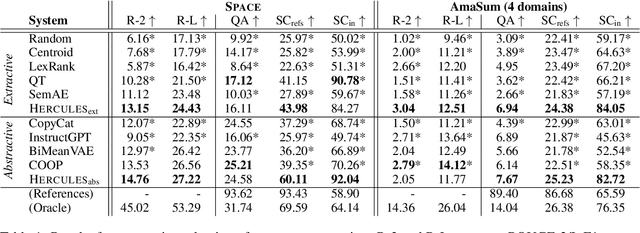
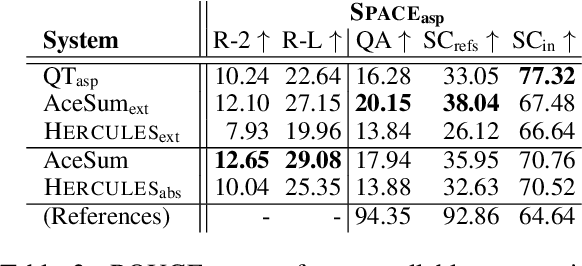

We propose a method for unsupervised opinion summarization that encodes sentences from customer reviews into a hierarchical discrete latent space, then identifies common opinions based on the frequency of their encodings. We are able to generate both abstractive summaries by decoding these frequent encodings, and extractive summaries by selecting the sentences assigned to the same frequent encodings. Our method is attributable, because the model identifies sentences used to generate the summary as part of the summarization process. It scales easily to many hundreds of input reviews, because aggregation is performed in the latent space rather than over long sequences of tokens. We also demonstrate that our appraoch enables a degree of control, generating aspect-specific summaries by restricting the model to parts of the encoding space that correspond to desired aspects (e.g., location or food). Automatic and human evaluation on two datasets from different domains demonstrates that our method generates summaries that are more informative than prior work and better grounded in the input reviews.
Improving Language Model Negotiation with Self-Play and In-Context Learning from AI Feedback
May 17, 2023We study whether multiple large language models (LLMs) can autonomously improve each other in a negotiation game by playing, reflecting, and criticizing. We are interested in this question because if LLMs were able to improve each other, it would imply the possibility of creating strong AI agents with minimal human intervention. We ask two LLMs to negotiate with each other, playing the roles of a buyer and a seller, respectively. They aim to reach a deal with the buyer targeting a lower price and the seller a higher one. A third language model, playing the critic, provides feedback to a player to improve the player's negotiation strategies. We let the two agents play multiple rounds, using previous negotiation history and AI feedback as in-context demonstrations to improve the model's negotiation strategy iteratively. We use different LLMs (GPT and Claude) for different roles and use the deal price as the evaluation metric. Our experiments reveal multiple intriguing findings: (1) Only a subset of the language models we consider can self-play and improve the deal price from AI feedback, weaker models either do not understand the game's rules or cannot incorporate AI feedback for further improvement. (2) Models' abilities to learn from the feedback differ when playing different roles. For example, it is harder for Claude-instant to improve as the buyer than as the seller. (3) When unrolling the game to multiple rounds, stronger agents can consistently improve their performance by meaningfully using previous experiences and iterative AI feedback, yet have a higher risk of breaking the deal. We hope our work provides insightful initial explorations of having models autonomously improve each other with game playing and AI feedback.
Conversational Semantic Parsing using Dynamic Context Graphs
May 04, 2023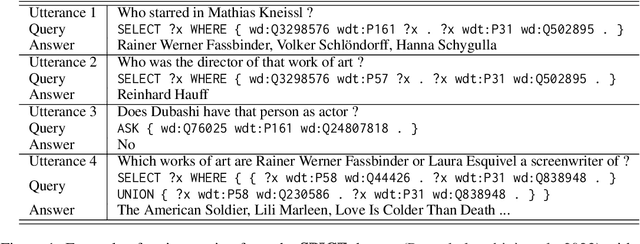
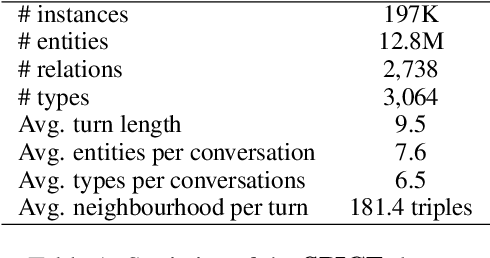
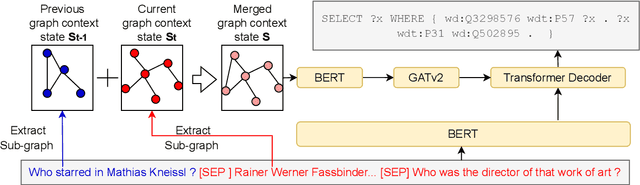
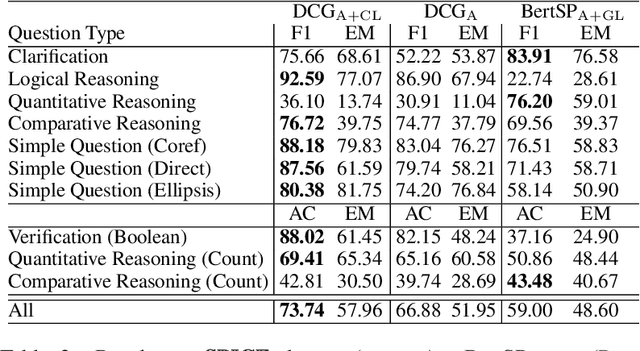
In this paper we consider the task of conversational semantic parsing over general purpose knowledge graphs (KGs) with millions of entities, and thousands of relation-types. We are interested in developing models capable of interactively mapping user utterances into executable logical forms (e.g., SPARQL) in the context of the conversational history. Our key idea is to represent information about an utterance and its context via a subgraph which is created dynamically, i.e., the number of nodes varies per utterance. Moreover, rather than treating the subgraph as a sequence we exploit its underlying structure, and thus encode it using a graph neural network which further allows us to represent a large number of (unseen) nodes. Experimental results show that modeling context dynamically is superior to static approaches, delivering performance improvements across the board (i.e., for simple and complex questions). Our results further confirm that modeling the structure of context is better at processing discourse information, (i.e., at handling ellipsis and resolving coreference) and longer interactions.
Text-Blueprint: An Interactive Platform for Plan-based Conditional Generation
Apr 28, 2023While conditional generation models can now generate natural language well enough to create fluent text, it is still difficult to control the generation process, leading to irrelevant, repetitive, and hallucinated content. Recent work shows that planning can be a useful intermediate step to render conditional generation less opaque and more grounded. We present a web browser-based demonstration for query-focused summarization that uses a sequence of question-answer pairs, as a blueprint plan for guiding text generation (i.e., what to say and in what order). We illustrate how users may interact with the generated text and associated plan visualizations, e.g., by editing and modifying the blueprint in order to improve or control the generated output. A short video demonstrating our system is available at https://goo.gle/text-blueprint-demo.
Semantic Parsing for Conversational Question Answering over Knowledge Graphs
Jan 28, 2023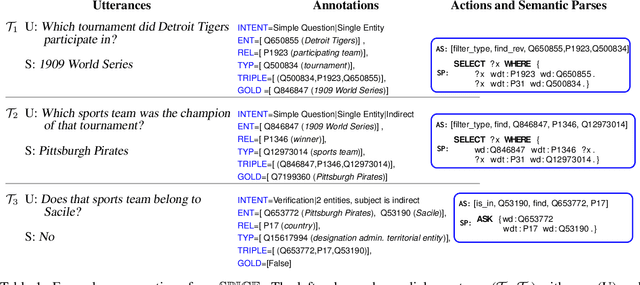
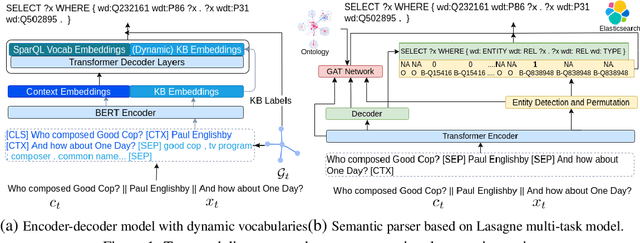
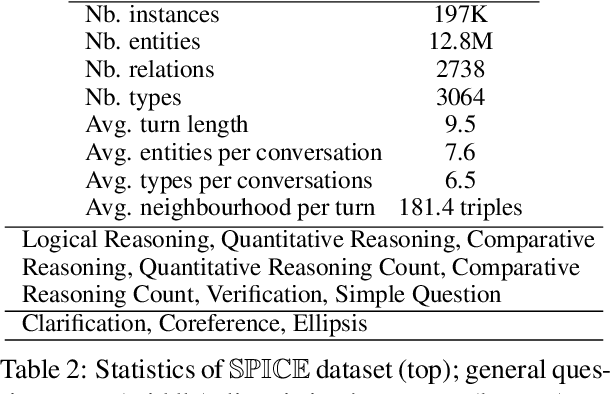
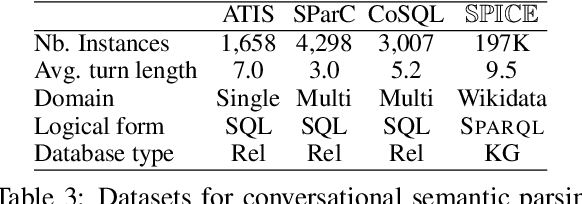
In this paper, we are interested in developing semantic parsers which understand natural language questions embedded in a conversation with a user and ground them to formal queries over definitions in a general purpose knowledge graph (KG) with very large vocabularies (covering thousands of concept names and relations, and millions of entities). To this end, we develop a dataset where user questions are annotated with Sparql parses and system answers correspond to execution results thereof. We present two different semantic parsing approaches and highlight the challenges of the task: dealing with large vocabularies, modelling conversation context, predicting queries with multiple entities, and generalising to new questions at test time. We hope our dataset will serve as useful testbed for the development of conversational semantic parsers. Our dataset and models are released at https://github.com/EdinburghNLP/SPICE.
mFACE: Multilingual Summarization with Factual Consistency Evaluation
Dec 20, 2022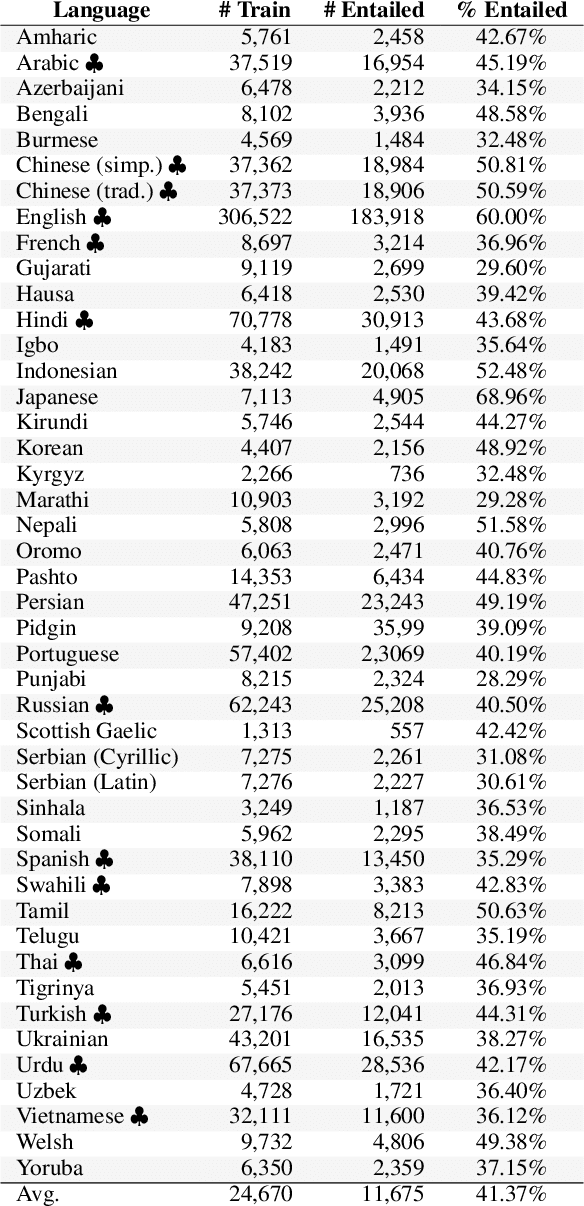
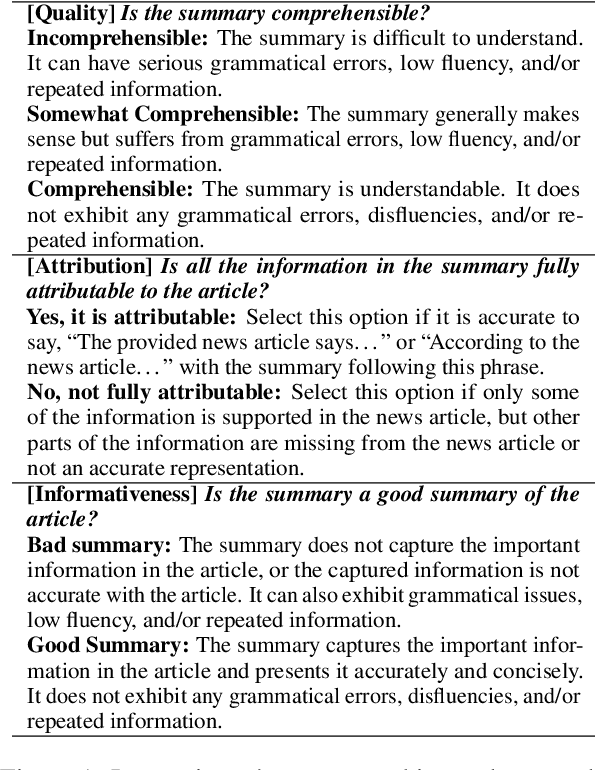
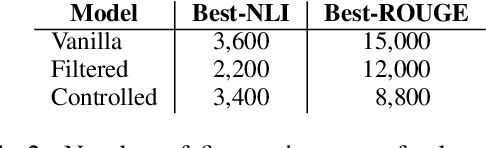
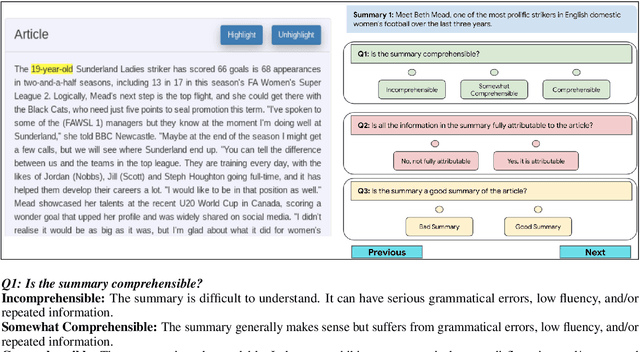
Abstractive summarization has enjoyed renewed interest in recent years, thanks to pre-trained language models and the availability of large-scale datasets. Despite promising results, current models still suffer from generating factually inconsistent summaries, reducing their utility for real-world application. Several recent efforts attempt to address this by devising models that automatically detect factual inconsistencies in machine generated summaries. However, they focus exclusively on English, a language with abundant resources. In this work, we leverage factual consistency evaluation models to improve multilingual summarization. We explore two intuitive approaches to mitigate hallucinations based on the signal provided by a multilingual NLI model, namely data filtering and controlled generation. Experimental results in the 45 languages from the XLSum dataset show gains over strong baselines in both automatic and human evaluation.
Little Red Riding Hood Goes Around the Globe:Crosslingual Story Planning and Generation with Large Language Models
Dec 20, 2022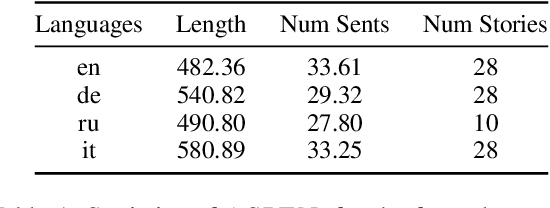
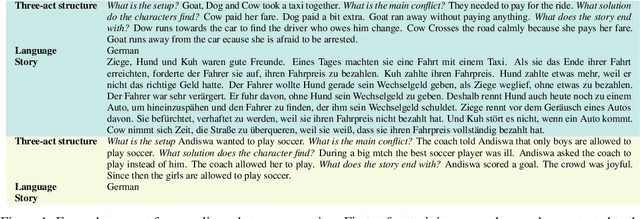
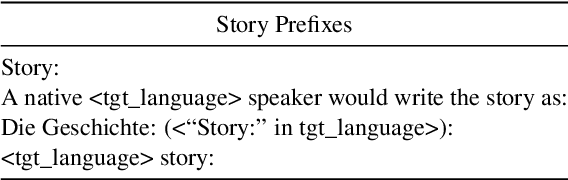

We consider the problem of automatically generating stories in multiple languages. Compared to prior work in monolingual story generation, crosslingual story generation allows for more universal research on story planning. We propose to use Prompting Large Language Models with Plans to study which plan is optimal for story generation. We consider 4 types of plans and systematically analyse how the outputs differ for different planning strategies. The study demonstrates that formulating the plans as question-answer pairs leads to more coherent generated stories while the plan gives more control to the story creators.
Real-World Compositional Generalization with Disentangled Sequence-to-Sequence Learning
Dec 12, 2022Compositional generalization is a basic mechanism in human language learning, which current neural networks struggle with. A recently proposed Disentangled sequence-to-sequence model (Dangle) shows promising generalization capability by learning specialized encodings for each decoding step. We introduce two key modifications to this model which encourage more disentangled representations and improve its compute and memory efficiency, allowing us to tackle compositional generalization in a more realistic setting. Specifically, instead of adaptively re-encoding source keys and values at each time step, we disentangle their representations and only re-encode keys periodically, at some interval. Our new architecture leads to better generalization performance across existing tasks and datasets, and a new machine translation benchmark which we create by detecting naturally occurring compositional patterns in relation to a training set. We show this methodology better emulates real-world requirements than artificial challenges.
QAmeleon: Multilingual QA with Only 5 Examples
Nov 15, 2022The availability of large, high-quality datasets has been one of the main drivers of recent progress in question answering (QA). Such annotated datasets however are difficult and costly to collect, and rarely exist in languages other than English, rendering QA technology inaccessible to underrepresented languages. An alternative to building large monolingual training datasets is to leverage pre-trained language models (PLMs) under a few-shot learning setting. Our approach, QAmeleon, uses a PLM to automatically generate multilingual data upon which QA models are trained, thus avoiding costly annotation. Prompt tuning the PLM for data synthesis with only five examples per language delivers accuracy superior to translation-based baselines, bridges nearly 60% of the gap between an English-only baseline and a fully supervised upper bound trained on almost 50,000 hand labeled examples, and always leads to substantial improvements compared to fine-tuning a QA model directly on labeled examples in low resource settings. Experiments on the TyDiQA-GoldP and MLQA benchmarks show that few-shot prompt tuning for data synthesis scales across languages and is a viable alternative to large-scale annotation.