 Add to Chrome
 Add to Firefox
 Add to Edge
Hierarchical Indexing for Retrieval-Augmented Opinion Summarization
Mar 01, 2024
We propose a method for unsupervised abstractive opinion summarization, that combines the attributability and scalability of extractive approaches with the coherence and fluency of Large Language Models (LLMs). Our method, HIRO, learns an index structure that maps sentences to a path through a semantically organized discrete hierarchy. At inference time, we populate the index and use it to identify and retrieve clusters of sentences containing popular opinions from input reviews. Then, we use a pretrained LLM to generate a readable summary that is grounded in these extracted evidential clusters. The modularity of our approach allows us to evaluate its efficacy at each stage. We show that HIRO learns an encoding space that is more semantically structured than prior work, and generates summaries that are more representative of the opinions in the input reviews. Human evaluation confirms that HIRO generates more coherent, detailed and accurate summaries that are significantly preferred by annotators compared to prior work.

Archer: A Human-Labeled Text-to-SQL Dataset with Arithmetic, Commonsense and Hypothetical Reasoning
Feb 25, 2024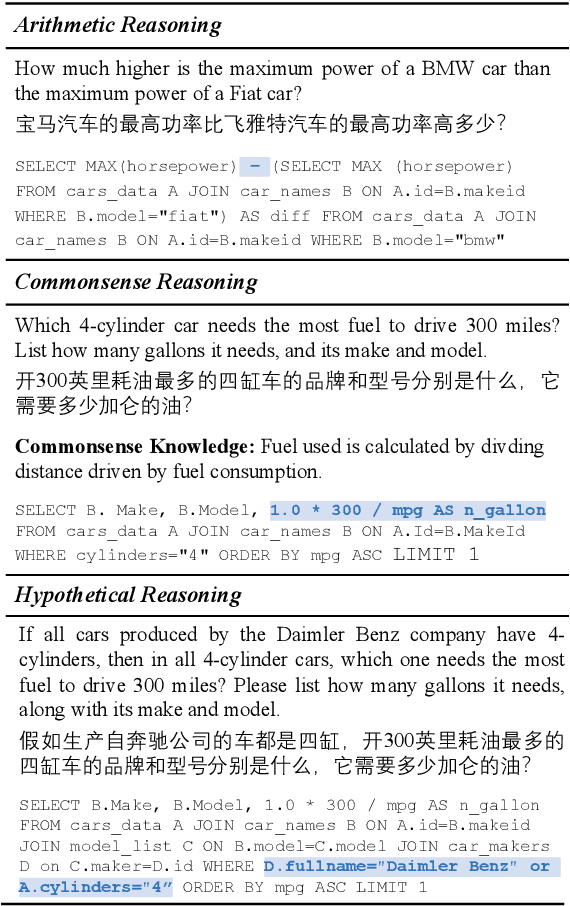
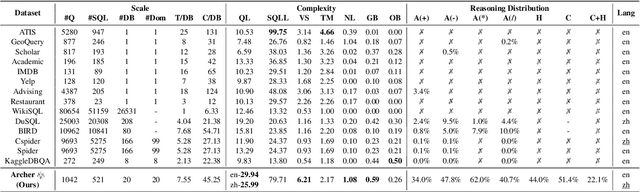
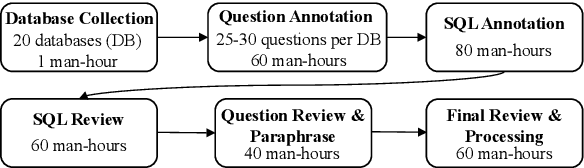
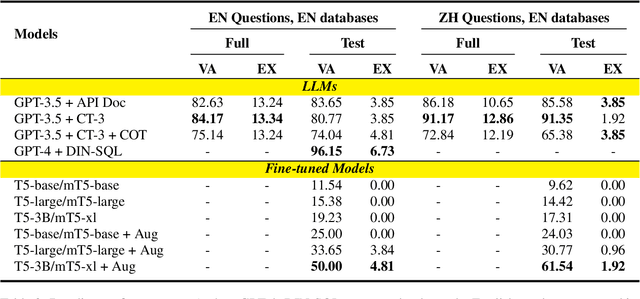
We present Archer, a challenging bilingual text-to-SQL dataset specific to complex reasoning, including arithmetic, commonsense and hypothetical reasoning. It contains 1,042 English questions and 1,042 Chinese questions, along with 521 unique SQL queries, covering 20 English databases across 20 domains. Notably, this dataset demonstrates a significantly higher level of complexity compared to existing publicly available datasets. Our evaluation shows that Archer challenges the capabilities of current state-of-the-art models, with a high-ranked model on the Spider leaderboard achieving only 6.73% execution accuracy on Archer test set. Thus, Archer presents a significant challenge for future research in this field.
TrustScore: Reference-Free Evaluation of LLM Response Trustworthiness
Feb 19, 2024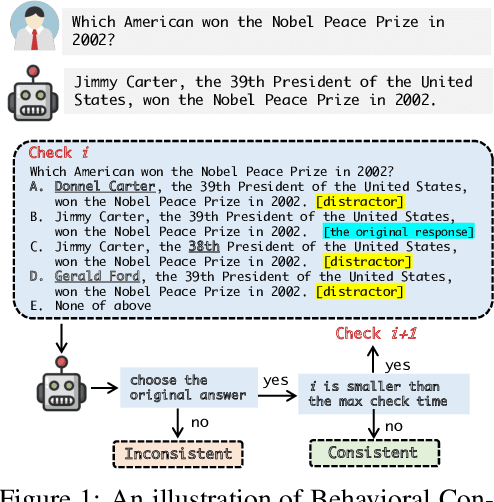
Large Language Models (LLMs) have demonstrated impressive capabilities across various domains, prompting a surge in their practical applications. However, concerns have arisen regarding the trustworthiness of LLMs outputs, particularly in closed-book question-answering tasks, where non-experts may struggle to identify inaccuracies due to the absence of contextual or ground truth information. This paper introduces TrustScore, a framework based on the concept of Behavioral Consistency, which evaluates whether an LLMs response aligns with its intrinsic knowledge. Additionally, TrustScore can seamlessly integrate with fact-checking methods, which assesses alignment with external knowledge sources. The experimental results show that TrustScore achieves strong correlations with human judgments, surpassing existing reference-free metrics, and achieving results on par with reference-based metrics.
Improving Generalization in Semantic Parsing by Increasing Natural Language Variation
Feb 13, 2024Text-to-SQL semantic parsing has made significant progress in recent years, with various models demonstrating impressive performance on the challenging Spider benchmark. However, it has also been shown that these models often struggle to generalize even when faced with small perturbations of previously (accurately) parsed expressions. This is mainly due to the linguistic form of questions in Spider which are overly specific, unnatural, and display limited variation. In this work, we use data augmentation to enhance the robustness of text-to-SQL parsers against natural language variations. Existing approaches generate question reformulations either via models trained on Spider or only introduce local changes. In contrast, we leverage the capabilities of large language models to generate more realistic and diverse questions. Using only a few prompts, we achieve a two-fold increase in the number of questions in Spider. Training on this augmented dataset yields substantial improvements on a range of evaluation sets, including robustness benchmarks and out-of-domain data.
SimLM: Can Language Models Infer Parameters of Physical Systems?
Dec 21, 2023Recent developments in large-scale machine learning models for general-purpose understanding, translation and generation of language are driving impact across a variety of sectors including medicine, robotics, and scientific discovery. The strength of such Large Language Models (LLMs) stems from the large corpora that they are trained with. While this imbues them with a breadth of capabilities, they have been found unsuitable for some specific types of problems such as advanced mathematics. In this paper, we highlight the inability of LLMs to reason about physics tasks. We demonstrate that their ability to infer parameters of physical systems can be improved, without retraining, by augmenting their context with feedback from physical simulation.
Compositional Generalization for Data-to-Text Generation
Dec 05, 2023


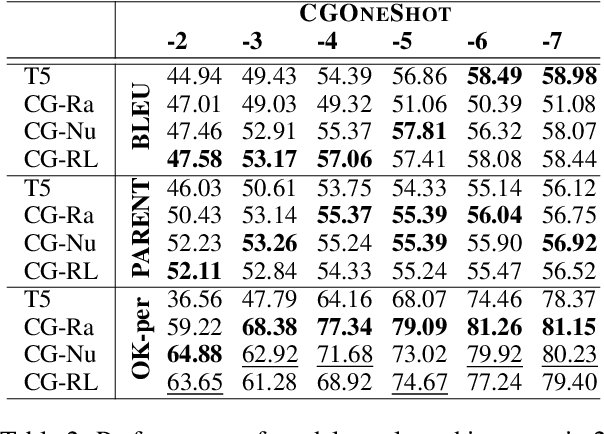
Data-to-text generation involves transforming structured data, often represented as predicate-argument tuples, into coherent textual descriptions. Despite recent advances, systems still struggle when confronted with unseen combinations of predicates, producing unfaithful descriptions (e.g. hallucinations or omissions). We refer to this issue as compositional generalisation, and it encouraged us to create a benchmark for assessing the performance of different approaches on this specific problem. Furthermore, we propose a novel model that addresses compositional generalization by clustering predicates into groups. Our model generates text in a sentence-by-sentence manner, relying on one cluster of predicates at a time. This approach significantly outperforms T5~baselines across all evaluation metrics.Notably, it achieved a 31% improvement over T5 in terms of a metric focused on maintaining faithfulness to the input.
PixT3: Pixel-based Table To Text generation
Nov 16, 2023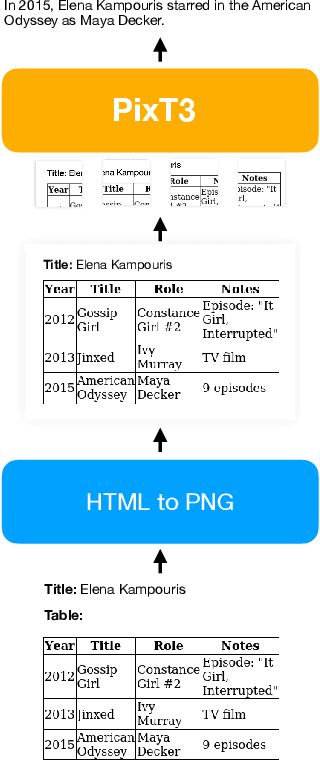
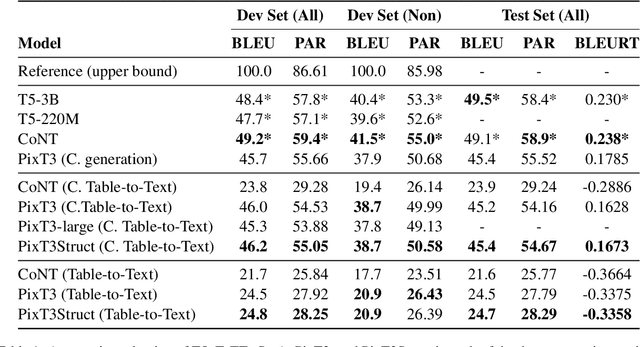
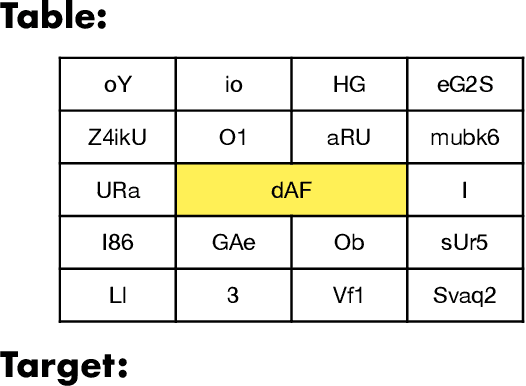
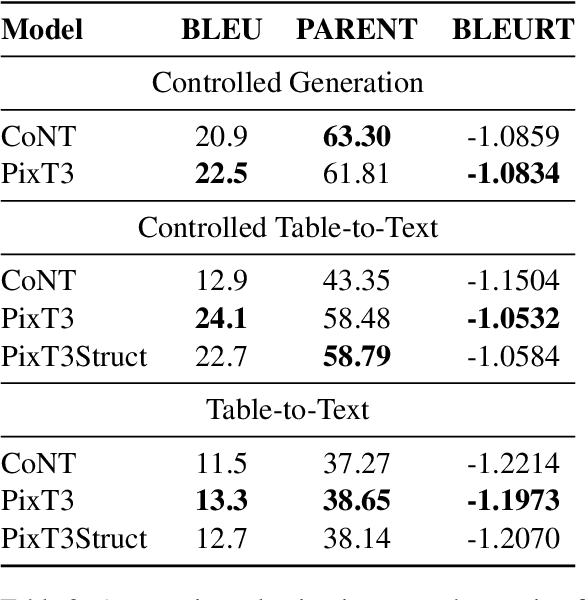
Table-to-Text has been traditionally approached as a linear language to text problem. However, visually represented tables are rich in visual information and serve as a concise, effective form of representing data and its relationships. When using text-based approaches, after the linearization process, this information is either lost or represented in a space inefficient manner. This inefficiency has remained a constant challenge for text-based approaches making them struggle with large tables. In this paper, we demonstrate that image representation of tables are more space-efficient than the typical textual linearizations, and multi-modal approaches are competitive in Table-to-Text tasks. We present PixT3, a multimodal table-to-text model that outperforms the state-of-the-art (SotA) in the ToTTo benchmark in a pure Table-to-Text setting while remaining competitive in controlled Table-to-Text scenarios. It also generalizes better in unseen datasets, outperforming ToTTo SotA in all generation settings. Additionally, we introduce a new intermediate training curriculum to reinforce table structural awareness, leading to improved generation and overall faithfulness of the models.
Parameter-Efficient Multilingual Summarisation: An Empirical Study
Nov 14, 2023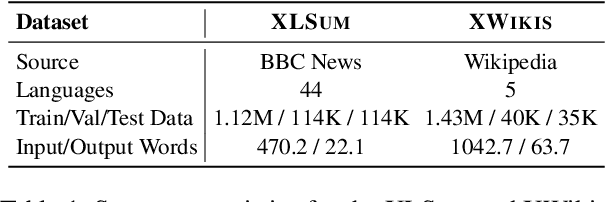
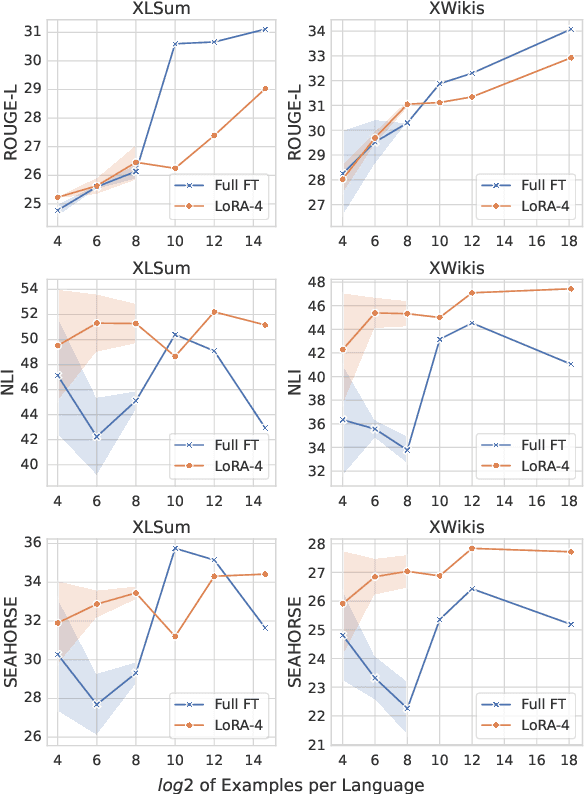
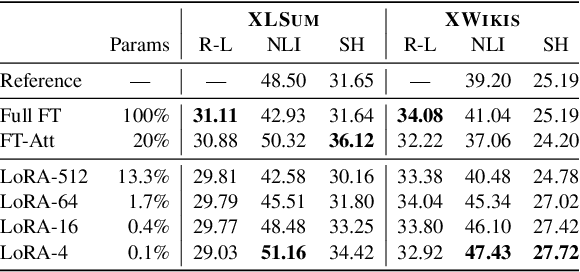
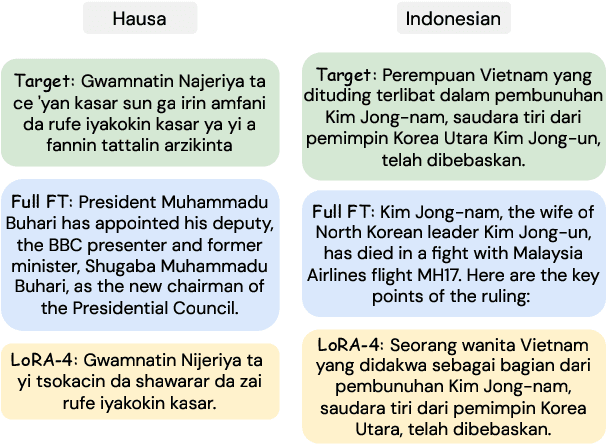
With the increasing prevalence of Large Language Models, traditional full fine-tuning approaches face growing challenges, especially in memory-intensive tasks. This paper investigates the potential of Parameter-Efficient Fine-Tuning, focusing on Low-Rank Adaptation (LoRA), for complex and under-explored multilingual summarisation tasks. We conduct an extensive study across different data availability scenarios, including full-data, low-data, and cross-lingual transfer, leveraging models of different sizes. Our findings reveal that LoRA lags behind full fine-tuning when trained with full data, however, it excels in low-data scenarios and cross-lingual transfer. Interestingly, as models scale up, the performance gap between LoRA and full fine-tuning diminishes. Additionally, we investigate effective strategies for few-shot cross-lingual transfer, finding that continued LoRA tuning achieves the best performance compared to both full fine-tuning and dynamic composition of language-specific LoRA modules.
Visual Storytelling with Question-Answer Plans
Oct 17, 2023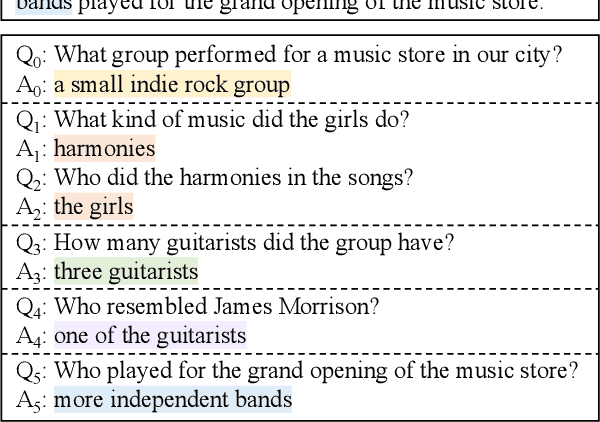

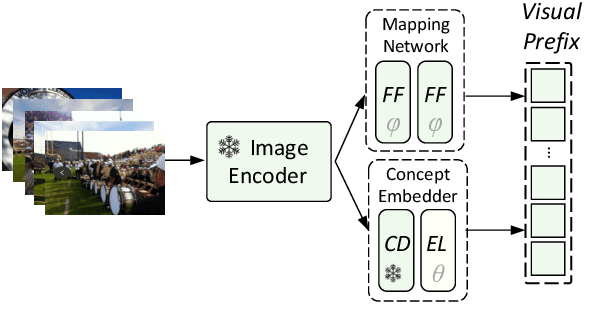
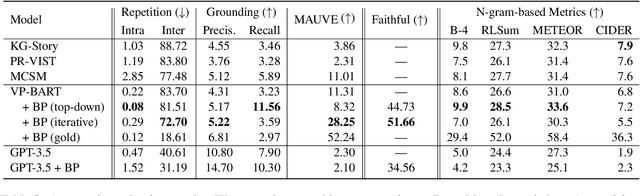
Visual storytelling aims to generate compelling narratives from image sequences. Existing models often focus on enhancing the representation of the image sequence, e.g., with external knowledge sources or advanced graph structures. Despite recent progress, the stories are often repetitive, illogical, and lacking in detail. To mitigate these issues, we present a novel framework which integrates visual representations with pretrained language models and planning. Our model translates the image sequence into a visual prefix, a sequence of continuous embeddings which language models can interpret. It also leverages a sequence of question-answer pairs as a blueprint plan for selecting salient visual concepts and determining how they should be assembled into a narrative. Automatic and human evaluation on the VIST benchmark (Huang et al., 2016) demonstrates that blueprint-based models generate stories that are more coherent, interesting, and natural compared to competitive baselines and state-of-the-art systems.
Optimal Transport Posterior Alignment for Cross-lingual Semantic Parsing
Jul 09, 2023Cross-lingual semantic parsing transfers parsing capability from a high-resource language (e.g., English) to low-resource languages with scarce training data. Previous work has primarily considered silver-standard data augmentation or zero-shot methods, however, exploiting few-shot gold data is comparatively unexplored. We propose a new approach to cross-lingual semantic parsing by explicitly minimizing cross-lingual divergence between probabilistic latent variables using Optimal Transport. We demonstrate how this direct guidance improves parsing from natural languages using fewer examples and less training. We evaluate our method on two datasets, MTOP and MultiATIS++SQL, establishing state-of-the-art results under a few-shot cross-lingual regime. Ablation studies further reveal that our method improves performance even without parallel input translations. In addition, we show that our model better captures cross-lingual structure in the latent space to improve semantic representation similarity.