 Add to Chrome
 Add to Firefox
 Add to Edge
Mitigating Errors in LLM-Generated Web API Invocations via Retrieval-Augmented Generation and Constrained Decoding
Jul 07, 2026
Integration of web APIs is a cornerstone of modern software systems, yet writing correct web API invocation code remains challenging due to complex and evolving API specifications. Although LLMs are increasingly used for code generation, previous work has empirically shown that their ability to generate correct web API integrations is limited. At the same time, mitigation techniques and their effectiveness for this setting remain insufficiently understood. In this paper, we propose and systematically evaluate retrieval-augmented generation (RAG) and constrained decoding (CD) as two complementary approaches to improving LLM-generated web API invocation code. For RAG, we design a retriever that processes OpenAPI specifications and retrieves compact endpoint representations to inject into model prompts. For CD, we introduce an automatic translation from OpenAPI specifications to regex-based constraints enforced during generation. We evaluate both approaches on WAPIIBench's existing synthetic dataset and on a new real-world dataset derived from GitHub repositories. Our results show that RAG reduces hallucinations and improves correctness when generating full API invocations but reduces it when the endpoint is already provided as it encourages the generation of unnecessary parameters. In contrast, CD reliably prevents illegal URLs, HTTP methods, and arguments and substantially improves overall correctness for both starter codes.

SHERLOC: Structured Diagnostic Localization for Code Repair Agents
Jun 23, 2026LLM agents solve repository-level coding tasks through multi-turn tool use, but utilize half their budget on locating faults before editing. Dedicated localization frameworks have emerged, yet are still evaluated as file retrieval rather than actionable diagnosis, producing locations without the diagnostic context a repair agent needs. We introduce SHERLOC (Structured Hypothesis-driven Exploration and Reasoning for Localization), a training-free framework pairing a reasoning LLM with compact repository tools and self-recovery, without fine-tuning or multi-agent orchestration. SHERLOC reaches state-of-the-art localization across model scales: 84.33% accuracy@1 on SWE-Bench Lite and 81.27% recall@1 on SWE-Bench Verified; at ~30B parameters, it matches or outperforms other agentic methods. Injecting our locations and diagnostic findings into repair agents yields, on average, +5.95 pp resolve rate on SWE-Bench Verified while cutting localization and total tokens by 36.7% and 23.1%.
Efficient Post-training of LLMs for Code Generation With Offline Reinforcement Learning
May 27, 2026Post-training using online reinforcement learning (RL) is an important training step for LLMs, including code-generating models. However, online RL for code generation involves LLM inference and verification of the generated output, which can take considerable time and resources. In this paper, we explore the application of offline RL to code-generating models by leveraging existing code datasets. Our experiments demonstrate that offline RL is an effective training strategy for improving LLM performance. We show that offline RL can be especially beneficial for small LLMs and challenging coding problems.
Domain-Adaptable Reinforcement Learning for Code Generation with Dense Rewards
May 20, 2026Large language models show strong potential for automated code generation, but lack guarantees for correctness, quality, safety, and domain-specific constraints. For instance in robotics, where code generation is increasingly being used for planning and executing actions, awareness of the environment and physical constraints is critical. To facilitate the adaption of code-generating LLMs to diverse requirements, including domain-specific ones, we present a reinforcement learning framework that fine-tunes pre-trained LLMs using proximal policy optimization. Our customizable execution-aware reward formula captures and optimizes syntax, functional correctness, code style, security, and simulator executability. A token-level reward mapping mechanism enables effective credit assignment from execution outcomes to generated tokens. The framework is evaluated on general-purpose code generation (MBPP/MBPP+) and robotic program synthesis (RoboEval). The results show substantial improvements in functional correctness and simulator executability, including an absolute pass@1 increase of 19% on MBPP and a reduction in execution failures by 51% on RoboEval. These findings demonstrate that structured reinforcement learning can effectively align language models to correct program generation and domain-specific requirements.
Towards Understanding What State Space Models Learn About Code
Feb 06, 2026State Space Models (SSMs) have emerged as an efficient alternative to the transformer architecture. Recent studies show that SSMs can match or surpass Transformers on code understanding tasks, such as code retrieval, when trained under similar conditions. However, their internal mechanisms remain a black box. We present the first systematic analysis of what SSM-based code models actually learn and perform the first comparative analysis of SSM and Transformer-based code models. Our analysis reveals that SSMs outperform Transformers at capturing code syntax and semantics in pretraining but forgets certain syntactic and semantic relations during fine-tuning on task, especially when the task emphasizes short-range dependencies. To diagnose this, we introduce SSM-Interpret, a frequency-domain framework that exposes a spectral shift toward short-range dependencies during fine-tuning. Guided by these findings, we propose architectural modifications that significantly improve the performance of SSM-based code model, validating that our analysis directly enables better models.
Analysis of Long Range Dependency Understanding in State Space Models
Jan 19, 2026Although state-space models (SSMs) have demonstrated strong performance on long-sequence benchmarks, most research has emphasized predictive accuracy rather than interpretability. In this work, we present the first systematic kernel interpretability study of the diagonalized state-space model (S4D) trained on a real-world task (vulnerability detection in source code). Through time and frequency domain analysis of the S4D kernel, we show that the long-range modeling capability of S4D varies significantly under different model architectures, affecting model performance. For instance, we show that the depending on the architecture, S4D kernel can behave as low-pass, band-pass or high-pass filter. The insights from our analysis can guide future work in designing better S4D-based models.
Where Do LLMs Still Struggle? An In-Depth Analysis of Code Generation Benchmarks
Nov 06, 2025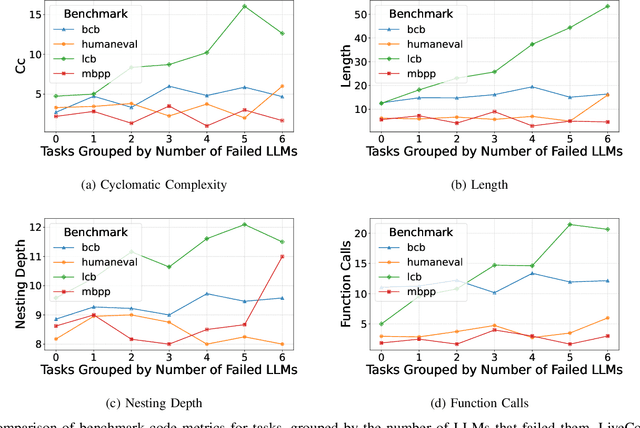
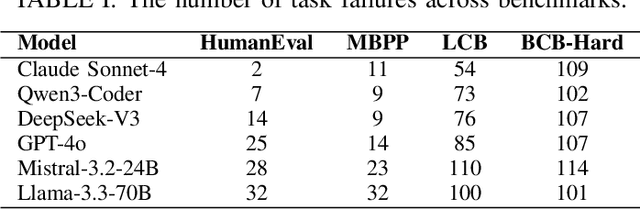

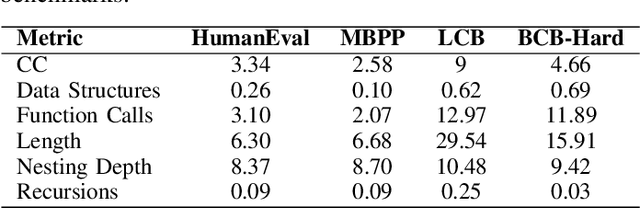
Large Language Models (LLMs) have achieved remarkable success in code generation, and the race to improve their performance has become a central focus of AI research. Benchmarks and leaderboards are increasingly popular, offering quantitative rankings of LLMs. However, they provide limited insight into the tasks that LLMs consistently fail to solve - information that is crucial for understanding current limitations and guiding the development of more capable models. To address this gap, we examined code generation tasks across four popular benchmarks, identifying those that major LLMs are most likely to fail. To understand the causes of these failures, we investigated whether the static complexity of solution code contributes to them, followed by a systematic inspection of 114 tasks that LLMs consistently struggled with. Our analysis revealed four recurring patterns of weaknesses in LLMs, as well as common complications within benchmark tasks that most often lead to failure.
Adaptable Hindsight Experience Replay for Search-Based Learning
Nov 05, 2025AlphaZero-like Monte Carlo Tree Search systems, originally introduced for two-player games, dynamically balance exploration and exploitation using neural network guidance. This combination makes them also suitable for classical search problems. However, the original method of training the network with simulation results is limited in sparse reward settings, especially in the early stages, where the network cannot yet give guidance. Hindsight Experience Replay (HER) addresses this issue by relabeling unsuccessful trajectories from the search tree as supervised learning signals. We introduce Adaptable HER (\ours{}), a flexible framework that integrates HER with AlphaZero, allowing easy adjustments to HER properties such as relabeled goals, policy targets, and trajectory selection. Our experiments, including equation discovery, show that the possibility of modifying HER is beneficial and surpasses the performance of pure supervised or reinforcement learning.
BiGSCoder: State Space Model for Code Understanding
May 02, 2025We present BiGSCoder, a novel encoder-only bidirectional state-space model (SSM) featuring a gated architecture, pre-trained for code understanding on a code dataset using masked language modeling. Our work aims to systematically evaluate SSMs' capabilities in coding tasks compared to traditional transformer architectures; BiGSCoder is built for this purpose. Through comprehensive experiments across diverse pre-training configurations and code understanding benchmarks, we demonstrate that BiGSCoder outperforms transformer-based models, despite utilizing simpler pre-training strategies and much less training data. Our results indicate that BiGSCoder can serve as a more sample-efficient alternative to conventional transformer models. Furthermore, our study shows that SSMs perform better without positional embeddings and can effectively extrapolate to longer sequences during fine-tuning.
Integrating Symbolic Execution into the Fine-Tuning of Code-Generating LLMs
Apr 21, 2025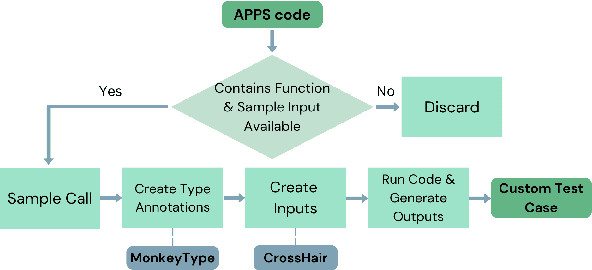
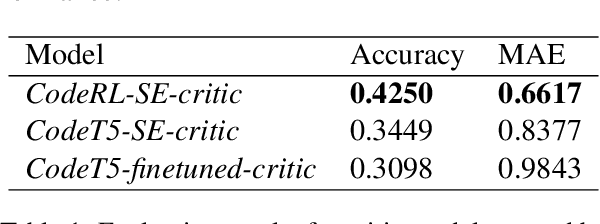
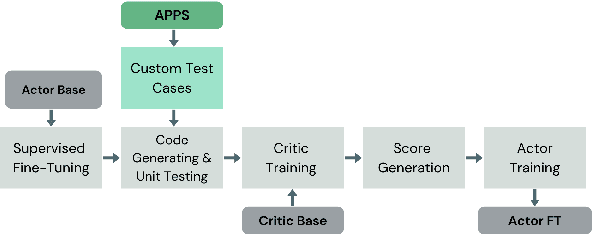
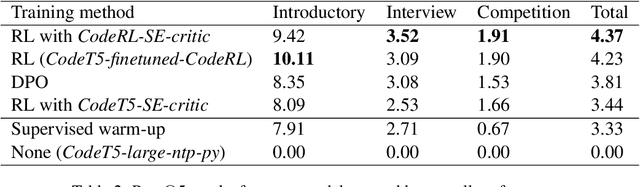
Code-generating Large Language Models (LLMs) have become essential tools in modern software development, enhancing productivity and accelerating development. This paper aims to investigate the fine-tuning of code-generating LLMs using Reinforcement Learning and Direct Preference Optimization, further improving their performance. To achieve this, we enhance the training data for the reward model with the help of symbolic execution techniques, ensuring more comprehensive and objective data. With symbolic execution, we create a custom dataset that better captures the nuances in code evaluation. Our reward models, fine-tuned on this dataset, demonstrate significant improvements over the baseline, CodeRL, in estimating the quality of generated code. Our code-generating LLMs, trained with the help of reward model feedback, achieve similar results compared to the CodeRL benchmark.