 Add to Chrome
 Add to Firefox
 Add to Edge
Mitigating Errors in LLM-Generated Web API Invocations via Retrieval-Augmented Generation and Constrained Decoding
Jul 07, 2026
Integration of web APIs is a cornerstone of modern software systems, yet writing correct web API invocation code remains challenging due to complex and evolving API specifications. Although LLMs are increasingly used for code generation, previous work has empirically shown that their ability to generate correct web API integrations is limited. At the same time, mitigation techniques and their effectiveness for this setting remain insufficiently understood. In this paper, we propose and systematically evaluate retrieval-augmented generation (RAG) and constrained decoding (CD) as two complementary approaches to improving LLM-generated web API invocation code. For RAG, we design a retriever that processes OpenAPI specifications and retrieves compact endpoint representations to inject into model prompts. For CD, we introduce an automatic translation from OpenAPI specifications to regex-based constraints enforced during generation. We evaluate both approaches on WAPIIBench's existing synthetic dataset and on a new real-world dataset derived from GitHub repositories. Our results show that RAG reduces hallucinations and improves correctness when generating full API invocations but reduces it when the endpoint is already provided as it encourages the generation of unnecessary parameters. In contrast, CD reliably prevents illegal URLs, HTTP methods, and arguments and substantially improves overall correctness for both starter codes.

Domain-Adaptable Reinforcement Learning for Code Generation with Dense Rewards
May 20, 2026Large language models show strong potential for automated code generation, but lack guarantees for correctness, quality, safety, and domain-specific constraints. For instance in robotics, where code generation is increasingly being used for planning and executing actions, awareness of the environment and physical constraints is critical. To facilitate the adaption of code-generating LLMs to diverse requirements, including domain-specific ones, we present a reinforcement learning framework that fine-tunes pre-trained LLMs using proximal policy optimization. Our customizable execution-aware reward formula captures and optimizes syntax, functional correctness, code style, security, and simulator executability. A token-level reward mapping mechanism enables effective credit assignment from execution outcomes to generated tokens. The framework is evaluated on general-purpose code generation (MBPP/MBPP+) and robotic program synthesis (RoboEval). The results show substantial improvements in functional correctness and simulator executability, including an absolute pass@1 increase of 19% on MBPP and a reduction in execution failures by 51% on RoboEval. These findings demonstrate that structured reinforcement learning can effectively align language models to correct program generation and domain-specific requirements.
Where Do LLMs Still Struggle? An In-Depth Analysis of Code Generation Benchmarks
Nov 06, 2025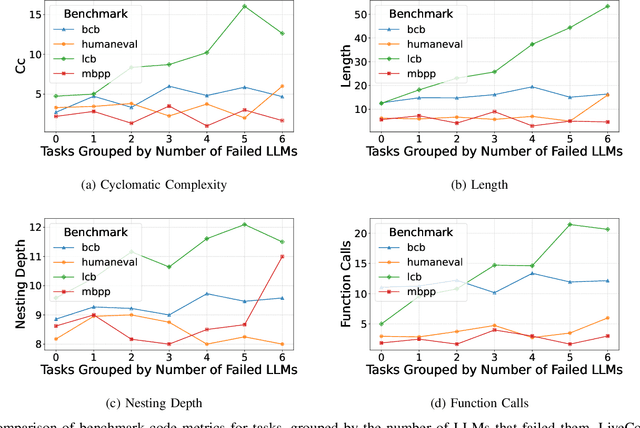
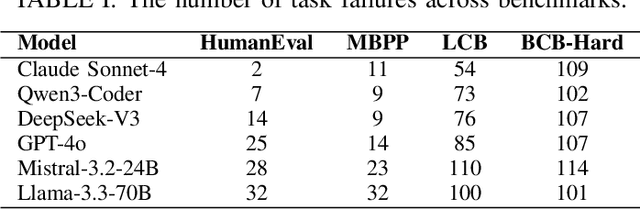

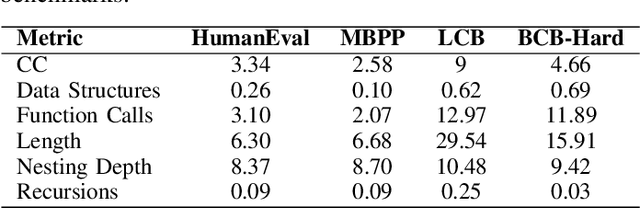
Large Language Models (LLMs) have achieved remarkable success in code generation, and the race to improve their performance has become a central focus of AI research. Benchmarks and leaderboards are increasingly popular, offering quantitative rankings of LLMs. However, they provide limited insight into the tasks that LLMs consistently fail to solve - information that is crucial for understanding current limitations and guiding the development of more capable models. To address this gap, we examined code generation tasks across four popular benchmarks, identifying those that major LLMs are most likely to fail. To understand the causes of these failures, we investigated whether the static complexity of solution code contributes to them, followed by a systematic inspection of 114 tasks that LLMs consistently struggled with. Our analysis revealed four recurring patterns of weaknesses in LLMs, as well as common complications within benchmark tasks that most often lead to failure.
Towards Trustworthy AI Software Development Assistance
Dec 14, 2023It is expected that in the near future, AI software development assistants will play an important role in the software industry. However, current software development assistants tend to be unreliable, often producing incorrect, unsafe, or low-quality code. We seek to resolve these issues by introducing a holistic architecture for constructing, training, and using trustworthy AI software development assistants. In the center of the architecture, there is a foundational LLM trained on datasets representative of real-world coding scenarios and complex software architectures, and fine-tuned on code quality criteria beyond correctness. The LLM will make use of graph-based code representations for advanced semantic comprehension. We envision a knowledge graph integrated into the system to provide up-to-date background knowledge and to enable the assistant to provide appropriate explanations. Finally, a modular framework for constrained decoding will ensure that certain guarantees (e.g., for correctness and security) hold for the generated code.