 Add to Chrome
 Add to Firefox
 Add to Edge
Augmenting Dysarthric Speech Severity Assessment with MOS Supervision
Jun 17, 2026
Dysarthria is a speech disorder marked by reduced intelligibility and communicative effectiveness. Automatic utterance-level assessment of dysarthric speech can support scalable speech monitoring and therapy-related analysis. Yet training such systems is bottlenecked by the scarcity of clinically annotated dysarthric speech. This work proposes to augment dysarthric speech assessment using data from speech synthesis evaluations, specifically human-annotated utterances with Mean Opinion Score (MOS) labels from the QualiSpeech corpus. Experiments show that fine-tuning on speech synthesis assessment data consistently improves performance on both intelligibility and naturalness prediction, while joint training yields gains primarily on naturalness. These results suggest that synthesis artifacts and dysarthric speech share perceptual commonalities, and speech synthesis evaluation corpora offer a practical augmentation source that reduces reliance on scarce clinical annotations.

How Long Reasoning Chains Influence LLMs' Judgment of Answer Factuality
Apr 08, 2026Large language models (LLMs) has been widely adopted as a scalable surrogate for human evaluation, yet such judges remain imperfect and susceptible to surface-level biases. One possible reason is that these judges lack sufficient information in assessing answer correctness. With the rise of reasoning-capable models, exposing a generator's reasoning content to the judge provides richer information and is a natural candidate for improving judgment accuracy. However, its actual impact on judge behavior remains understudied. In this paper, we systematically investigate how access to reasoning chains affects LLM-based judgment across factual question answering (QA) and mathematical reasoning benchmarks. We find that weak judges are easily swayed by reasoning presence, frequently accepting incorrect answers accompanied by fluent reasoning, while strong judges can partially leverage reasoning as informative evidence. Nevertheless, even strong judges are misled by seemingly high-quality reasoning chains. Controlled experiments further reveal that both fluency and factuality of reasoning chains are critical signals driving judge decisions. These findings highlight the need for more robust LLM judges that can distinguish genuine reasoning quality from superficial fluency when evaluating modern reasoning models.
Unleashing the Power of Continual Learning on Non-Centralized Devices: A Survey
Dec 18, 2024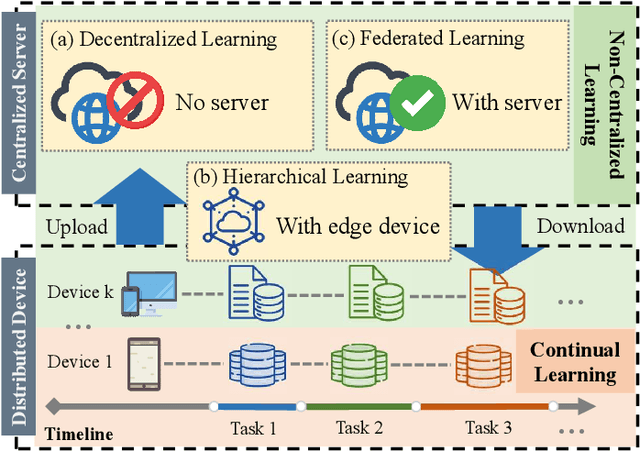
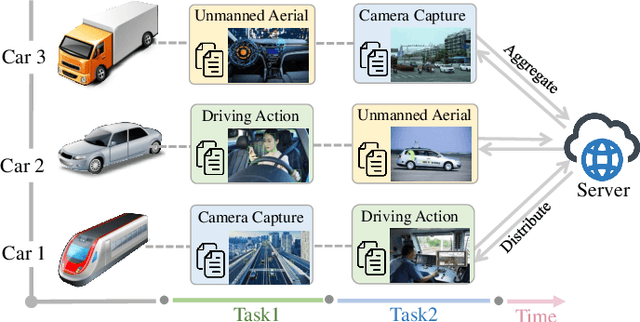
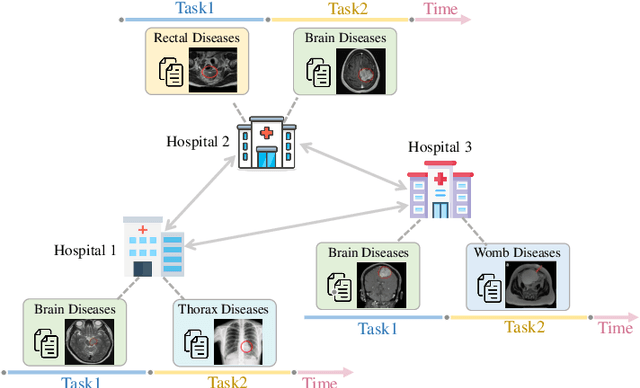
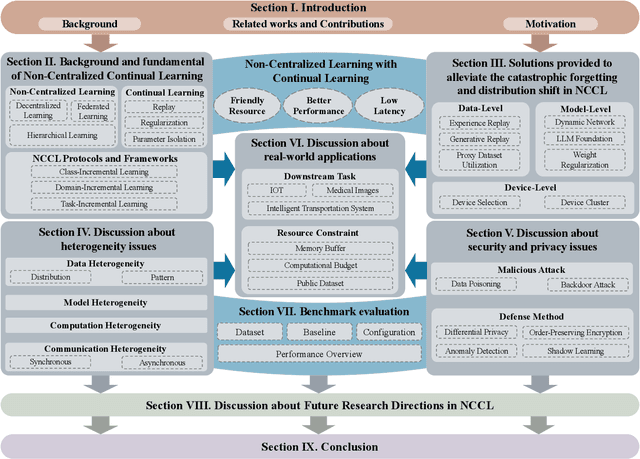
Non-Centralized Continual Learning (NCCL) has become an emerging paradigm for enabling distributed devices such as vehicles and servers to handle streaming data from a joint non-stationary environment. To achieve high reliability and scalability in deploying this paradigm in distributed systems, it is essential to conquer challenges stemming from both spatial and temporal dimensions, manifesting as distribution shifts, catastrophic forgetting, heterogeneity, and privacy issues. This survey focuses on a comprehensive examination of the development of the non-centralized continual learning algorithms and the real-world deployment across distributed devices. We begin with an introduction to the background and fundamentals of non-centralized learning and continual learning. Then, we review existing solutions from three levels to represent how existing techniques alleviate the catastrophic forgetting and distribution shift. Additionally, we delve into the various types of heterogeneity issues, security, and privacy attributes, as well as real-world applications across three prevalent scenarios. Furthermore, we establish a large-scale benchmark to revisit this problem and analyze the performance of the state-of-the-art NCCL approaches. Finally, we discuss the important challenges and future research directions in NCCL.