 Add to Chrome
 Add to Firefox
 Add to Edge
HOBBIT: A Mixed Precision Expert Offloading System for Fast MoE Inference
Nov 03, 2024
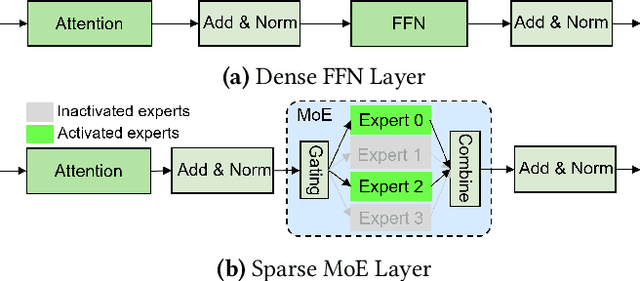
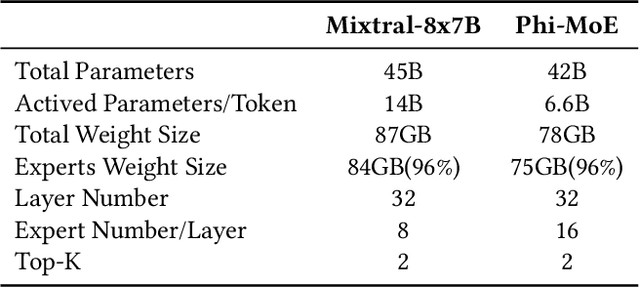
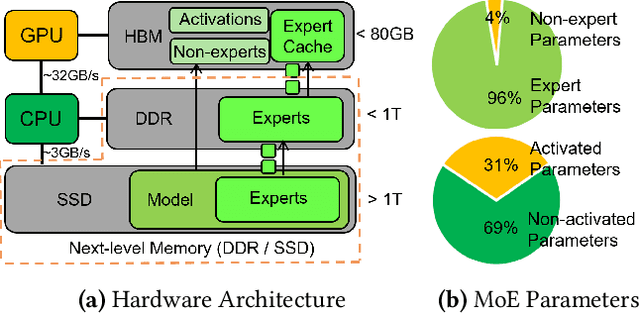
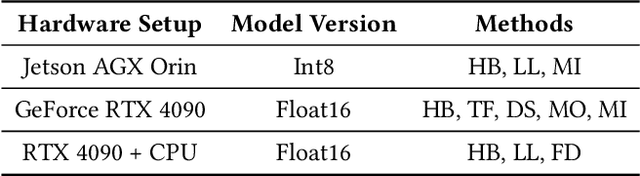
The Mixture-of-Experts (MoE) architecture has demonstrated significant advantages in the era of Large Language Models (LLMs), offering enhanced capabilities with reduced inference costs. However, deploying MoE-based LLMs on memoryconstrained edge devices remains challenging due to their substantial memory requirements. While existing expertoffloading methods alleviate the memory requirements, they often incur significant expert-loading costs or compromise model accuracy. We present HOBBIT, a mixed precision expert offloading system to enable flexible and efficient MoE inference. Our key insight is that dynamically replacing less critical cache-miss experts with low precision versions can substantially reduce expert-loading latency while preserving model accuracy. HOBBIT introduces three innovative techniques that map the natural hierarchy of MoE computation: (1) a token-level dynamic expert loading mechanism, (2) a layer-level adaptive expert prefetching technique, and (3) a sequence-level multidimensional expert caching policy. These innovations fully leverage the benefits of mixedprecision expert inference. By implementing HOBBIT on top of the renowned LLM inference framework Llama.cpp, we evaluate its performance across different edge devices with representative MoE models. The results demonstrate that HOBBIT achieves up to a 9.93x speedup in decoding compared to state-of-the-art MoE offloading systems.

SparseTem: Boosting the Efficiency of CNN-Based Video Encoders by Exploiting Temporal Continuity
Oct 28, 2024Deep learning models have become pivotal in the field of video processing and is increasingly critical in practical applications such as autonomous driving and object detection. Although Vision Transformers (ViTs) have demonstrated their power, Convolutional Neural Networks (CNNs) remain a highly efficient and high-performance choice for feature extraction and encoding. However, the intensive computational demands of convolution operations hinder its broader adoption as a video encoder. Given the inherent temporal continuity in video frames, changes between consecutive frames are minimal, allowing for the skipping of redundant computations. This technique, which we term as Diff Computation, presents two primary challenges. First, Diff Computation requires to cache intermediate feature maps to ensure the correctness of non-linear computations, leading to significant memory consumption. Second, the imbalance of sparsity among layers, introduced by Diff Computation, incurs accuracy degradation. To address these issues, we propose a memory-efficient scheduling method to eliminate memory overhead and an online adjustment mechanism to minimize accuracy degradation. We integrate these techniques into our framework, SparseTem, to seamlessly support various CNN-based video encoders. SparseTem achieves speedup of 1.79x for EfficientDet and 4.72x for CRNN, with minimal accuracy drop and no additional memory overhead. Extensive experimental results demonstrate that SparseTem sets a new state-of-the-art by effectively utilizing temporal continuity to accelerate CNN-based video encoders.
vTensor: Flexible Virtual Tensor Management for Efficient LLM Serving
Jul 22, 2024
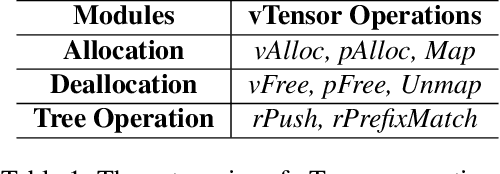
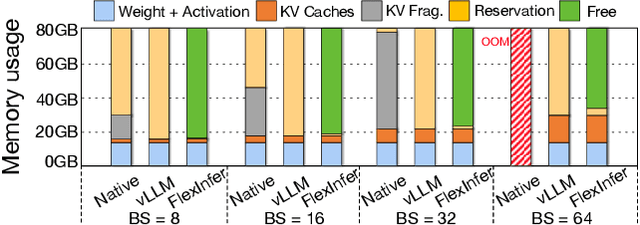

Large Language Models (LLMs) are widely used across various domains, processing millions of daily requests. This surge in demand poses significant challenges in optimizing throughput and latency while keeping costs manageable. The Key-Value (KV) cache, a standard method for retaining previous computations, makes LLM inference highly bounded by memory. While batching strategies can enhance performance, they frequently lead to significant memory fragmentation. Even though cutting-edge systems like vLLM mitigate KV cache fragmentation using paged Attention mechanisms, they still suffer from inefficient memory and computational operations due to the tightly coupled page management and computation kernels. This study introduces the vTensor, an innovative tensor structure for LLM inference based on GPU virtual memory management (VMM). vTensor addresses existing limitations by decoupling computation from memory defragmentation and offering dynamic extensibility. Our framework employs a CPU-GPU heterogeneous approach, ensuring efficient, fragmentation-free memory management while accommodating various computation kernels across different LLM architectures. Experimental results indicate that vTensor achieves an average speedup of 1.86x across different models, with up to 2.42x in multi-turn chat scenarios. Additionally, vTensor provides average speedups of 2.12x and 3.15x in kernel evaluation, reaching up to 3.92x and 3.27x compared to SGLang Triton prefix-prefilling kernels and vLLM paged Attention kernel, respectively. Furthermore, it frees approximately 71.25% (57GB) of memory on the NVIDIA A100 GPU compared to vLLM, enabling more memory-intensive workloads.
AutoVCoder: A Systematic Framework for Automated Verilog Code Generation using LLMs
Jul 21, 2024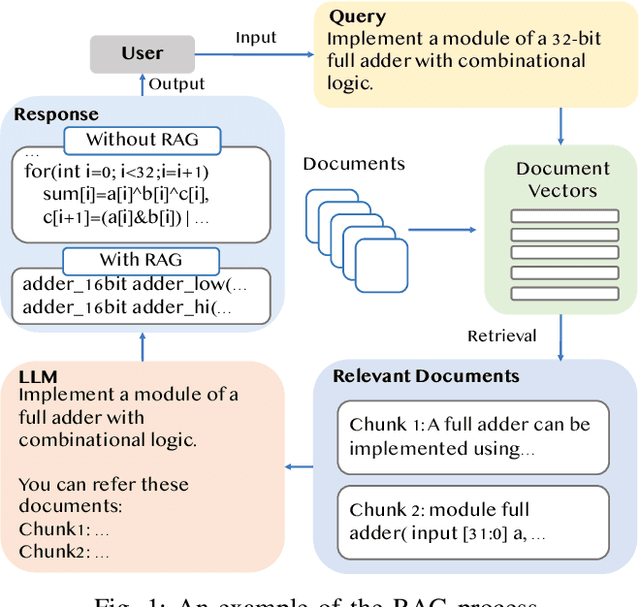
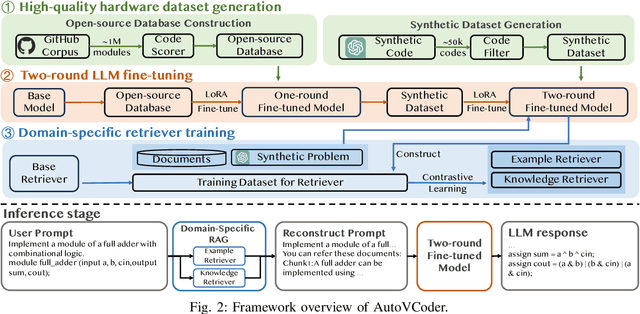

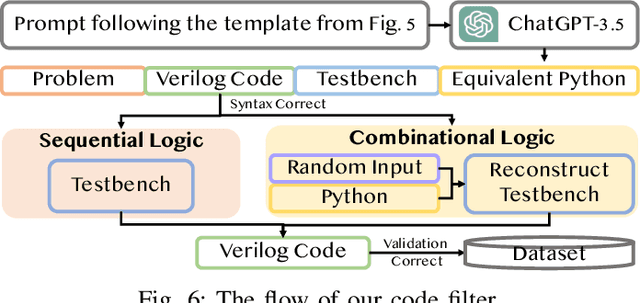
Recently, the use of large language models (LLMs) for software code generation, e.g., C/C++ and Python, has proven a great success. However, LLMs still suffer from low syntactic and functional correctness when it comes to the generation of register-transfer level (RTL) code, such as Verilog. To address this issue, in this paper, we develop AutoVCoder, a systematic open-source framework that significantly improves the LLMs' correctness of generating Verilog code and enhances the quality of its output at the same time. Our framework integrates three novel techniques, including a high-quality hardware dataset generation approach, a two-round LLM fine-tuning method and a domain-specific retrieval-augmented generation (RAG) mechanism. Experimental results demonstrate that AutoVCoder outperforms both industrial and academic LLMs in Verilog code generation. Specifically, AutoVCoder shows a 0.5% and 2.2% improvement in functional correctness on the EvalMachine and EvalHuman benchmarks compared with BetterV, and also achieves a 3.4% increase in syntax correctness and a 3.4% increase in functional correctness on the RTLLM benchmark compared with RTLCoder.
SimGen: Simulator-conditioned Driving Scene Generation
Jun 13, 2024


Controllable synthetic data generation can substantially lower the annotation cost of training data in autonomous driving research and development. Prior works use diffusion models to generate driving images conditioned on the 3D object layout. However, those models are trained on small-scale datasets like nuScenes, which lack appearance and layout diversity. Moreover, the trained models can only generate images based on the real-world layout data from the validation set of the same dataset, where overfitting might happen. In this work, we introduce a simulator-conditioned scene generation framework called SimGen that can learn to generate diverse driving scenes by mixing data from the simulator and the real world. It uses a novel cascade diffusion pipeline to address challenging sim-to-real gaps and multi-condition conflicts. A driving video dataset DIVA is collected to enhance the generative diversity of SimGen, which contains over 147.5 hours of real-world driving videos from 73 locations worldwide and simulated driving data from the MetaDrive simulator. SimGen achieves superior generation quality and diversity while preserving controllability based on the text prompt and the layout pulled from a simulator. We further demonstrate the improvements brought by SimGen for synthetic data augmentation on the BEV detection and segmentation task and showcase its capability in safety-critical data generation. Code, data, and models will be made available.
A Codesign of Scheduling and Parallelization for Large Model Training in Heterogeneous Clusters
Mar 24, 2024Joint consideration of scheduling and adaptive parallelism offers great opportunities for improving the training efficiency of large models on heterogeneous GPU clusters. However, integrating adaptive parallelism into a cluster scheduler expands the cluster scheduling space. The new space is the product of the original scheduling space and the parallelism exploration space of adaptive parallelism (also a product of pipeline, data, and tensor parallelism). The exponentially enlarged scheduling space and ever-changing optimal parallelism plan from adaptive parallelism together result in the contradiction between low-overhead and accurate performance data acquisition for efficient cluster scheduling. This paper presents Crius, a training system for efficiently scheduling multiple large models with adaptive parallelism in a heterogeneous cluster. Crius proposes a novel scheduling granularity called Cell. It represents a job with deterministic resources and pipeline stages. The exploration space of Cell is shrunk to the product of only data and tensor parallelism, thus exposing the potential for accurate and low-overhead performance estimation. Crius then accurately estimates Cells and efficiently schedules training jobs. When a Cell is selected as a scheduling choice, its represented job runs with the optimal parallelism plan explored. Experimental results show that Crius reduces job completion time by up to 48.9% and schedules large models with up to 1.49x cluster throughput improvement.
Embodied Understanding of Driving Scenarios
Mar 07, 2024

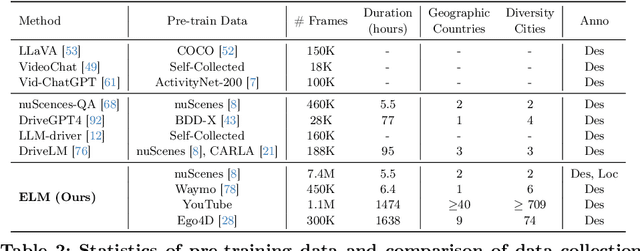
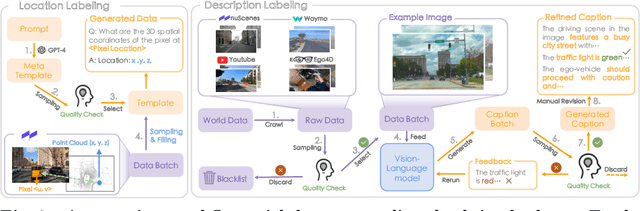
Embodied scene understanding serves as the cornerstone for autonomous agents to perceive, interpret, and respond to open driving scenarios. Such understanding is typically founded upon Vision-Language Models (VLMs). Nevertheless, existing VLMs are restricted to the 2D domain, devoid of spatial awareness and long-horizon extrapolation proficiencies. We revisit the key aspects of autonomous driving and formulate appropriate rubrics. Hereby, we introduce the Embodied Language Model (ELM), a comprehensive framework tailored for agents' understanding of driving scenes with large spatial and temporal spans. ELM incorporates space-aware pre-training to endow the agent with robust spatial localization capabilities. Besides, the model employs time-aware token selection to accurately inquire about temporal cues. We instantiate ELM on the reformulated multi-faced benchmark, and it surpasses previous state-of-the-art approaches in all aspects. All code, data, and models will be publicly shared.
Extend Your Own Correspondences: Unsupervised Distant Point Cloud Registration by Progressive Distance Extension
Mar 06, 2024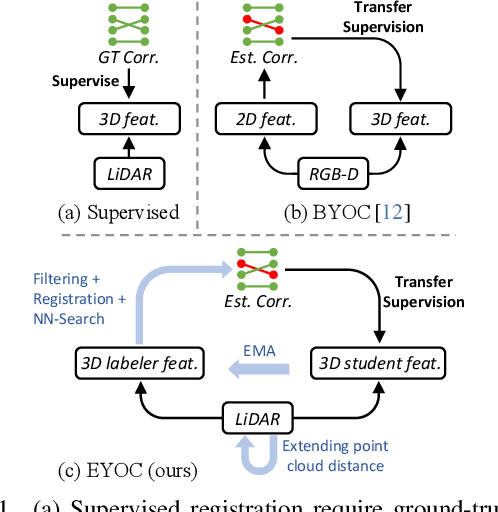
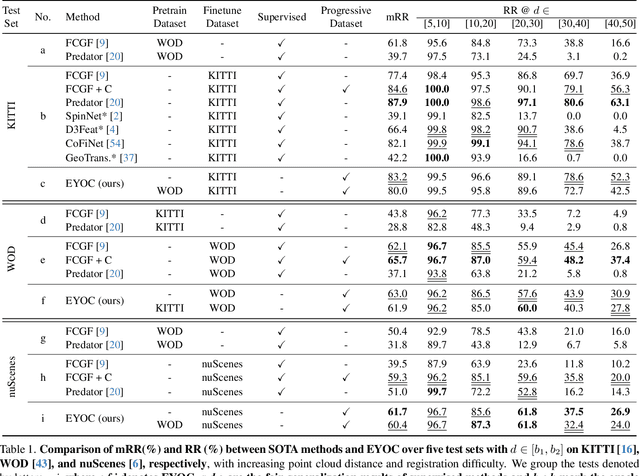
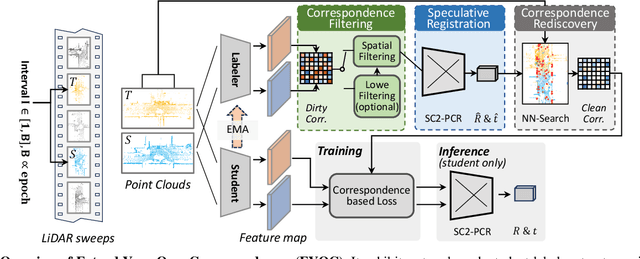
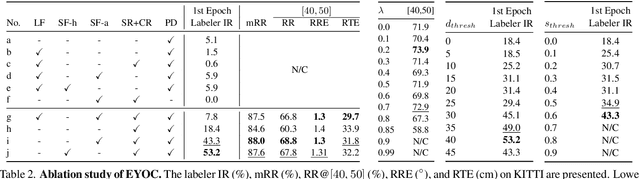
Registration of point clouds collected from a pair of distant vehicles provides a comprehensive and accurate 3D view of the driving scenario, which is vital for driving safety related applications, yet existing literature suffers from the expensive pose label acquisition and the deficiency to generalize to new data distributions. In this paper, we propose EYOC, an unsupervised distant point cloud registration method that adapts to new point cloud distributions on the fly, requiring no global pose labels. The core idea of EYOC is to train a feature extractor in a progressive fashion, where in each round, the feature extractor, trained with near point cloud pairs, can label slightly farther point cloud pairs, enabling self-supervision on such far point cloud pairs. This process continues until the derived extractor can be used to register distant point clouds. Particularly, to enable high-fidelity correspondence label generation, we devise an effective spatial filtering scheme to select the most representative correspondences to register a point cloud pair, and then utilize the aligned point clouds to discover more correct correspondences. Experiments show that EYOC can achieve comparable performance with state-of-the-art supervised methods at a lower training cost. Moreover, it outwits supervised methods regarding generalization performance on new data distributions.
Hierarchical Source-to-Post-Route QoR Prediction in High-Level Synthesis with GNNs
Jan 14, 2024

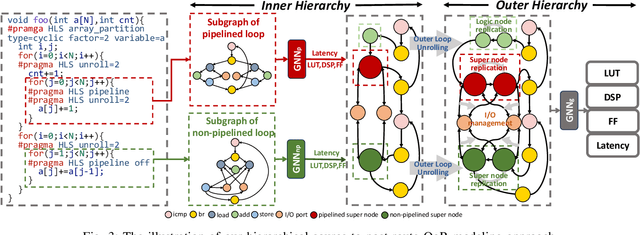

High-level synthesis (HLS) notably speeds up the hardware design process by avoiding RTL programming. However, the turnaround time of HLS increases significantly when post-route quality of results (QoR) are considered during optimization. To tackle this issue, we propose a hierarchical post-route QoR prediction approach for FPGA HLS, which features: (1) a modeling flow that directly estimates latency and post-route resource usage from C/C++ programs; (2) a graph construction method that effectively represents the control and data flow graph of source code and effects of HLS pragmas; and (3) a hierarchical GNN training and prediction method capable of capturing the impact of loop hierarchies. Experimental results show that our method presents a prediction error of less than 10% for different types of QoR metrics, which gains tremendous improvement compared with the state-of-the-art GNN methods. By adopting our proposed methodology, the runtime for design space exploration in HLS is shortened to tens of minutes and the achieved ADRS is reduced to 6.91% on average.
STAG: Enabling Low Latency and Low Staleness of GNN-based Services with Dynamic Graphs
Sep 27, 2023Many emerging user-facing services adopt Graph Neural Networks (GNNs) to improve serving accuracy. When the graph used by a GNN model changes, representations (embedding) of nodes in the graph should be updated accordingly. However, the node representation update is too slow, resulting in either long response latency of user queries (the inference is performed after the update completes) or high staleness problem (the inference is performed based on stale data). Our in-depth analysis shows that the slow update is mainly due to neighbor explosion problem in graphs and duplicated computation. Based on such findings, we propose STAG, a GNN serving framework that enables low latency and low staleness of GNN-based services. It comprises a collaborative serving mechanism and an additivity-based incremental propagation strategy. With the collaborative serving mechanism, only part of node representations are updated during the update phase, and the final representations are calculated in the inference phase. It alleviates the neighbor explosion problem. The additivity-based incremental propagation strategy reuses intermediate data during the update phase, eliminating duplicated computation problem. Experimental results show that STAG accelerates the update phase by 1.3x~90.1x, and greatly reduces staleness time with a slight increase in response latency.