 Add to Chrome
 Add to Firefox
 Add to Edge
On Token's Dilemma: Dynamic MoE with Drift-Aware Token Assignment for Continual Learning of Large Vision Language Models
Mar 29, 2026
Multimodal Continual Instruction Tuning aims to continually enhance Large Vision Language Models (LVLMs) by learning from new data without forgetting previously acquired knowledge. Mixture of Experts (MoE) architectures naturally facilitate this by incrementally adding new experts and expanding routers while keeping the existing ones frozen. However, despite expert isolation, MoE-based continual learners still suffer from forgetting due to routing-drift: old-task tokens become mistakenly attracted to newly added experts, degrading performance on prior tasks. We analyze the failure mode at the token level and reveal the token's dilemma: ambiguous and old tokens in new-task data offer minimal learning benefit yet induce forgetting when routed to new experts, due to their ambiguous routing assignment during training. Motivated by this, we propose LLaVA-DyMoE, a dynamic MoE framework that incrementally expands the MoE with drift-aware token assignment. We characterize token types via their routing score distributions and apply targeted regularization. Specifically, a token-level assignment guidance steers ambiguous and old tokens away from new experts to preserve established routing patterns and alleviate routing-drift, while complementary routing score regularizations enforce expert-group separation and promote new-expert specialization. Extensive experiments demonstrate that our LLaVA-DyMoE effectively mitigates routing-drift-induced forgetting, achieving over a 7% gain in mean final accuracy and a 12% reduction in forgetting compared to baselines. The project page is https://zhaoc5.github.io/DyMoE.

MultiEdit: Advancing Instruction-based Image Editing on Diverse and Challenging Tasks
Sep 18, 2025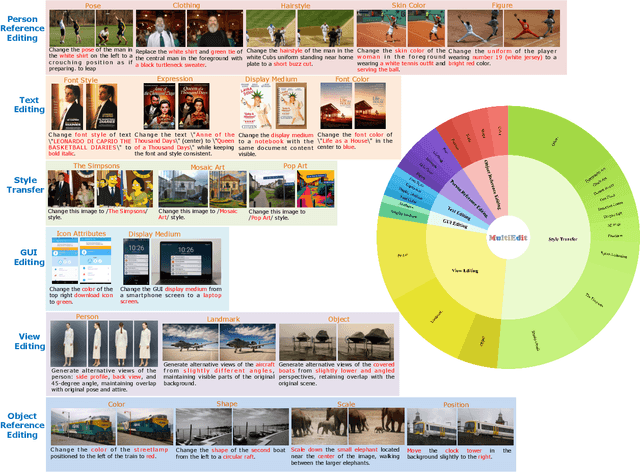
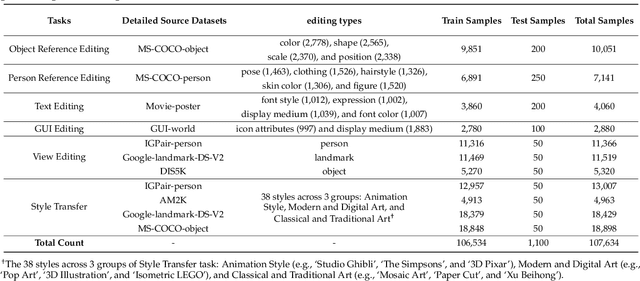
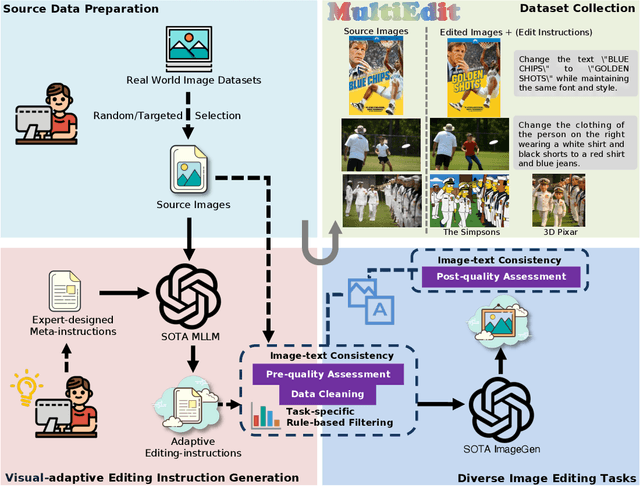
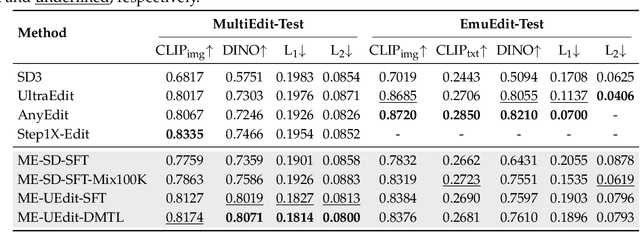
Current instruction-based image editing (IBIE) methods struggle with challenging editing tasks, as both editing types and sample counts of existing datasets are limited. Moreover, traditional dataset construction often contains noisy image-caption pairs, which may introduce biases and limit model capabilities in complex editing scenarios. To address these limitations, we introduce MultiEdit, a comprehensive dataset featuring over 107K high-quality image editing samples. It encompasses 6 challenging editing tasks through a diverse collection of 18 non-style-transfer editing types and 38 style transfer operations, covering a spectrum from sophisticated style transfer to complex semantic operations like person reference editing and in-image text editing. We employ a novel dataset construction pipeline that utilizes two multi-modal large language models (MLLMs) to generate visual-adaptive editing instructions and produce high-fidelity edited images, respectively. Extensive experiments demonstrate that fine-tuning foundational open-source models with our MultiEdit-Train set substantially improves models' performance on sophisticated editing tasks in our proposed MultiEdit-Test benchmark, while effectively preserving their capabilities on the standard editing benchmark. We believe MultiEdit provides a valuable resource for advancing research into more diverse and challenging IBIE capabilities. Our dataset is available at https://huggingface.co/datasets/inclusionAI/MultiEdit.
Local-Global Transformer Enhanced Unfolding Network for Pan-sharpening
Apr 28, 2023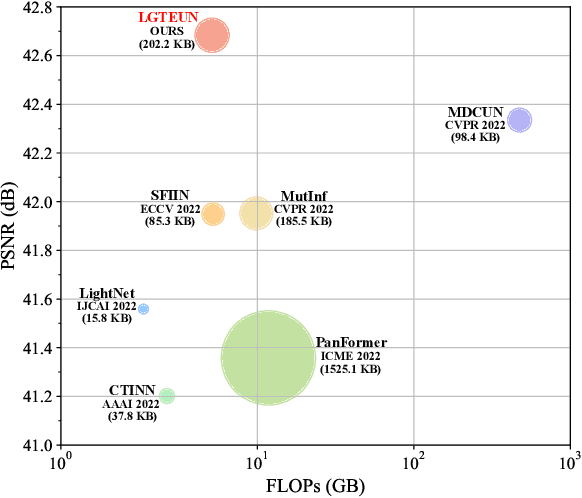
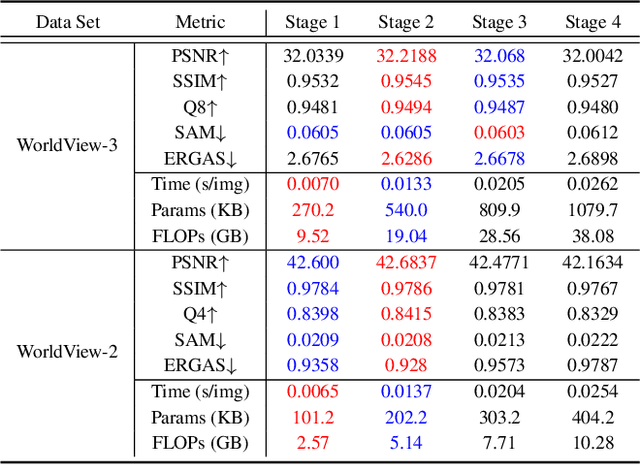

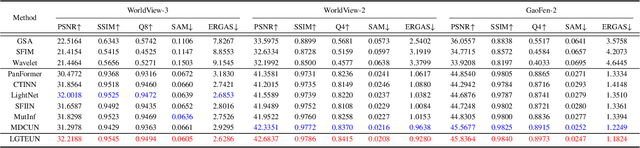
Pan-sharpening aims to increase the spatial resolution of the low-resolution multispectral (LrMS) image with the guidance of the corresponding panchromatic (PAN) image. Although deep learning (DL)-based pan-sharpening methods have achieved promising performance, most of them have a two-fold deficiency. For one thing, the universally adopted black box principle limits the model interpretability. For another thing, existing DL-based methods fail to efficiently capture local and global dependencies at the same time, inevitably limiting the overall performance. To address these mentioned issues, we first formulate the degradation process of the high-resolution multispectral (HrMS) image as a unified variational optimization problem, and alternately solve its data and prior subproblems by the designed iterative proximal gradient descent (PGD) algorithm. Moreover, we customize a Local-Global Transformer (LGT) to simultaneously model local and global dependencies, and further formulate an LGT-based prior module for image denoising. Besides the prior module, we also design a lightweight data module. Finally, by serially integrating the data and prior modules in each iterative stage, we unfold the iterative algorithm into a stage-wise unfolding network, Local-Global Transformer Enhanced Unfolding Network (LGTEUN), for the interpretable MS pan-sharpening. Comprehensive experimental results on three satellite data sets demonstrate the effectiveness and efficiency of LGTEUN compared with state-of-the-art (SOTA) methods. The source code is available at https://github.com/lms-07/LGTEUN.