 Add to Chrome
 Add to Firefox
 Add to Edge
BAG: Budget-Aware Gating for Diffusion Caching
Aug 10, 2026
Diffusion caching is a lightweight strategy that accelerates Diffusion Transformers (DiTs) by reusing intermediate features across denoising steps, but existing paradigms face a fundamental trade-off: online heuristics lack global budget awareness, whereas static schedules lack instance adaptivity and fail to flexibly adapt to varying runtime budget constraints. To bridge this gap, we present BAG (Budget-Aware Gating), a novel caching policy that unifies global budget pacing with dynamic, instance-adaptive feature reuse. Rather than relying on hand-crafted rules, BAG employs a lightweight gating network that dynamically decides whether to execute a full computation or reuse cached features at each step by jointly conditioning on the budget state and local trajectory feedback. We train this policy via offline-to-online schedule distillation, transferring the decision-making of offline-searched schedules into a compact online gate. Extensive experiments on FLUX.1-dev and Wan2.1 demonstrate that BAG consistently outperforms state-of-the-art caching methods across various speedup tiers while remaining robust across different resolutions, seeds, and guidance scales. Code will be released.

Budget-Constrained Step-Level Diffusion Caching
Jun 11, 2026Step-level caching accelerates diffusion models by exploiting temporal redundancy across denoising steps. Existing methods make per-step cache decisions using threshold-based heuristics, without directly optimizing for final output quality. As a result, their inference latency varies across inputs and is difficult to control at deployment. In this work, we propose BudCache, which inverts this formulation: rather than letting per-step error thresholds dictate the runtime cost, we fix the compute budget in advance and search for the cache policy that best preserves the final output. To tackle the combinatorial complexity of step selection, we combine Simulated Annealing with deterministic Hill Climbing. This offline search identifies high-quality cache policies within minutes and introduces no online search or thresholding overhead during inference. When the compute budget is very tight, we further introduce cache-aware schedule alignment, which adapts the time discretization to the selected cache policy to reduce cache-induced trajectory mismatch. Experiments on FLUX.1-dev and Wan2.1 show that BudCache achieves better generation quality than heuristic caching baselines under the same inference budgets. Code is available at https://github.com/Westlake-AGI-Lab/BudCache
Improving Diffusion Generalization with Weak-to-Strong Segmented Guidance
Mar 21, 2026Diffusion models generate synthetic images through an iterative refinement process. However, the misalignment between the simulation-free objective and the iterative process often causes accumulated gradient error along the sampling trajectory, which leads to unsatisfactory results and a failure to generalize. Guidance techniques like Classifier Free Guidance (CFG) and AutoGuidance (AG) alleviate this by extrapolating between the main and inferior signal for stronger generalization. Despite empirical success, the effective operational regimes of prevalent guidance methods are still under-explored, leading to ambiguity when selecting the appropriate guidance method given a precondition. In this work, we first conduct synthetic comparisons to isolate and demonstrate the effective regime of guidance methods represented by CFG and AG from the perspective of weak-to-strong principle. Based on this, we propose a hybrid instantiation called SGG under the principle, taking the benefits of both. Furthermore, we demonstrate that the W2S principle along with SGG can be migrated into the training objective, improving the generalization ability of unguided diffusion models. We validate our approach with comprehensive experiments. At inference time, evaluations on SD3 and SD3.5 confirm that SGG outperforms existing training-free guidance variants. Training-time experiments on transformer architectures demonstrate the effective migration and performance gains in both conditional and unconditional settings. Code is available at https://github.com/851695e35/SGG.
Few-Step Diffusion Sampling Through Instance-Aware Discretizations
Mar 18, 2026Diffusion and flow matching models generate high-fidelity data by simulating paths defined by Ordinary or Stochastic Differential Equations (ODEs/SDEs), starting from a tractable prior distribution. The probability flow ODE formulation enables the use of advanced numerical solvers to accelerate sampling. Orthogonal yet vital to solver design is the discretization strategy. While early approaches employed handcrafted heuristics and recent methods adopt optimization-based techniques, most existing strategies enforce a globally shared timestep schedule across all samples. This uniform treatment fails to account for instance-specific complexity in the generative process, potentially limiting performance. Motivated by controlled experiments on synthetic data, which reveals the suboptimality of global schedules under instance-specific dynamics, we propose an instance-aware discretization framework. Our method learns to adapt timestep allocations based on input-dependent priors, extending gradient-based discretization search to the conditional generative setting. Empirical results across diverse settings, including synthetic data, pixel-space diffusion, latent-space images and video flow matching models, demonstrate that our method consistently improves generation quality with marginal tuning cost compared to training and negligible inference overhead.
DyWeight: Dynamic Gradient Weighting for Few-Step Diffusion Sampling
Mar 12, 2026Diffusion Models (DMs) have achieved state-of-the-art generative performance across multiple modalities, yet their sampling process remains prohibitively slow due to the need for hundreds of function evaluations. Recent progress in multi-step ODE solvers has greatly improved efficiency by reusing historical gradients, but existing methods rely on handcrafted coefficients that fail to adapt to the non-stationary dynamics of diffusion sampling. To address this limitation, we propose Dynamic Gradient Weighting (DyWeight), a lightweight, learning-based multi-step solver that introduces a streamlined implicit coupling paradigm. By relaxing classical numerical constraints, DyWeight learns unconstrained time-varying parameters that adaptively aggregate historical gradients while intrinsically scaling the effective step size. This implicit time calibration accurately aligns the solver's numerical trajectory with the model's internal denoising dynamics under large integration steps, avoiding complex decoupled parameterizations and optimizations. Extensive experiments on CIFAR-10, FFHQ, AFHQv2, ImageNet64, LSUN-Bedroom, Stable Diffusion and FLUX.1-dev demonstrate that DyWeight achieves superior visual fidelity and stability with significantly fewer function evaluations, establishing a new state-of-the-art among efficient diffusion solvers. Code is available at https://github.com/Westlake-AGI-Lab/DyWeight
CleanStyle: Plug-and-Play Style Conditioning Purification for Text-to-Image Stylization
Feb 24, 2026Style transfer in diffusion models enables controllable visual generation by injecting the style of a reference image. However, recent encoder-based methods, while efficient and tuning-free, often suffer from content leakage, where semantic elements from the style image undesirably appear in the output, impairing prompt fidelity and stylistic consistency. In this work, we introduce CleanStyle, a plug-and-play framework that filters out content-related noise from the style embedding without retraining. Motivated by empirical analysis, we observe that such leakage predominantly stems from the tail components of the style embedding, which are isolated via Singular Value Decomposition (SVD). To address this, we propose CleanStyleSVD (CS-SVD), which dynamically suppresses tail components using a time-aware exponential schedule, providing clean, style-preserving conditional embeddings throughout the denoising process. Furthermore, we present Style-Specific Classifier-Free Guidance (SS-CFG), which reuses the suppressed tail components to construct style-aware unconditional inputs. Unlike conventional methods that use generic negative embeddings (e.g., zero vectors), SS-CFG introduces targeted negative signals that reflect style-specific but prompt-irrelevant visual elements. This enables the model to effectively suppress these distracting patterns during generation, thereby improving prompt fidelity and enhancing the overall visual quality of stylized outputs. Our approach is lightweight, interpretable, and can be seamlessly integrated into existing encoder-based diffusion models without retraining. Extensive experiments demonstrate that CleanStyle substantially reduces content leakage, improves stylization quality and improves prompt alignment across a wide range of style references and prompts.
StyleStudio: Text-Driven Style Transfer with Selective Control of Style Elements
Dec 11, 2024
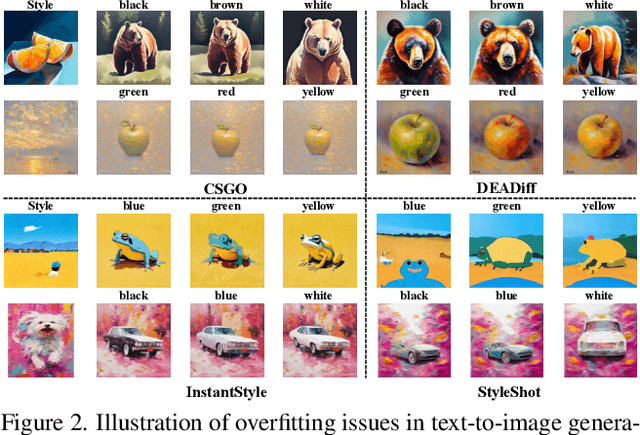
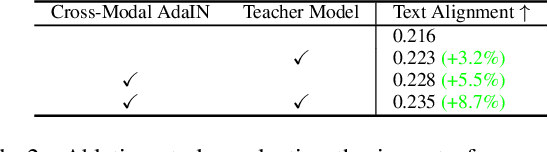
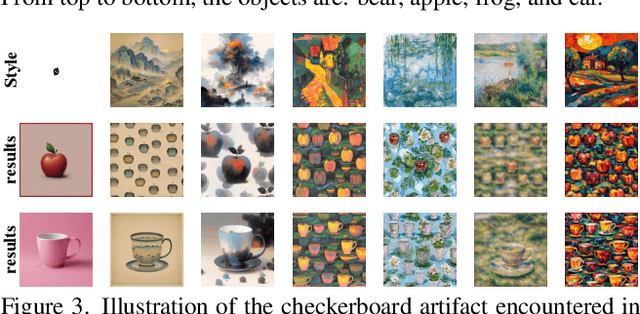
Text-driven style transfer aims to merge the style of a reference image with content described by a text prompt. Recent advancements in text-to-image models have improved the nuance of style transformations, yet significant challenges remain, particularly with overfitting to reference styles, limiting stylistic control, and misaligning with textual content. In this paper, we propose three complementary strategies to address these issues. First, we introduce a cross-modal Adaptive Instance Normalization (AdaIN) mechanism for better integration of style and text features, enhancing alignment. Second, we develop a Style-based Classifier-Free Guidance (SCFG) approach that enables selective control over stylistic elements, reducing irrelevant influences. Finally, we incorporate a teacher model during early generation stages to stabilize spatial layouts and mitigate artifacts. Our extensive evaluations demonstrate significant improvements in style transfer quality and alignment with textual prompts. Furthermore, our approach can be integrated into existing style transfer frameworks without fine-tuning.