 Add to Chrome
 Add to Firefox
 Add to Edge
AffordanceVLA: A Vision-Language-Action Model Empowering Action Generation through Affordance-Aware Understanding
Jun 04, 2026
Vision-Language-Action (VLA) models leverage the rich world knowledge of pretrained vision-language models (VLMs) to enable instruction-following robotic manipulation. However, the structural mismatch between VLM semantic spaces and embodied control policies often hinders the learning of precise perception--action mappings. To address this challenge, we propose \textbf{AffordanceVLA}, a unified framework that introduces structured affordance forecasting as a task-oriented intermediate representation to establish a more precise and robust perception--action mapping. Specifically, we progressively model manipulation priors through three complementary components: 1) \textbf{Which2Act} for object-centric grounding via visual latent prediction to suppress distractions; 2) \textbf{Where2Act} for 2D interaction localization via affordance map estimation; and 3) \textbf{How2Act} for 3D geometric reasoning to guide manipulation policies. These affordance cues provide spatially grounded, semantically conditioned, and action-coupled intermediate representations, thereby naturally bridging vision, language and action. We integrate these modules into a Mixture-of-Transformer (MoT) architecture with specialized experts and train the model using a three-stage training strategy with a progressive data curriculum. To overcome the scarcity of dense affordance labels in robotic datasets, we also develop a robust automated data augmentation pipeline. Extensive experiments on simulation and real-world demonstrate that AffordanceVLA achieves strong performance across diverse manipulation scenarios.

X-Stream: Exploring MLLMs as Multiplexers for Multi-Stream Understanding
Jun 01, 2026While video streaming understanding has made significant strides, real-world applications, such as live sports broadcasting, autonomous driving, and multi-screen collaboration, inherently demand continuous, multi-stream interactions. However, existing benchmarks are confined to single-stream paradigms, leaving a critical gap in evaluating online, cross-stream reasoning. To bridge this, we introduce X-Stream, the first benchmark dedicated to multi-stream streaming understanding. Comprising 4,220 rigorously curated QA pairs across 932 videos, X-Stream evaluates 11 subtasks across multi-window, multi-view, and multi-device scenarios. Crucially, our dataset is constructed using a novel dual-verification pipeline that prevents over-reliance on a single stream. Furthermore, we pioneer the conceptualization of multi-modal large language models (MLLMs) as naive multiplexers, systematically evaluating their performance through the lens of Signal Multiplexing Theory. Our extensive online inference experiments reveal a stark reality: state-of-the-art MLLMs struggle significantly with concurrent streams, achieving only about 50% score and exhibiting poor proactive ability. Ultimately, X-Stream exposes the trade-off of current multiplexing schemes, providing both a practical evaluation protocol and empirical guidance for next-generation multi-stream agents.
In-Context Audio Control of Video Diffusion Transformers
Dec 21, 2025Recent advancements in video generation have seen a shift towards unified, transformer-based foundation models that can handle multiple conditional inputs in-context. However, these models have primarily focused on modalities like text, images, and depth maps, while strictly time-synchronous signals like audio have been underexplored. This paper introduces In-Context Audio Control of video diffusion transformers (ICAC), a framework that investigates the integration of audio signals for speech-driven video generation within a unified full-attention architecture, akin to FullDiT. We systematically explore three distinct mechanisms for injecting audio conditions: standard cross-attention, 2D self-attention, and unified 3D self-attention. Our findings reveal that while 3D attention offers the highest potential for capturing spatio-temporal audio-visual correlations, it presents significant training challenges. To overcome this, we propose a Masked 3D Attention mechanism that constrains the attention pattern to enforce temporal alignment, enabling stable training and superior performance. Our experiments demonstrate that this approach achieves strong lip synchronization and video quality, conditioned on an audio stream and reference images.
DebiasDiff: Debiasing Text-to-image Diffusion Models with Self-discovering Latent Attribute Directions
Dec 25, 2024While Diffusion Models (DM) exhibit remarkable performance across various image generative tasks, they nonetheless reflect the inherent bias presented in the training set. As DMs are now widely used in real-world applications, these biases could perpetuate a distorted worldview and hinder opportunities for minority groups. Existing methods on debiasing DMs usually requires model re-training with a human-crafted reference dataset or additional classifiers, which suffer from two major limitations: (1) collecting reference datasets causes expensive annotation cost; (2) the debiasing performance is heavily constrained by the quality of the reference dataset or the additional classifier. To address the above limitations, we propose DebiasDiff, a plug-and-play method that learns attribute latent directions in a self-discovering manner, thus eliminating the reliance on such reference dataset. Specifically, DebiasDiff consists of two parts: a set of attribute adapters and a distribution indicator. Each adapter in the set aims to learn an attribute latent direction, and is optimized via noise composition through a self-discovering process. Then, the distribution indicator is multiplied by the set of adapters to guide the generation process towards the prescribed distribution. Our method enables debiasing multiple attributes in DMs simultaneously, while remaining lightweight and easily integrable with other DMs, eliminating the need for re-training. Extensive experiments on debiasing gender, racial, and their intersectional biases show that our method outperforms previous SOTA by a large margin.
DiTCtrl: Exploring Attention Control in Multi-Modal Diffusion Transformer for Tuning-Free Multi-Prompt Longer Video Generation
Dec 24, 2024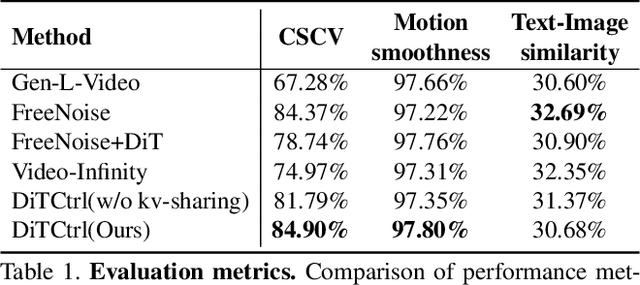
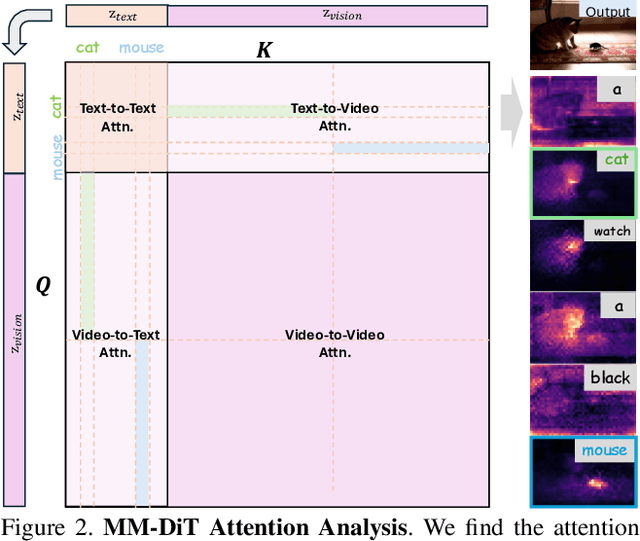
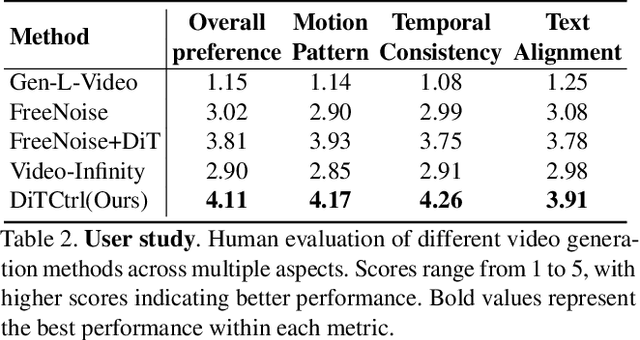
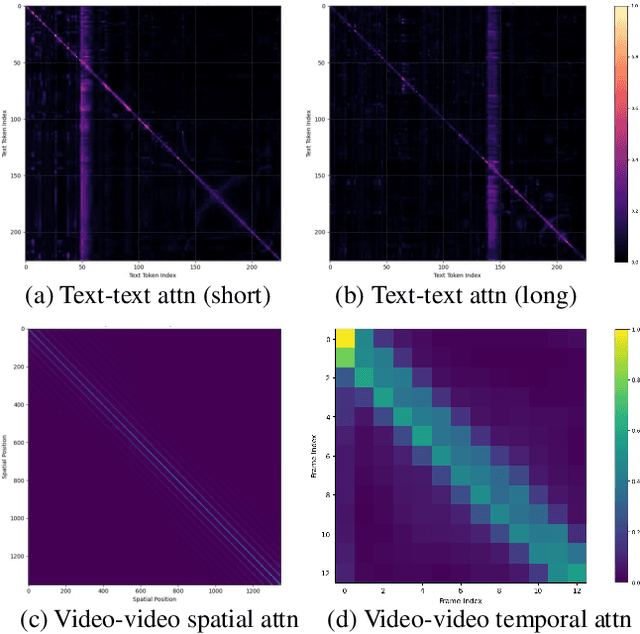
Sora-like video generation models have achieved remarkable progress with a Multi-Modal Diffusion Transformer MM-DiT architecture. However, the current video generation models predominantly focus on single-prompt, struggling to generate coherent scenes with multiple sequential prompts that better reflect real-world dynamic scenarios. While some pioneering works have explored multi-prompt video generation, they face significant challenges including strict training data requirements, weak prompt following, and unnatural transitions. To address these problems, we propose DiTCtrl, a training-free multi-prompt video generation method under MM-DiT architectures for the first time. Our key idea is to take the multi-prompt video generation task as temporal video editing with smooth transitions. To achieve this goal, we first analyze MM-DiT's attention mechanism, finding that the 3D full attention behaves similarly to that of the cross/self-attention blocks in the UNet-like diffusion models, enabling mask-guided precise semantic control across different prompts with attention sharing for multi-prompt video generation. Based on our careful design, the video generated by DiTCtrl achieves smooth transitions and consistent object motion given multiple sequential prompts without additional training. Besides, we also present MPVBench, a new benchmark specially designed for multi-prompt video generation to evaluate the performance of multi-prompt generation. Extensive experiments demonstrate that our method achieves state-of-the-art performance without additional training.