 Add to Chrome
 Add to Firefox
 Add to Edge
Adam-SHANG: A Convergent Adam-Type Method for Stochastic Smooth Convex Optimization
May 13, 2026
We propose Adam-SHANG, a Lyapunov-guided Adam-type method that couples momentum, adaptive preconditioning, and a curvature-aware correction through a more stable lagged-preconditioner update. For stochastic smooth convex optimization, we prove convergence in expectation under an admissible stepsize condition that can always be satisfied by a conservative spectral bound, without imposing global monotonicity on the second-moment sequence. To obtain a less conservative practical rule, we introduce a computable trace-ratio stepsize, motivated by a local coordinatewise alignment condition. The same structural update is also tested beyond the convex setting with simplified parameters. Experiments validate the predicted stochastic decay and show competitive training performance against Adam and AdamW on deep learning tasks.

Improved physics-informed neural network in mitigating gradient related failures
Jul 28, 2024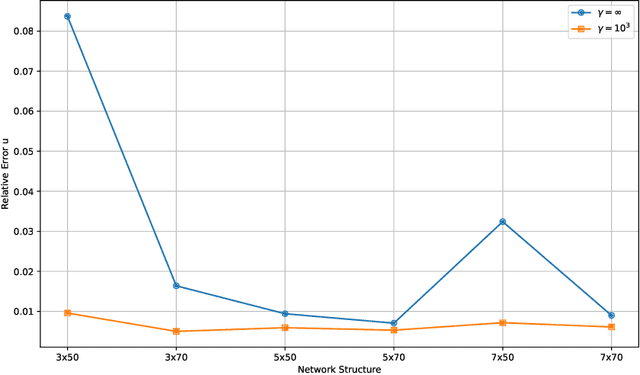
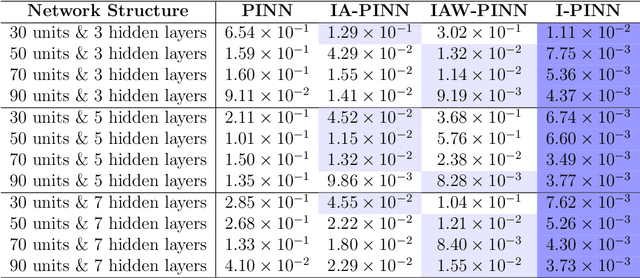
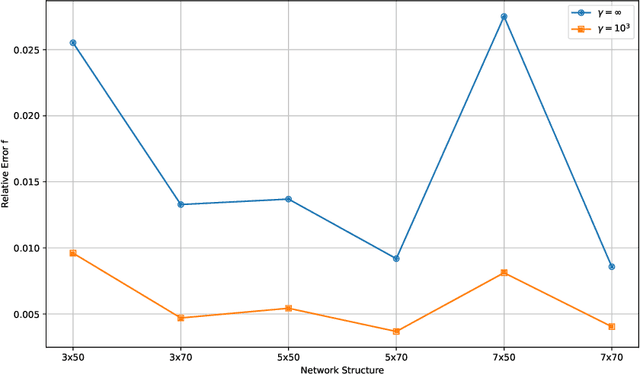
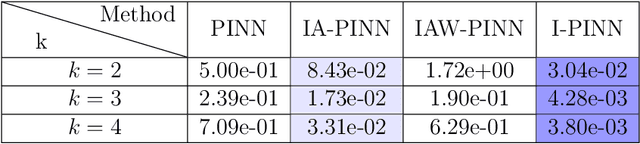
Physics-informed neural networks (PINNs) integrate fundamental physical principles with advanced data-driven techniques, driving significant advancements in scientific computing. However, PINNs face persistent challenges with stiffness in gradient flow, which limits their predictive capabilities. This paper presents an improved PINN (I-PINN) to mitigate gradient-related failures. The core of I-PINN is to combine the respective strengths of neural networks with an improved architecture and adaptive weights containingupper bounds. The capability to enhance accuracy by at least one order of magnitude and accelerate convergence, without introducing extra computational complexity relative to the baseline model, is achieved by I-PINN. Numerical experiments with a variety of benchmarks illustrate the improved accuracy and generalization of I-PINN. The supporting data and code are accessible at https://github.com/PanChengN/I-PINN.git, enabling broader research engagement.