 Add to Chrome
 Add to Firefox
 Add to Edge
Architecture-Optimization Co-Design for Physics-Informed Neural Networks Via Attentive Representations and Conflict-Resolved Gradients
Jan 19, 2026
Physics-Informed Neural Networks (PINNs) provide a learning-based framework for solving partial differential equations (PDEs) by embedding governing physical laws into neural network training. In practice, however, their performance is often hindered by limited representational capacity and optimization difficulties caused by competing physical constraints and conflicting gradients. In this work, we study PINN training from a unified architecture-optimization perspective. We first propose a layer-wise dynamic attention mechanism to enhance representational flexibility, resulting in the Layer-wise Dynamic Attention PINN (LDA-PINN). We then reformulate PINN training as a multi-task learning problem and introduce a conflict-resolved gradient update strategy to alleviate gradient interference, leading to the Gradient-Conflict-Resolved PINN (GC-PINN). By integrating these two components, we develop the Architecture-Conflict-Resolved PINN (ACR-PINN), which combines attentive representations with conflict-aware optimization while preserving the standard PINN loss formulation. Extensive experiments on benchmark PDEs, including the Burgers, Helmholtz, Klein-Gordon, and lid-driven cavity flow problems, demonstrate that ACR-PINN achieves faster convergence and significantly lower relative $L_2$ and $L_\infty$ errors than standard PINNs. These results highlight the effectiveness of architecture-optimization co-design for improving the robustness and accuracy of PINN-based solvers.

Improved physics-informed neural network in mitigating gradient related failures
Jul 28, 2024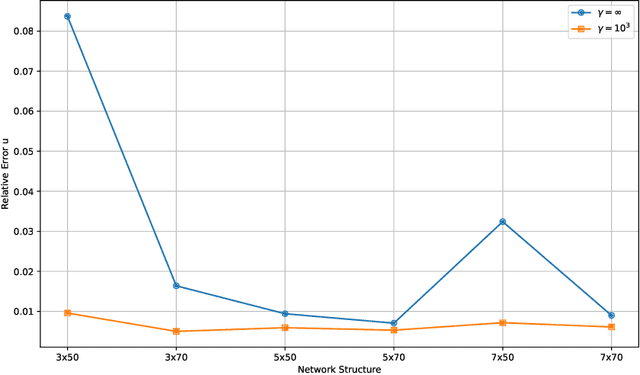
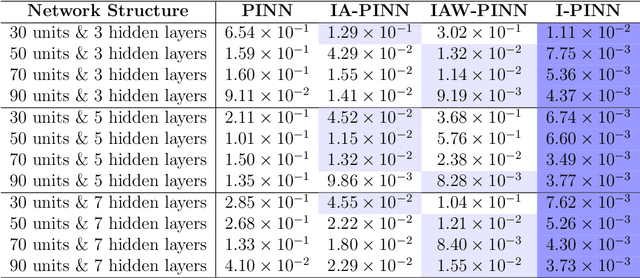
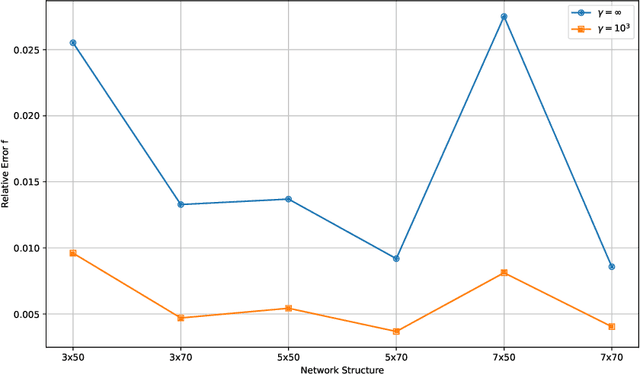
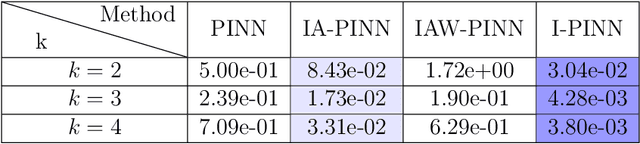
Physics-informed neural networks (PINNs) integrate fundamental physical principles with advanced data-driven techniques, driving significant advancements in scientific computing. However, PINNs face persistent challenges with stiffness in gradient flow, which limits their predictive capabilities. This paper presents an improved PINN (I-PINN) to mitigate gradient-related failures. The core of I-PINN is to combine the respective strengths of neural networks with an improved architecture and adaptive weights containingupper bounds. The capability to enhance accuracy by at least one order of magnitude and accelerate convergence, without introducing extra computational complexity relative to the baseline model, is achieved by I-PINN. Numerical experiments with a variety of benchmarks illustrate the improved accuracy and generalization of I-PINN. The supporting data and code are accessible at https://github.com/PanChengN/I-PINN.git, enabling broader research engagement.