 Add to Chrome
 Add to Firefox
 Add to Edge
Adam-SHANG: A Convergent Adam-Type Method for Stochastic Smooth Convex Optimization
May 13, 2026
We propose Adam-SHANG, a Lyapunov-guided Adam-type method that couples momentum, adaptive preconditioning, and a curvature-aware correction through a more stable lagged-preconditioner update. For stochastic smooth convex optimization, we prove convergence in expectation under an admissible stepsize condition that can always be satisfied by a conservative spectral bound, without imposing global monotonicity on the second-moment sequence. To obtain a less conservative practical rule, we introduce a computable trace-ratio stepsize, motivated by a local coordinatewise alignment condition. The same structural update is also tested beyond the convex setting with simplified parameters. Experiments validate the predicted stochastic decay and show competitive training performance against Adam and AdamW on deep learning tasks.

Adam-HNAG: A Convergent Reformulation of Adam with Accelerated Rate
Apr 09, 2026Adam has achieved strong empirical success, but its theory remains incomplete even in the deterministic full-batch setting, largely because adaptive preconditioning and momentum are tightly coupled. In this work, a convergent reformulation of full-batch Adam is developed by combining variable and operator splitting with a curvature-aware gradient correction. This leads to a continuous-time Adam-HNAG flow with an exponentially decaying Lyapunov function, as well as two discrete methods: Adam-HNAG, and Adam-HNAG-s, a synchronous variant closer in form to Adam. Within a unified Lyapunov analysis framework, convergence guarantees are established for both methods in the convex smooth setting, including accelerated convergence. Numerical experiments support the theory and illustrate the different empirical behavior of the two discretizations. To the best of our knowledge, this provides the first convergence proof for Adam-type methods in convex optimization.
Efficient Reflectance Capture with a Deep Gated Mixture-of-Experts
Mar 29, 2022
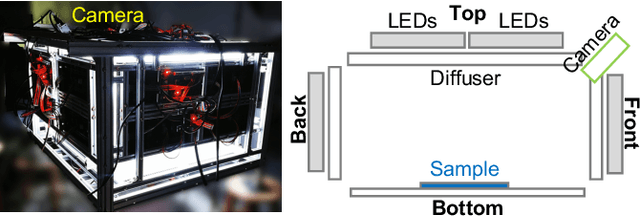

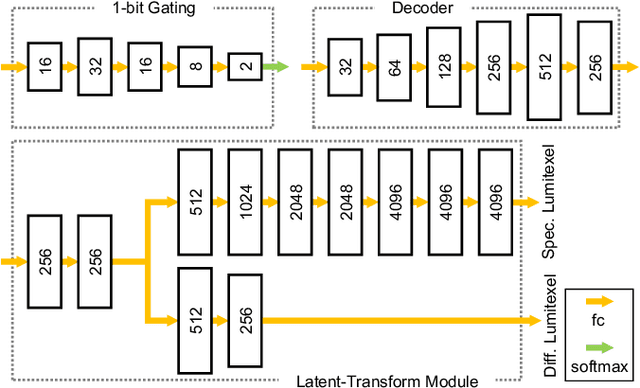
We present a novel framework to efficiently acquire near-planar anisotropic reflectance in a pixel-independent fashion, using a deep gated mixtureof-experts. While existing work employs a unified network to handle all possible input, our network automatically learns to condition on the input for enhanced reconstruction. We train a gating module to select one out of a number of specialized decoders for reflectance reconstruction, based on photometric measurements, essentially trading generality for quality. A common, pre-trained latent transform module is also appended to each decoder, to offset the burden of the increased number of decoders. In addition, the illumination conditions during acquisition can be jointly optimized. The effectiveness of our framework is validated on a wide variety of challenging samples using a near-field lightstage. Compared with the state-of-the-art technique, our results are improved at the same input bandwidth, and our bandwidth can be reduced to about 1/3 for equal-quality results.