 Add to Chrome
 Add to Firefox
 Add to Edge
Children's English Reading Story Generation via Supervised Fine-Tuning of Compact LLMs with Controllable Difficulty and Safety
May 13, 2026
Large Language Models (LLMs) are widely applied in educational practices, such as for generating children's stories. However, the generated stories are often too difficult for children to read, and the operational cost of LLMs hinders their widespread adoption in educational settings. We used an existing expert-designed children's reading curriculum and its corresponding generated stories from GPT-4o and Llama 3.3 70B to design different experiments for fine-tuning three 8B-parameter LLMs, which then generated new English reading stories that were subjected to quantitative and qualitative evaluation. Our method prioritizes controllability over scale, enabling educators to target reading levels and error patterns with a compact, affordable model. Our evaluation results show that with appropriate fine-tuning designs, children's English reading stories generated by 8B LLMs perform better on difficulty-related metrics than those from zero-shot GPT-4o and Llama 3.3 70B, with almost no discernible safety issues. Such fine-tuned LLMs could be more broadly used by teachers, parents, and children in classrooms and at home to generate engaging English reading stories with children's interests, controllable difficulty and safety.

AI-Assisted Engineering Should Track the Epistemic Status and Temporal Validity of Architectural Decisions
Jan 28, 2026This position paper argues that AI-assisted software engineering requires explicit mechanisms for tracking the epistemic status and temporal validity of architectural decisions. LLM coding assistants generate decisions faster than teams can validate them, yet no widely-adopted framework distinguishes conjecture from verified knowledge, prevents trust inflation through conservative aggregation, or detects when evidence expires. We propose three requirements for responsible AI-assisted engineering: (1) epistemic layers that separate unverified hypotheses from empirically validated claims, (2) conservative assurance aggregation grounded in the Gödel t-norm that prevents weak evidence from inflating confidence, and (3) automated evidence decay tracking that surfaces stale assumptions before they cause failures. We formalize these requirements as the First Principles Framework (FPF), ground its aggregation semantics in fuzzy logic, and define a quintet of invariants that any valid aggregation operator must satisfy. Our retrospective audit applying FPF criteria to two internal projects found that 20-25% of architectural decisions had stale evidence within two months, validating the need for temporal accountability. We outline research directions including learnable aggregation operators, federated evidence sharing, and SMT-based claim validation.
Predicting Different Types of Subtle Toxicity in Unhealthy Online Conversations
Jun 07, 2021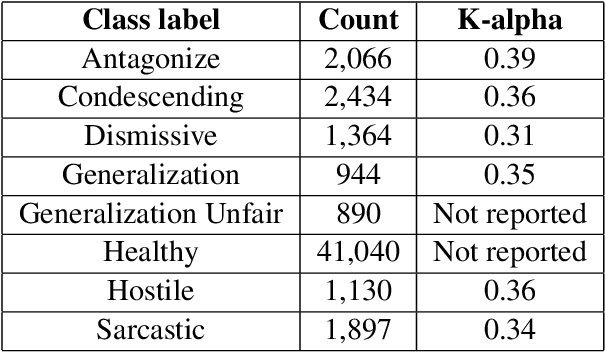
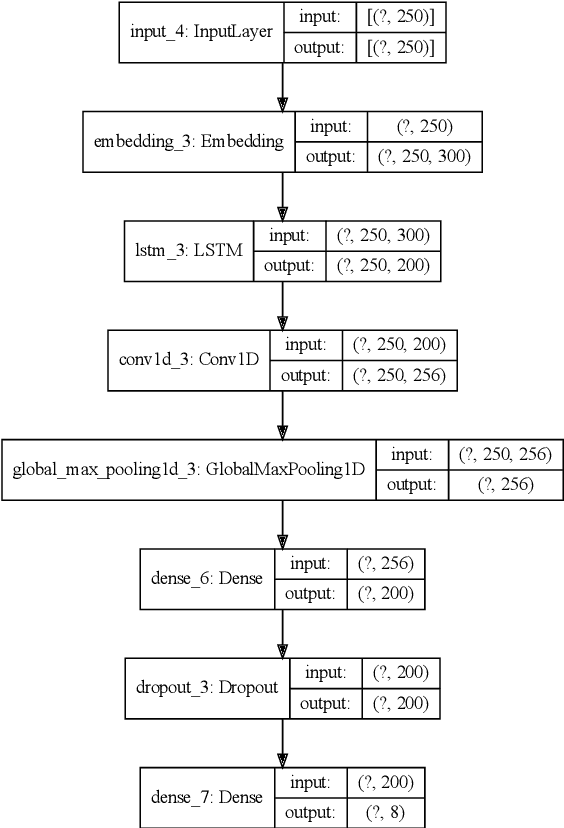
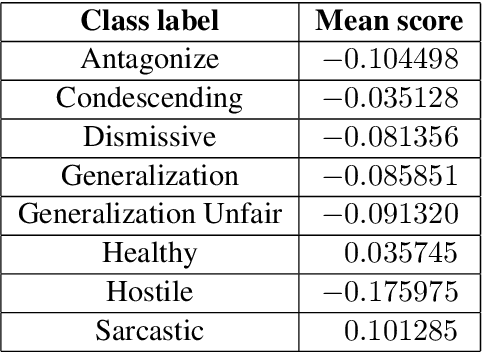

This paper investigates the use of machine learning models for the classification of unhealthy online conversations containing one or more forms of subtler abuse, such as hostility, sarcasm, and generalization. We leveraged a public dataset of 44K online comments containing healthy and unhealthy comments labeled with seven forms of subtle toxicity. We were able to distinguish between these comments with a top micro F1-score, macro F1-score, and ROC-AUC of 88.76%, 67.98%, and 0.71, respectively. Hostile comments were easier to detect than other types of unhealthy comments. We also conducted a sentiment analysis which revealed that most types of unhealthy comments were associated with a slight negative sentiment, with hostile comments being the most negative ones.