 Add to Chrome
 Add to Firefox
 Add to Edge
Maximising the Set-Piece Return: Optimising Football Corner Tactics with Graph Reinforcement Learning
Jun 04, 2026
Machine learning is increasingly employed for the evaluation of football tactics. However, existing approaches focus on characterising historical actions or analyst-specified counterfactual scenarios. In this work, we seek to go beyond the imitation of historically observed patterns towards discovering new generalisable player configurations and strategies. To tackle this, we focus on optimising corner kick routines, and formulate a decision-making problem in which a central policy makes adjustments to attacking player positions and velocities to maximise first contact shot probability. Unlike classic optimisation that solves for isolated setups, we contribute a reinforcement learning architecture operating on graph-structured data that yields a general policy for adjusting arbitrary starting player positions. Evaluated on over 3,000 Premier League corners, our approach strongly outperforms baseline optimisation techniques under matched inference budgets. Our results suggest that graph reinforcement learning can shift set-piece analysis from historical evaluation and imitation towards reward-driven tactical discovery.

Risk-Aware Reinforcement Learning for Mobile Manipulation
Mar 04, 2026For robots to successfully transition from lab settings to everyday environments, they must begin to reason about the risks associated with their actions and make informed, risk-aware decisions. This is particularly true for robots performing mobile manipulation tasks, which involve both interacting with and navigating within dynamic, unstructured spaces. However, existing whole-body controllers for mobile manipulators typically lack explicit mechanisms for risk-sensitive decision-making under uncertainty. To our knowledge, we are the first to (i) learn risk-aware visuomotor policies for mobile manipulation conditioned on egocentric depth observations with runtime-adjustable risk sensitivity, and (ii) show risk-aware behaviours can be transferred through Imitation Learning (IL) to a visuomotor policy conditioned on egocentric depth observations. Our method achieves this by first training a privileged teacher policy using Distributional Reinforcement Learning (DRL), with a risk-neutral distributional critic. Distortion risk-metrics are then applied to the critic's predicted return distribution to calculate risk-adjusted advantage estimates used in policy updates to achieve a range of risk-aware behaviours. We then distil teacher policies with IL to obtain risk-aware student policies conditioned on egocentric depth observations. We perform extensive evaluations demonstrating that our trained visuomotor policies exhibit risk-aware behaviour (specifically achieving better worst-case performance) while performing reactive whole-body motions in unmapped environments, leveraging live depth observations for perception.
Distillation and Interpretability of Ensemble Forecasts of ENSO Phase using Entropic Learning
Feb 15, 2026This paper introduces a distillation framework for an ensemble of entropy-optimal Sparse Probabilistic Approximation (eSPA) models, trained exclusively on satellite-era observational and reanalysis data to predict ENSO phase up to 24 months in advance. While eSPA ensembles yield state-of-the-art forecast skill, they are harder to interpret than individual eSPA models. We show how to compress the ensemble into a compact set of "distilled" models by aggregating the structure of only those ensemble members that make correct predictions. This process yields a single, diagnostically tractable model for each forecast lead time that preserves forecast performance while also enabling diagnostics that are impractical to implement on the full ensemble. An analysis of the regime persistence of the distilled model "superclusters", as well as cross-lead clustering consistency, shows that the discretised system accurately captures the spatiotemporal dynamics of ENSO. By considering the effective dimension of the feature importance vectors, the complexity of the input space required for correct ENSO phase prediction is shown to peak when forecasts must cross the boreal spring predictability barrier. Spatial importance maps derived from the feature importance vectors are introduced to identify where predictive information resides in each field and are shown to include known physical precursors at certain lead times. Case studies of key events are also presented, showing how fields reconstructed from distilled model centroids trace the evolution from extratropical and inter-basin precursors to the mature ENSO state. Overall, the distillation framework enables a rigorous investigation of long-range ENSO predictability that complements real-time data-driven operational forecasts.
Multi-Scale Wavelet Transformers for Operator Learning of Dynamical Systems
Feb 01, 2026Recent years have seen a surge in data-driven surrogates for dynamical systems that can be orders of magnitude faster than numerical solvers. However, many machine learning-based models such as neural operators exhibit spectral bias, attenuating high-frequency components that often encode small-scale structure. This limitation is particularly damaging in applications such as weather forecasting, where misrepresented high frequencies can induce long-horizon instability. To address this issue, we propose multi-scale wavelet transformers (MSWTs), which learn system dynamics in a tokenized wavelet domain. The wavelet transform explicitly separates low- and high-frequency content across scales. MSWTs leverage a wavelet-preserving downsampling scheme that retains high-frequency features and employ wavelet-based attention to capture dependencies across scales and frequency bands. Experiments on chaotic dynamical systems show substantial error reductions and improved long horizon spectral fidelity. On the ERA5 climate reanalysis, MSWTs further reduce climatological bias, demonstrating their effectiveness in a real-world forecasting setting.
Physics-Based Causal Reasoning for Safe & Robust Next-Best Action Selection in Robot Manipulation Tasks
Mar 21, 2024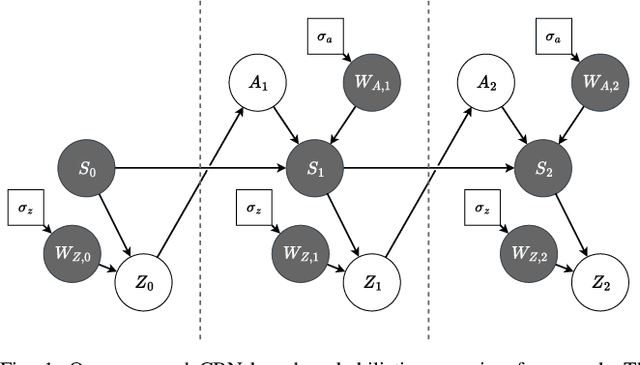
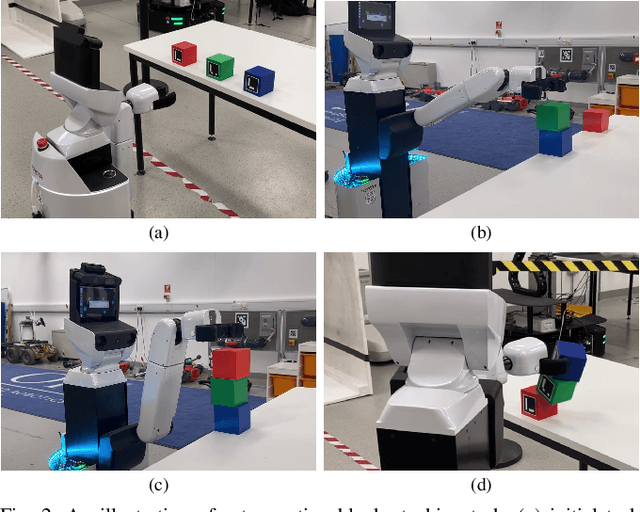
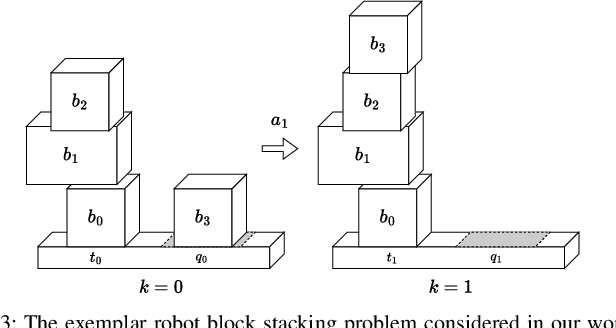
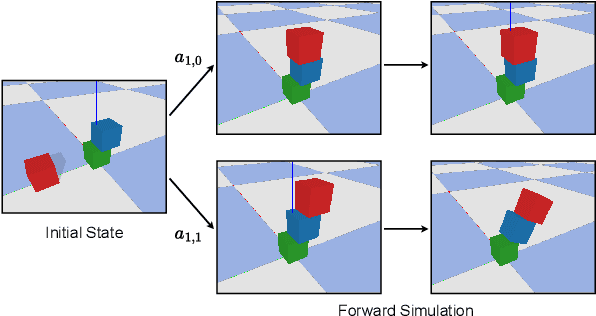
Safe and efficient object manipulation is a key enabler of many real-world robot applications. However, this is challenging because robot operation must be robust to a range of sensor and actuator uncertainties. In this paper, we present a physics-informed causal-inference-based framework for a robot to probabilistically reason about candidate actions in a block stacking task in a partially observable setting. We integrate a physics-based simulation of the rigid-body system dynamics with a causal Bayesian network (CBN) formulation to define a causal generative probabilistic model of the robot decision-making process. Using simulation-based Monte Carlo experiments, we demonstrate our framework's ability to successfully: (1) predict block tower stability with high accuracy (Pred Acc: 88.6%); and, (2) select an approximate next-best action for the block stacking task, for execution by an integrated robot system, achieving 94.2% task success rate. We also demonstrate our framework's suitability for real-world robot systems by demonstrating successful task executions with a domestic support robot, with perception and manipulation sub-system integration. Hence, we show that by embedding physics-based causal reasoning into robots' decision-making processes, we can make robot task execution safer, more reliable, and more robust to various types of uncertainty.