 Add to Chrome
 Add to Firefox
 Add to Edge
RL-Native Distillation: Exploiting Scored Trajectories for Few-Step Image Generation
Aug 10, 2026
Efficient text-to-image generation requires both reinforcement-learning (RL)-based reward alignment and few-step distillation, yet these procedures are typically performed sequentially, increasing training cost and risking the loss of reward gains during compression. We instead take an RL-native perspective: diffusion RL already generates reward-scored finite-step trajectories, whose intermediate states provide a natural source of distillation supervision rather than a disposable byproduct of sampling. Based on this insight, we propose REST (Reward-Enhanced Scored-Trajectory Distillation), a single-stage RL-distillation co-training framework that attaches a decoupled student to an arbitrary RL teacher. The student learns segment-wise from the teacher's evolving rollout trajectories while leaving the original teacher optimization unchanged. To prevent uniform imitation from preserving undesirable low-reward behaviors, we further introduce Advantage-Modulated Distillation (AMD), which transforms rollout advantages into signed weights over a base distillation loss. AMD strengthens supervision from preferred trajectories and mildly repels the student from low-reward ones. The resulting framework is lightweight and plug-and-play, requires no extra image rollouts, no separate distillation dataset, and no adversarial training. Experiments on compositional generation, visual text rendering, and human-preference alignment show that REST enables few-step CFG-free inference that matches or surpasses its 40-step RL teacher, with an overall additional training cost below 25% over pure RL. REST improves DrawBench PickScore over RTDMD by 0.82 while requiring only one-fifth of the training iterations.

UCNN: A Convolutional Strategy on Unstructured Mesh
Jan 12, 2021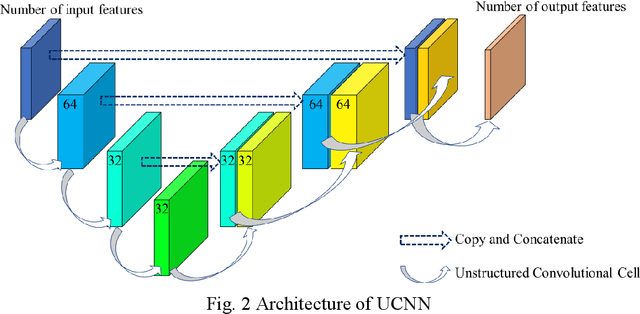
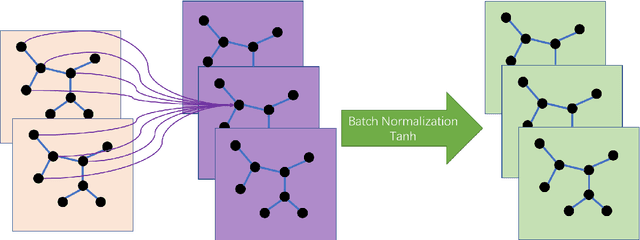
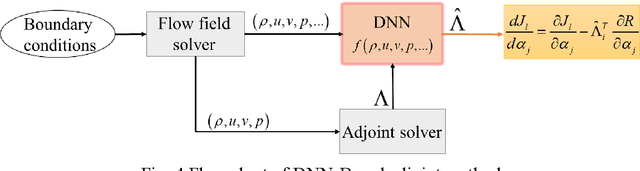
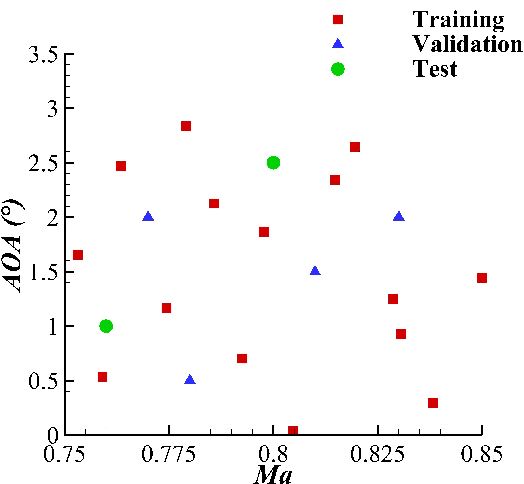
In machine learning for fluid mechanics, fully-connected neural network (FNN) only uses the local features for modelling, while the convolutional neural network (CNN) cannot be applied to data on structured/unstructured mesh. In order to overcome the limitations of FNN and CNN, the unstructured convolutional neural network (UCNN) is proposed, which aggregates and effectively exploits the features of neighbour nodes through the weight function. Adjoint vector modelling is taken as the task to study the performance of UCNN. The mapping function from flow-field features to adjoint vector is constructed through efficient parallel implementation on GPU. The modelling capability of UCNN is compared with that of FNN on validation set and in aerodynamic shape optimization at test case. The influence of mesh changing on the modelling capability of UCNN is further studied. The results indicate that UCNN is more accurate in modelling process.