 Add to Chrome
 Add to Firefox
 Add to Edge
When Evidence Conflicts: Uncertainty and Order Effects in Retrieval-Augmented Biomedical Question Answering
May 13, 2026
Biomedical retrieval-augmented large language models (LLMs) often face evidence that is incomplete, misleading, or internally contradictory, yet evaluation usually emphasizes answer accuracy under helpful context rather than reliability under conflict. Using HealthContradict, we evaluate six open-weight LLMs under five controlled evidence conditions: no retrieved context, correct-only context, incorrect-only context, and two mixed conditions containing both correct and contradictory documents in opposite orders. In this conflicting-evidence order contrast, where the same two documents are both present and only their order is reversed, accuracy drops for every model and 11.4%--25.2% of predictions flip. To support abstention in these difficult cases, we also evaluate a conflict-aware abstention score that combines model confidence with a detector of evidence conflict. In the two hardest conditions, this score improves selective accuracy over confidence-only, with mean gains of 7.2--33.4 points in incorrect-only (`IC') and 3.6--14.4 points in incorrect-first conflicting (`ICC') conditions across 75%, 50%, and 25% coverage. These results show that conflicting biomedical evidence is both an uncertainty and robustness problem and motivate evaluation and abstention methods that explicitly account for evidence disagreement.

Multi-label Sequential Sentence Classification via Large Language Model
Nov 23, 2024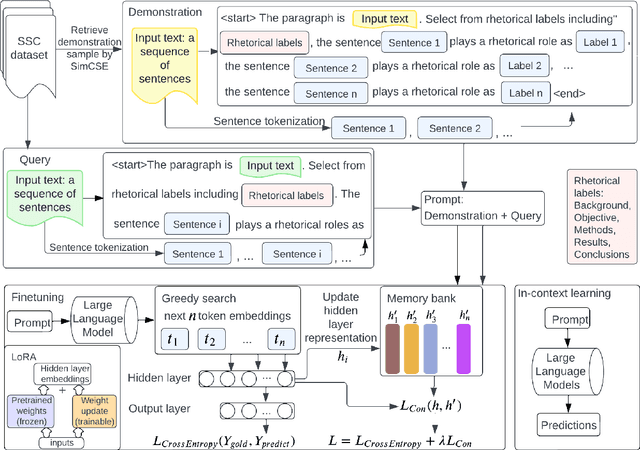


Sequential sentence classification (SSC) in scientific publications is crucial for supporting downstream tasks such as fine-grained information retrieval and extractive summarization. However, current SSC methods are constrained by model size, sequence length, and single-label setting. To address these limitations, this paper proposes LLM-SSC, a large language model (LLM)-based framework for both single- and multi-label SSC tasks. Unlike previous approaches that employ small- or medium-sized language models, the proposed framework utilizes LLMs to generate SSC labels through designed prompts, which enhance task understanding by incorporating demonstrations and a query to describe the prediction target. We also present a multi-label contrastive learning loss with auto-weighting scheme, enabling the multi-label classification task. To support our multi-label SSC analysis, we introduce and release a new dataset, biorc800, which mainly contains unstructured abstracts in the biomedical domain with manual annotations. Experiments demonstrate LLM-SSC's strong performance in SSC under both in-context learning and task-specific tuning settings. We release biorc800 and our code at: https://github.com/ScienceNLP-Lab/LLM-SSC.
Zero- and Few-Shot Event Detection via Prompt-Based Meta Learning
May 27, 2023With emerging online topics as a source for numerous new events, detecting unseen / rare event types presents an elusive challenge for existing event detection methods, where only limited data access is provided for training. To address the data scarcity problem in event detection, we propose MetaEvent, a meta learning-based framework for zero- and few-shot event detection. Specifically, we sample training tasks from existing event types and perform meta training to search for optimal parameters that quickly adapt to unseen tasks. In our framework, we propose to use the cloze-based prompt and a trigger-aware soft verbalizer to efficiently project output to unseen event types. Moreover, we design a contrastive meta objective based on maximum mean discrepancy (MMD) to learn class-separating features. As such, the proposed MetaEvent can perform zero-shot event detection by mapping features to event types without any prior knowledge. In our experiments, we demonstrate the effectiveness of MetaEvent in both zero-shot and few-shot scenarios, where the proposed method achieves state-of-the-art performance in extensive experiments on benchmark datasets FewEvent and MAVEN.