 Add to Chrome
 Add to Firefox
 Add to Edge
ANCHOR-RE: An Agentic Neuro-Symbolic Framework for Grounded Biomedical Relation Extraction
Aug 04, 2026
Biomedical relation extraction (BioRE) extracts structured knowledge from biomedical literature for applications such as knowledge base construction and hypothesis generation. Traditional symbolic systems such as SemRep provide high precision but limited recall, while large language models (LLMs) offer stronger contextual reasoning but remain prone to false-positive predictions. We developed ANCHOR-RE, a framework that integrates ontology-guided reasoning, external knowledge grounding, and data-driven verification rules into LLM inference. We evaluated it on three BioRE benchmarks (SemRepGS, DDI, and ChemProt) using both proprietary and open-weight LLMs. To assess generalizability beyond benchmark datasets while reducing potential evaluation bias from LLM pretraining contamination, we conducted a temporal evaluation using 100 biomedical articles published in 2026. With the proprietary backbone, ANCHOR-RE outperformed direct LLM prompting, improving micro-F1 from 0.654 to 0.676 on SemRepGS, from 0.769 to 0.872 on DDI, and from 0.939 to 0.941 on ChemProt. On DDI and ChemProt, it also outperformed previously reported inference-only methods and approached fine-tuned or instruction-tuned systems without parameter updates. Similar performance gains observed with open-weight LLMs indicate that the benefits were not limited to the proprietary backbone. On the post-cutoff set, manual assessment of 500 randomly sampled predictions yielded a precision of 69%, maintaining consistent precision on previously unseen biomedical literature. Neuro-symbolic reasoning can improve the reliability of LLM-based BioRE without fine-tuning. Results across multiple benchmarks, model families, and post-cutoff literature support ANCHOR-RE as a practical training-free approach to biomedical literature mining.

Divide-Prompt-Refine: a Training-Free, Structure-Aware Framework for Biomedical Abstract Generation
May 20, 2026Biomedical abstracts play a critical role in downstream NLP applications, such as information retrieval, biocuration, and biomedical knowledge discovery. However, a non-trivial number of biomedical articles do not have abstracts, diminishing the utility of these articles for downstream tasks. We propose DPR-BAG (Divide, Prompt, and Refine for Biomedical Abstract Generation), a training-free, zero-shot framework that generates coherent and factually grounded abstracts for biomedical articles with full text but no abstract. DPR-BAG decomposes full-text documents into structured rhetorical facets following the Background-Objective-Methods-Results-Conclusions (BOMRC) schema, performs parallel LLM-based summarization for each facet, and applies a final refinement stage to restore global discourse coherence. On PMC-MAD, a distribution-aligned dataset of 46,309 biomedical articles, DPR-BAG improves abstractive novelty over strong extractive and fine-tuned baselines, while maintaining factual consistency. Our ablation study reveals a counterintuitive finding: increasing prompt complexity or explicitly injecting entity-level guidance can degrade factual alignment, highlighting the importance of controlled prompting strategies. These findings underscore the potential of training-free, structure-aware frameworks for scalable biomedical abstract generation in low-resource settings. Our data and code are available at https://huggingface.co/datasets/pmc-mad/PMC-MAD and https://github.com/ScienceNLP-Lab/MultiTagger-v2/tree/main/DPR-BAG.
Robust Biomedical Publication Type and Study Design Classification with Knowledge-Guided Perturbations
May 12, 2026Accurately and consistently indexing biomedical literature by publication type and study design is essential for supporting evidence synthesis and knowledge discovery. Prior work on automated publication type and study design indexing has primarily focused on expanding label coverage, enriching feature representations, and improving in-domain accuracy, with evaluation typically conducted on data drawn from the same distribution as training. Although pretrained biomedical language models achieve strong performance under these settings, models optimized for in-domain accuracy may rely on superficial lexical or dataset-specific cues, resulting in reduced robustness under distributional shift. In this study, we introduce an evaluation framework based on controlled semantic perturbations to assess the robustness of a publication type classifier and investigate robustness-oriented training strategies that combine entity masking and domain-adversarial training to mitigate reliance on spurious topical correlations. Our results show that the commonly observed trade-off between robustness and in-domain accuracy can be mitigated when robustness objectives are designed to selectively suppress non-task-defining features while preserving salient methodological signals. We find that these improvements arise from two complementary mechanisms: (1) increased reliance on explicit methodological cues when such cues are present in the input, and (2) reduced reliance on spurious domain-specific topical features. These findings highlight the importance of feature-level robustness analysis for publication type and study design classification and suggest that refining masking and adversarial objectives to more selectively suppress topical information may further improve robustness. Data, code, and models are available at: https://github.com/ScienceNLP-Lab/MultiTagger-v2/tree/main/ICHI
Multi-label Sequential Sentence Classification via Large Language Model
Nov 23, 2024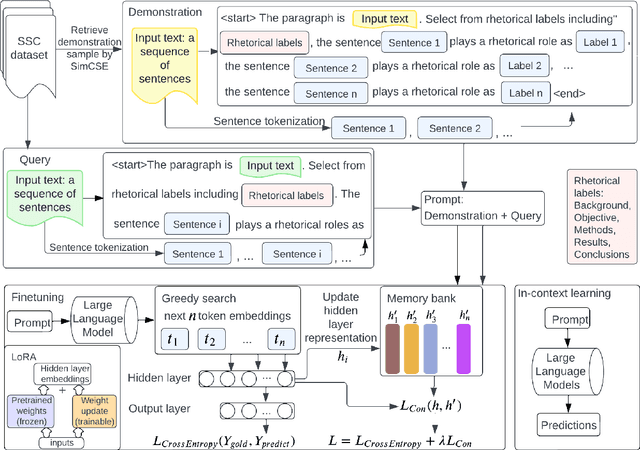


Sequential sentence classification (SSC) in scientific publications is crucial for supporting downstream tasks such as fine-grained information retrieval and extractive summarization. However, current SSC methods are constrained by model size, sequence length, and single-label setting. To address these limitations, this paper proposes LLM-SSC, a large language model (LLM)-based framework for both single- and multi-label SSC tasks. Unlike previous approaches that employ small- or medium-sized language models, the proposed framework utilizes LLMs to generate SSC labels through designed prompts, which enhance task understanding by incorporating demonstrations and a query to describe the prediction target. We also present a multi-label contrastive learning loss with auto-weighting scheme, enabling the multi-label classification task. To support our multi-label SSC analysis, we introduce and release a new dataset, biorc800, which mainly contains unstructured abstracts in the biomedical domain with manual annotations. Experiments demonstrate LLM-SSC's strong performance in SSC under both in-context learning and task-specific tuning settings. We release biorc800 and our code at: https://github.com/ScienceNLP-Lab/LLM-SSC.