 Add to Chrome
 Add to Firefox
 Add to Edge
LSS3D: Learnable Spatial Shifting for Consistent and High-Quality 3D Generation from Single-Image
Nov 15, 2025
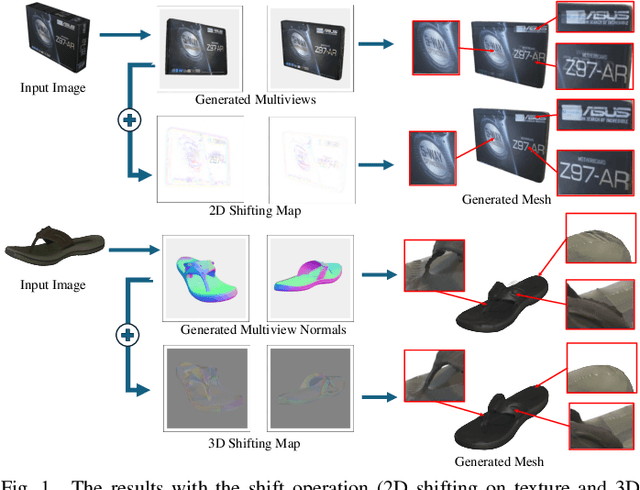
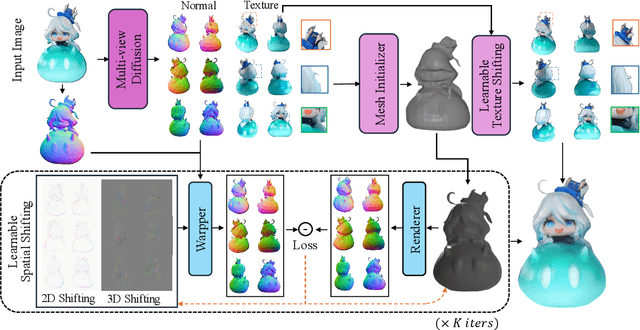
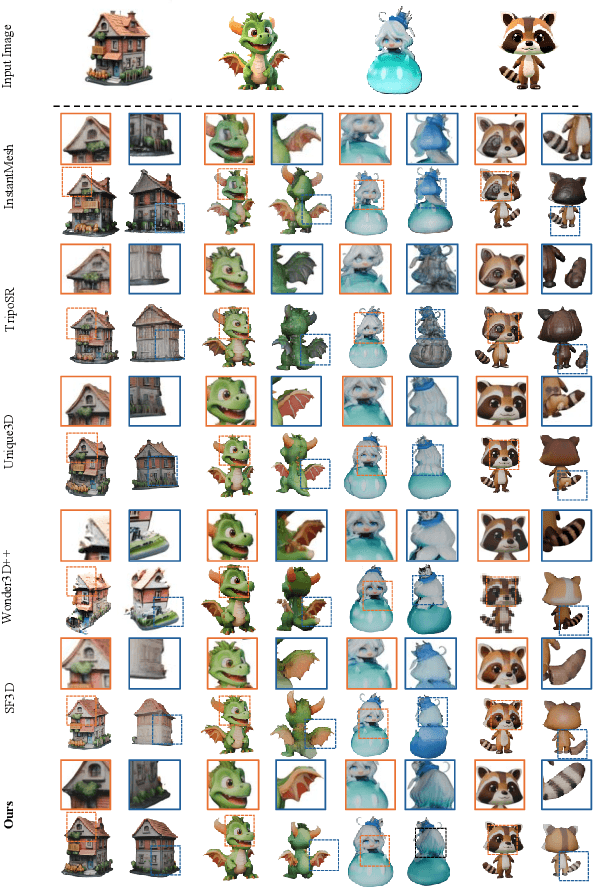
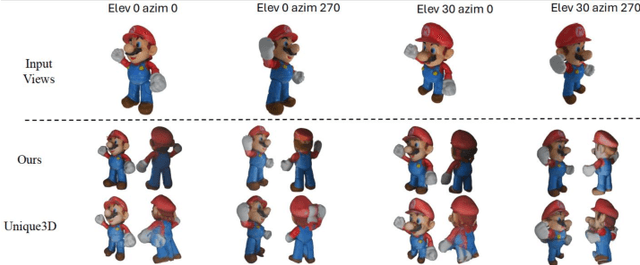
Recently, multi-view diffusion-based 3D generation methods have gained significant attention. However, these methods often suffer from shape and texture misalignment across generated multi-view images, leading to low-quality 3D generation results, such as incomplete geometric details and textural ghosting. Some methods are mainly optimized for the frontal perspective and exhibit poor robustness to oblique perspective inputs. In this paper, to tackle the above challenges, we propose a high-quality image-to-3D approach, named LSS3D, with learnable spatial shifting to explicitly and effectively handle the multiview inconsistencies and non-frontal input view. Specifically, we assign learnable spatial shifting parameters to each view, and adjust each view towards a spatially consistent target, guided by the reconstructed mesh, resulting in high-quality 3D generation with more complete geometric details and clean textures. Besides, we include the input view as an extra constraint for the optimization, further enhancing robustness to non-frontal input angles, especially for elevated viewpoint inputs. We also provide a comprehensive quantitative evaluation pipeline that can contribute to the community in performance comparisons. Extensive experiments demonstrate that our method consistently achieves leading results in both geometric and texture evaluation metrics across more flexible input viewpoints.

AppealCase: A Dataset and Benchmark for Civil Case Appeal Scenarios
May 22, 2025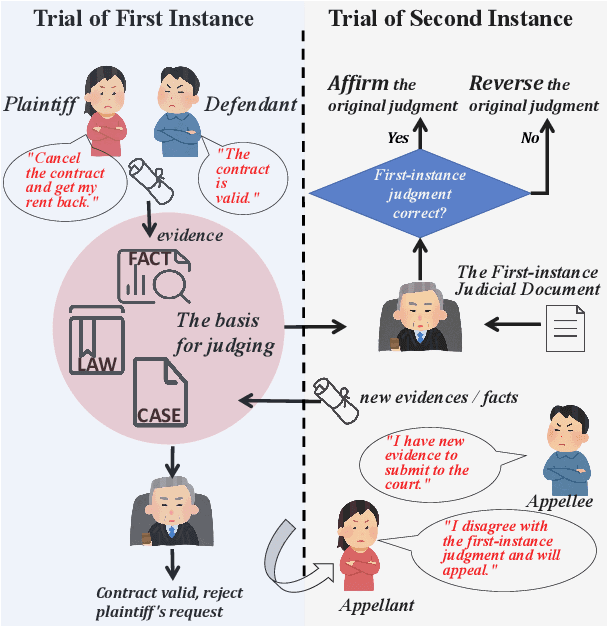
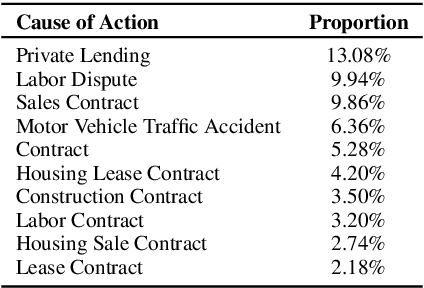
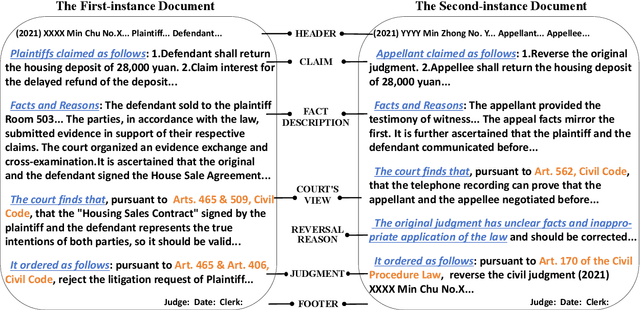
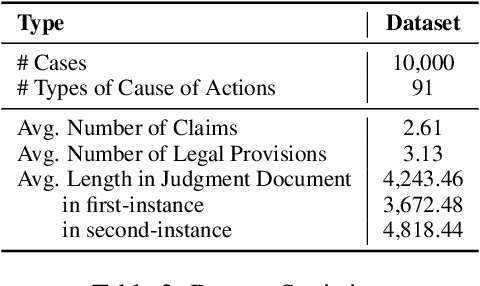
Recent advances in LegalAI have primarily focused on individual case judgment analysis, often overlooking the critical appellate process within the judicial system. Appeals serve as a core mechanism for error correction and ensuring fair trials, making them highly significant both in practice and in research. To address this gap, we present the AppealCase dataset, consisting of 10,000 pairs of real-world, matched first-instance and second-instance documents across 91 categories of civil cases. The dataset also includes detailed annotations along five dimensions central to appellate review: judgment reversals, reversal reasons, cited legal provisions, claim-level decisions, and whether there is new information in the second instance. Based on these annotations, we propose five novel LegalAI tasks and conduct a comprehensive evaluation across 20 mainstream models. Experimental results reveal that all current models achieve less than 50% F1 scores on the judgment reversal prediction task, highlighting the complexity and challenge of the appeal scenario. We hope that the AppealCase dataset will spur further research in LegalAI for appellate case analysis and contribute to improving consistency in judicial decision-making.