 Add to Chrome
 Add to Firefox
 Add to Edge
Evolving Robustness--Exploration Trade-off in Online Reinforcement Learning via Quantile Bayesian Risk MDPs
May 23, 2026
In online reinforcement learning, data scarcity creates epistemic uncertainty that makes robustness important early in learning, whereas sufficient exploration is needed to learn the true-environment optimal policy. We study this time-varying robustness--exploration trade-off through a quantile Bayesian risk-aware Markov decision process (BR-MDP), in which the quantile level controls how posterior uncertainty enters the Bellman backup. We characterize this control through an asymptotic normality result for the difference between the quantile BR-MDP value and the value in the true environment. The result implies that upper/lower-tail quantiles induce optimism/pessimism towards epistemic uncertainty, and the magnitude of the optimism/pessimism decreases as data accumulate. Building on this characterization, we propose an online Bayesian risk-aware algorithm with an adaptive quantile schedule that emphasizes robustness early and gradually encourages exploration of less-visited state--action pairs. We establish sublinear Bayesian regret bounds with respect to both the true optimal value and the optimal BR-MDP robust value. Numerical experiments demonstrate strong performance in both exploration-demanding and exploration-costly environments.

Differentiable Arbitrating in Zero-sum Markov Games
Feb 20, 2023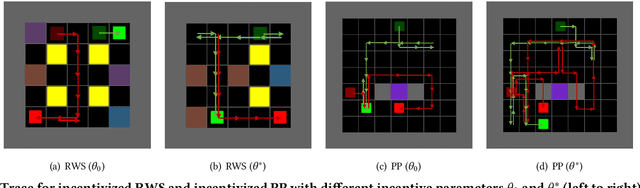
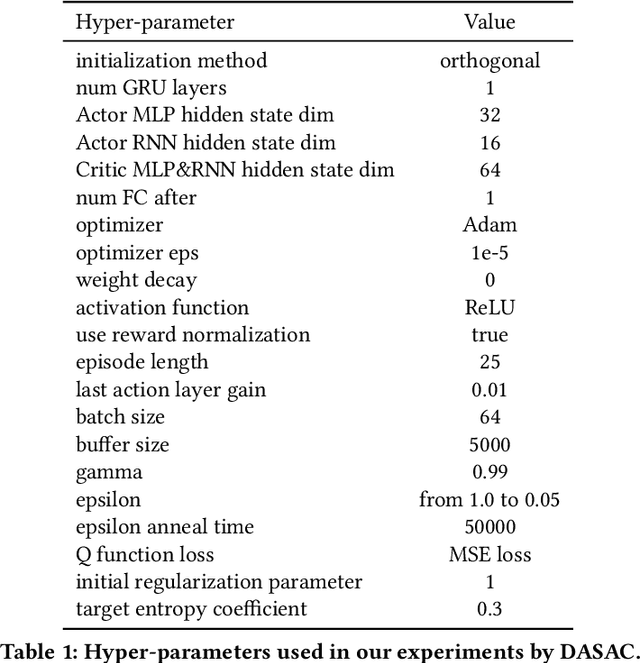
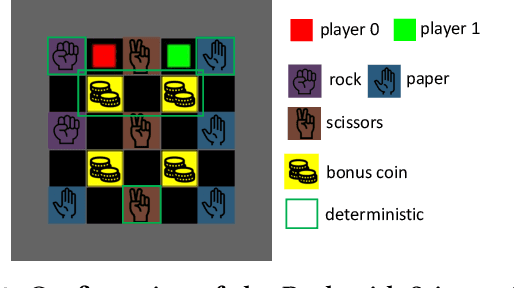
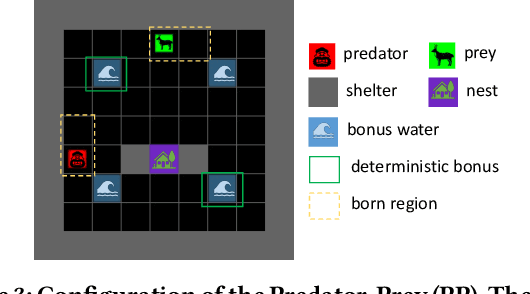
We initiate the study of how to perturb the reward in a zero-sum Markov game with two players to induce a desirable Nash equilibrium, namely arbitrating. Such a problem admits a bi-level optimization formulation. The lower level requires solving the Nash equilibrium under a given reward function, which makes the overall problem challenging to optimize in an end-to-end way. We propose a backpropagation scheme that differentiates through the Nash equilibrium, which provides the gradient feedback for the upper level. In particular, our method only requires a black-box solver for the (regularized) Nash equilibrium (NE). We develop the convergence analysis for the proposed framework with proper black-box NE solvers and demonstrate the empirical successes in two multi-agent reinforcement learning (MARL) environments.