 Add to Chrome
 Add to Firefox
 Add to Edge
Evolutionary Reinforcement Learning based AI tutor for Socratic Interdisciplinary Instruction
Dec 12, 2025
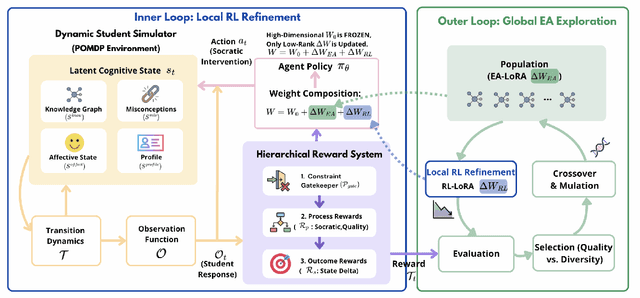
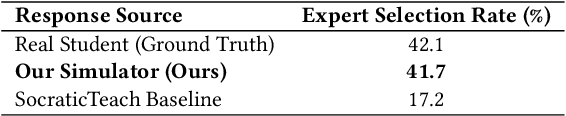
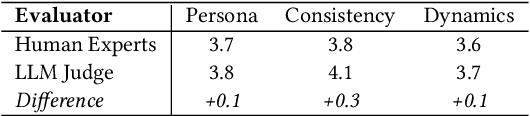
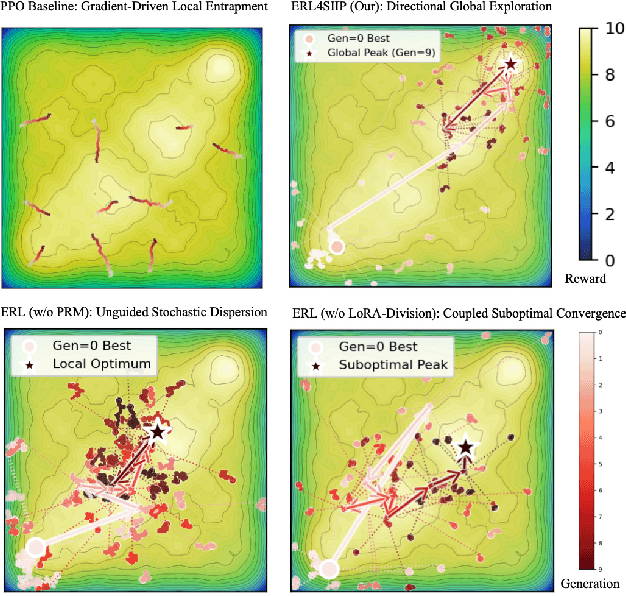
Cultivating higher-order cognitive abilities -- such as knowledge integration, critical thinking, and creativity -- in modern STEM education necessitates a pedagogical shift from passive knowledge transmission to active Socratic construction. Although Large Language Models (LLMs) hold promise for STEM Interdisciplinary education, current methodologies employing Prompt Engineering (PE), Supervised Fine-tuning (SFT), or standard Reinforcement Learning (RL) often fall short of supporting this paradigm. Existing methods are hindered by three fundamental challenges: the inability to dynamically model latent student cognitive states; severe reward sparsity and delay inherent in long-term educational goals; and a tendency toward policy collapse lacking strategic diversity due to reliance on behavioral cloning. Recognizing the unobservability and dynamic complexity of these interactions, we formalize the Socratic Interdisciplinary Instructional Problem (SIIP) as a structured Partially Observable Markov Decision Process (POMDP), demanding simultaneous global exploration and fine-grained policy refinement. To this end, we propose ERL4SIIP, a novel Evolutionary Reinforcement Learning (ERL) framework specifically tailored for this domain. ERL4SIIP integrates: (1) a dynamic student simulator grounded in a STEM knowledge graph for latent state modeling; (2) a Hierarchical Reward Mechanism that decomposes long-horizon goals into dense signals; and (3) a LoRA-Division based optimization strategy coupling evolutionary algorithms for population-level global search with PPO for local gradient ascent.

SID: Benchmarking Guided Instruction Capabilities in STEM Education with a Socratic Interdisciplinary Dialogues Dataset
Aug 06, 2025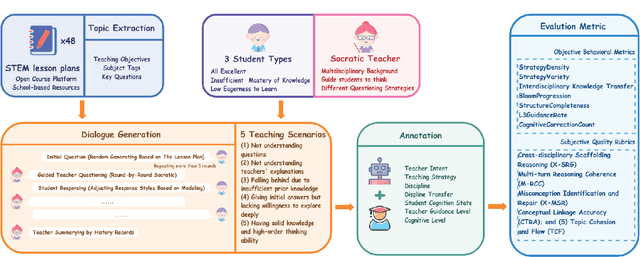
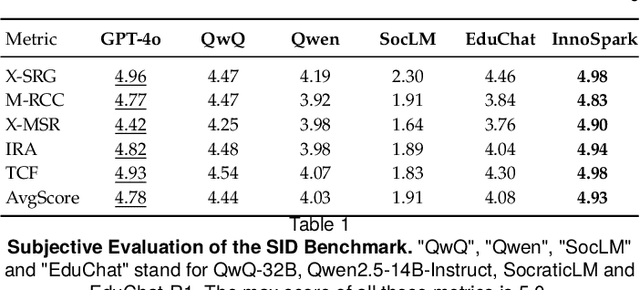
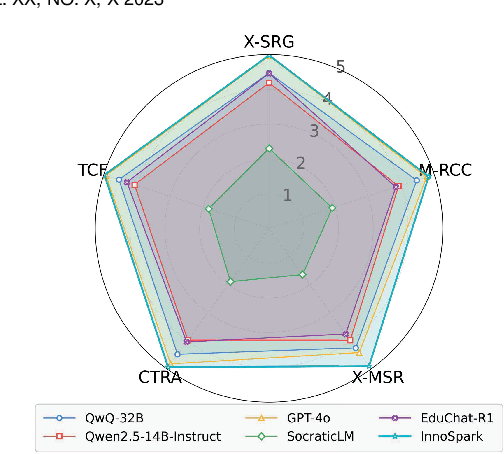
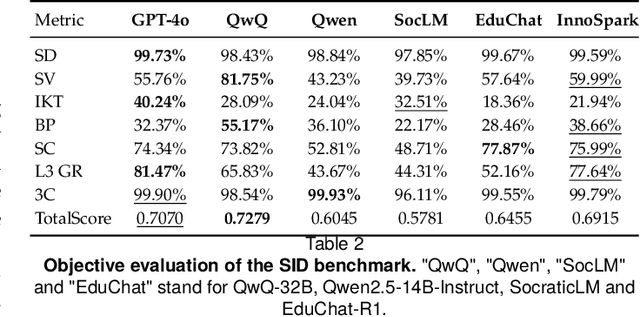
Fostering students' abilities for knowledge integration and transfer in complex problem-solving scenarios is a core objective of modern education, and interdisciplinary STEM is a key pathway to achieve this, yet it requires expert guidance that is difficult to scale. While LLMs offer potential in this regard, their true capability for guided instruction remains unclear due to the lack of an effective evaluation benchmark. To address this, we introduce SID, the first benchmark designed to systematically evaluate the higher-order guidance capabilities of LLMs in multi-turn, interdisciplinary Socratic dialogues. Our contributions include a large-scale dataset of 10,000 dialogue turns across 48 complex STEM projects, a novel annotation schema for capturing deep pedagogical features, and a new suite of evaluation metrics (e.g., X-SRG). Baseline experiments confirm that even state-of-the-art LLMs struggle to execute effective guided dialogues that lead students to achieve knowledge integration and transfer. This highlights the critical value of our benchmark in driving the development of more pedagogically-aware LLMs.
Surrogate-Assisted Evolutionary Reinforcement Learning Based on Autoencoder and Hyperbolic Neural Network
May 26, 2025Evolutionary Reinforcement Learning (ERL), training the Reinforcement Learning (RL) policies with Evolutionary Algorithms (EAs), have demonstrated enhanced exploration capabilities and greater robustness than using traditional policy gradient. However, ERL suffers from the high computational costs and low search efficiency, as EAs require evaluating numerous candidate policies with expensive simulations, many of which are ineffective and do not contribute meaningfully to the training. One intuitive way to reduce the ineffective evaluations is to adopt the surrogates. Unfortunately, existing ERL policies are often modeled as deep neural networks (DNNs) and thus naturally represented as high-dimensional vectors containing millions of weights, which makes the building of effective surrogates for ERL policies extremely challenging. This paper proposes a novel surrogate-assisted ERL that integrates Autoencoders (AE) and Hyperbolic Neural Networks (HNN). Specifically, AE compresses high-dimensional policies into low-dimensional representations while extracting key features as the inputs for the surrogate. HNN, functioning as a classification-based surrogate model, can learn complex nonlinear relationships from sampled data and enable more accurate pre-selection of the sampled policies without real evaluations. The experiments on 10 Atari and 4 Mujoco games have verified that the proposed method outperforms previous approaches significantly. The search trajectories guided by AE and HNN are also visually demonstrated to be more effective, in terms of both exploration and convergence. This paper not only presents the first learnable policy embedding and surrogate-modeling modules for high-dimensional ERL policies, but also empirically reveals when and why they can be successful.