 Add to Chrome
 Add to Firefox
 Add to Edge
CAKE: Compiler-Agent Co-Design for Frontier Kernel Evolution
Aug 12, 2026
GPU kernel agents and GPU programming languages have advanced separately, leaving expert kernels difficult to reproduce. Agents usually treat the compiler as a fixed black box and receive only errors, correctness outcomes, and timing, while existing DSLs either hide critical scheduling decisions or expose them through difficult layout abstractions. We present CAKE, a compiler-agent co-design in which agents author CAKE IR, a typed, hardware-explicit schedule representation. CAKE exposes warp roles, memory movement, synchronization, and pipelines while supporting verification, cost modeling, and localized diagnostics. The harness itself evolves: recurring failures become verifier rules, IR primitives, model calibrations, and reusable optimization tactics. In matched implementation-hidden Flash-KMeans clean starts on B200, the best CAKE IR candidate at an 80-million-token budget runs at 1.144x the tuned FlashML baseline, compared with 0.928x for direct CUDA/PTX. Beyond this benchmark, agent-generated Kimi Delta Attention achieves a 2.05x geometric-mean speedup over official FlashKDA and passes end-to-end serving validation. Dispatcher-backed KNN and KMeans improve performance by 1.42x to 2.12x across more than 400 shapes, and four kernel changes are available as upstream PRs. CAKE targets NVIDIA GPUs from Ampere through Blackwell and separates single-shape evolution from library generalization and dispatch.

Synthesizing Collective Communication Algorithms for Heterogeneous Networks with TACCL
Nov 15, 2021
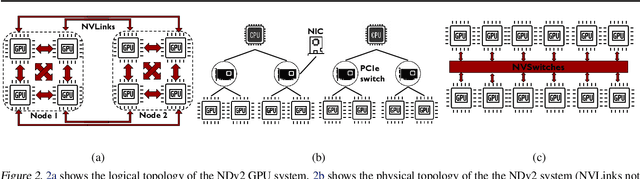
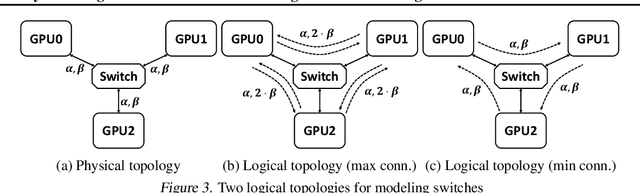
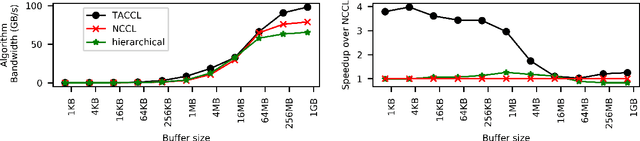
Large ML models and datasets have necessitated the use of multi-GPU systems for distributed model training. To harness the power offered by multi-GPU systems, it is critical to eliminate bottlenecks in inter-GPU communication - a problem made challenging by the heterogeneous nature of interconnects. In this work, we present TACCL, a synthesizer for collective communication primitives for large-scale multi-GPU systems. TACCL encodes a profiled topology and input size into a synthesis problem to generate optimized communication algorithms. TACCL is built on top of the standard NVIDIA Collective Communication Library (NCCL), allowing it to be a drop-in replacement for GPU communication in frameworks like PyTorch with minimal changes. TACCL generates algorithms for communication primitives like Allgather, Alltoall, and Allreduce that are up to $3\times$ faster than NCCL. Using TACCL's algorithms speeds up the end-to-end training of an internal mixture of experts model by $17\%$. By decomposing the optimization problem into parts and leveraging the symmetry in multi-GPU topologies, TACCL synthesizes collectives for up to 80-GPUs in less than 3 minutes, at least two orders of magnitude faster than other synthesis-based state-of-the-art collective communication libraries.
Analysis and Mitigations of Reverse Engineering Attacks on Local Feature Descriptors
May 09, 2021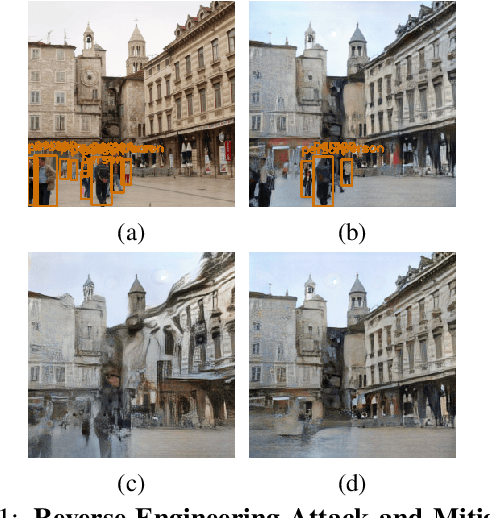
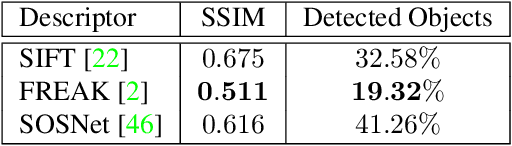
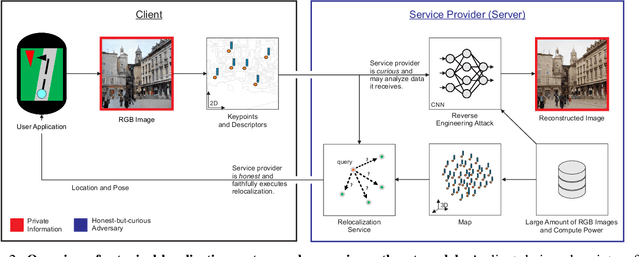
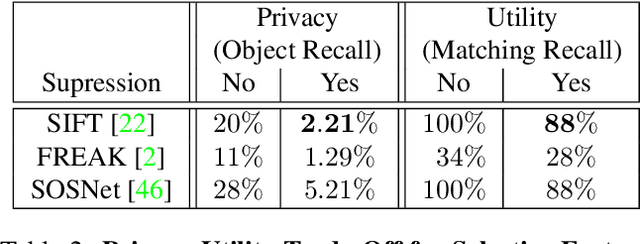
As autonomous driving and augmented reality evolve, a practical concern is data privacy. In particular, these applications rely on localization based on user images. The widely adopted technology uses local feature descriptors, which are derived from the images and it was long thought that they could not be reverted back. However, recent work has demonstrated that under certain conditions reverse engineering attacks are possible and allow an adversary to reconstruct RGB images. This poses a potential risk to user privacy. We take this a step further and model potential adversaries using a privacy threat model. Subsequently, we show under controlled conditions a reverse engineering attack on sparse feature maps and analyze the vulnerability of popular descriptors including FREAK, SIFT and SOSNet. Finally, we evaluate potential mitigation techniques that select a subset of descriptors to carefully balance privacy reconstruction risk while preserving image matching accuracy; our results show that similar accuracy can be obtained when revealing less information.
Automating Generation of Low Precision Deep Learning Operators
Oct 25, 2018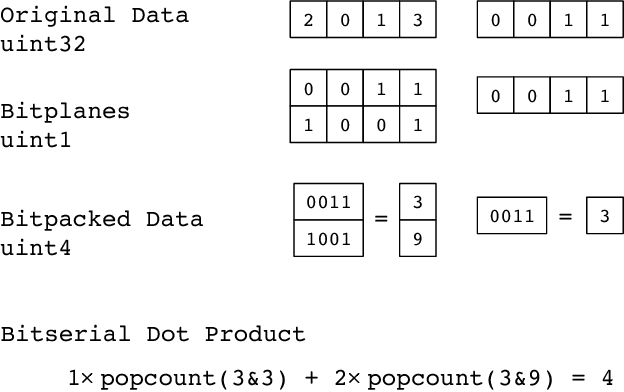
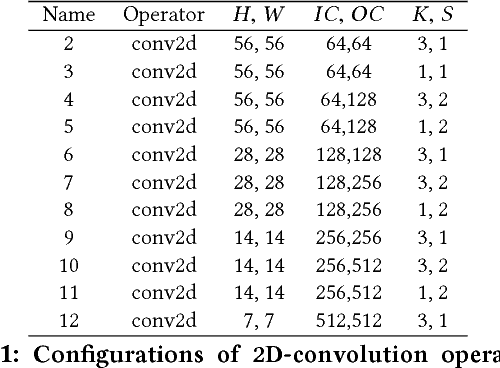
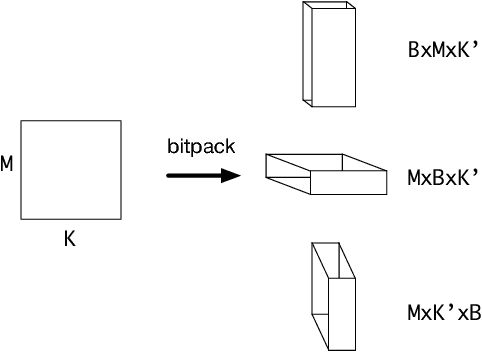
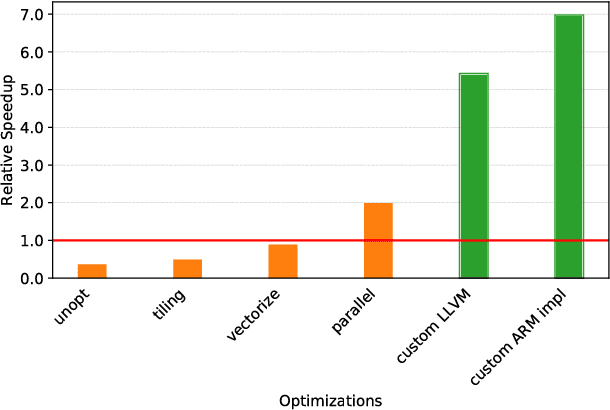
State of the art deep learning models have made steady progress in the fields of computer vision and natural language processing, at the expense of growing model sizes and computational complexity. Deploying these models on low power and mobile devices poses a challenge due to their limited compute capabilities and strict energy budgets. One solution that has generated significant research interest is deploying highly quantized models that operate on low precision inputs and weights less than eight bits, trading off accuracy for performance. These models have a significantly reduced memory footprint (up to 32x reduction) and can replace multiply-accumulates with bitwise operations during compute intensive convolution and fully connected layers. Most deep learning frameworks rely on highly engineered linear algebra libraries such as ATLAS or Intel's MKL to implement efficient deep learning operators. To date, none of the popular deep learning directly support low precision operators, partly due to a lack of optimized low precision libraries. In this paper we introduce a work flow to quickly generate high performance low precision deep learning operators for arbitrary precision that target multiple CPU architectures and include optimizations such as memory tiling and vectorization. We present an extensive case study on low power ARM Cortex-A53 CPU, and show how we can generate 1-bit, 2-bit convolutions with speedups up to 16x over an optimized 16-bit integer baseline and 2.3x better than handwritten implementations.
TVM: An Automated End-to-End Optimizing Compiler for Deep Learning
Oct 05, 2018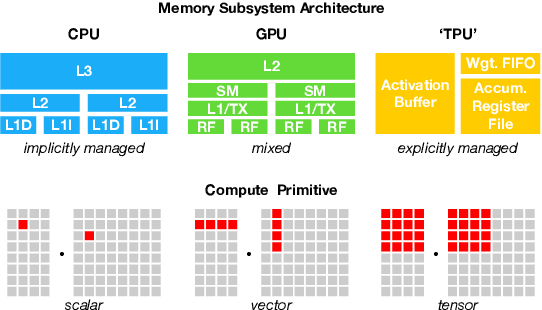
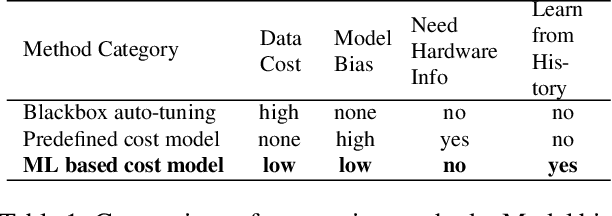
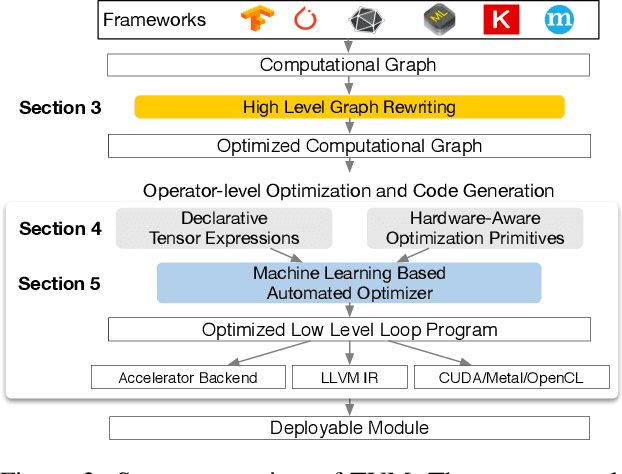
There is an increasing need to bring machine learning to a wide diversity of hardware devices. Current frameworks rely on vendor-specific operator libraries and optimize for a narrow range of server-class GPUs. Deploying workloads to new platforms -- such as mobile phones, embedded devices, and accelerators (e.g., FPGAs, ASICs) -- requires significant manual effort. We propose TVM, a compiler that exposes graph-level and operator-level optimizations to provide performance portability to deep learning workloads across diverse hardware back-ends. TVM solves optimization challenges specific to deep learning, such as high-level operator fusion, mapping to arbitrary hardware primitives, and memory latency hiding. It also automates optimization of low-level programs to hardware characteristics by employing a novel, learning-based cost modeling method for rapid exploration of code optimizations. Experimental results show that TVM delivers performance across hardware back-ends that are competitive with state-of-the-art, hand-tuned libraries for low-power CPU, mobile GPU, and server-class GPUs. We also demonstrate TVM's ability to target new accelerator back-ends, such as the FPGA-based generic deep learning accelerator. The system is open sourced and in production use inside several major companies.