 Add to Chrome
 Add to Firefox
 Add to Edge
LiveGesture Streamable Co-Speech Gesture Generation Model
Apr 13, 2026
We propose LiveGesture, the first fully streamable, speech-driven full-body gesture generation framework that operates with zero look-ahead and supports arbitrary sequence length. Unlike existing co-speech gesture methods, which are designed for offline generation and either treat body regions independently or entangle all joints within a single model, LiveGesture is built from the ground up for causal, region-coordinated motion generation. LiveGesture consists of two main modules: the Streamable Vector Quantized Motion Tokenizer (SVQ) and the Hierarchical Autoregressive Transformer (HAR). The SVQ tokenizer converts the motion sequence of each body region into causal, discrete motion tokens, enabling real-time, streamable token decoding. On top of SVQ, HAR employs region-expert autoregressive (xAR) transformers to model expressive, fine-grained motion dynamics for each body region. A causal spatio-temporal fusion module (xAR Fusion) then captures and integrates correlated motion dynamics across regions. Both xAR and xAR Fusion are conditioned on live, continuously arriving audio signals encoded by a streamable causal audio encoder. To enhance robustness under streaming noise and prediction errors, we introduce autoregressive masking training, which leverages uncertainty-guided token masking and random region masking to expose the model to imperfect, partially erroneous histories during training. Experiments on the BEAT2 dataset demonstrate that LiveGesture produces coherent, diverse, and beat-synchronous full-body gestures in real time, matching or surpassing state-of-the-art offline methods under true zero look-ahead conditions.

MMHMR: Generative Masked Modeling for Hand Mesh Recovery
Dec 18, 2024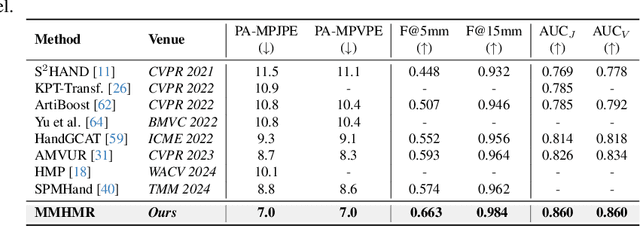
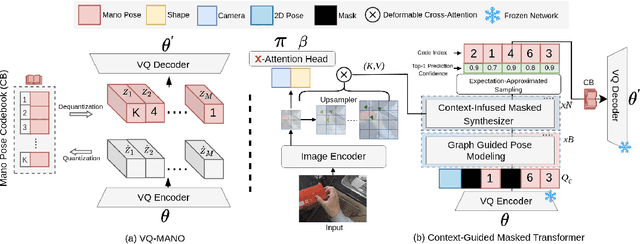
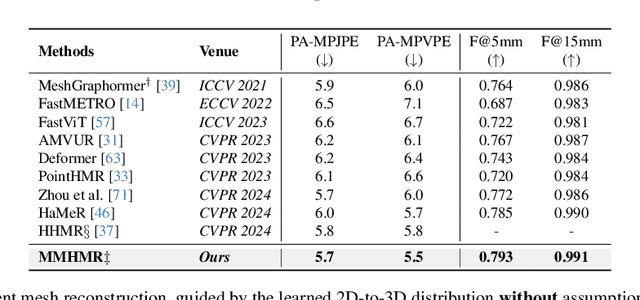

Reconstructing a 3D hand mesh from a single RGB image is challenging due to complex articulations, self-occlusions, and depth ambiguities. Traditional discriminative methods, which learn a deterministic mapping from a 2D image to a single 3D mesh, often struggle with the inherent ambiguities in 2D-to-3D mapping. To address this challenge, we propose MMHMR, a novel generative masked model for hand mesh recovery that synthesizes plausible 3D hand meshes by learning and sampling from the probabilistic distribution of the ambiguous 2D-to-3D mapping process. MMHMR consists of two key components: (1) a VQ-MANO, which encodes 3D hand articulations as discrete pose tokens in a latent space, and (2) a Context-Guided Masked Transformer that randomly masks out pose tokens and learns their joint distribution, conditioned on corrupted token sequences, image context, and 2D pose cues. This learned distribution facilitates confidence-guided sampling during inference, producing mesh reconstructions with low uncertainty and high precision. Extensive evaluations on benchmark and real-world datasets demonstrate that MMHMR achieves state-of-the-art accuracy, robustness, and realism in 3D hand mesh reconstruction. Project website: https://m-usamasaleem.github.io/publication/MMHMR/mmhmr.html