 Add to Chrome
 Add to Firefox
 Add to Edge
Towards Agentic Agent-based Models: Feasibility, Performance, and Statistical Model Checking
Jul 20, 2026
Agent-based models (ABMs) rely on simple, explicit and reproducible rules for individual decision making, while complex collective behavior emerges from interactions among agents. Recent advances in large language models (LLMs) make it tempting to replace, enrich, or perturb these rules with LLM-based agentic capabilities. However, this raises a methodological question: how does introducing LLM-driven decisions affect the reliability, computational cost, and behavior of ABM simulations? We investigate this for Mesa ABM models, a popular Python library for ABMs, analyzed by statistical model checking. Building on Mesa's integration with the statistical model checker MultiVeStA, we extend the classical Schelling segregation model with a hybrid population: ordinary agents classify neighbors using the standard symbolic rule, while one agent delegates this task to an LLM through tool calls. The LLM-enabled agent receives natural-language descriptions of neighboring agents and invokes tools that increment counters of similar/different neighbors; these counters determine its happiness according to the original Schelling dynamics. This provides a minimal but controlled setting where the semantic, operational, and computational behavior of LLM-based decisions can be studied inside an otherwise standard ABM. We report preliminary experiments with locally served LLMs of different sizes, showing that smaller models may fail simple semantic classification experiments or become operationally unusable during repeated tool-call generation, while larger tested models pass these preliminary checks. We discuss how statistical model checking can estimate classical ABM observables and quantify the impact of introducing agentic LLM components into simulation models.

Scaling Weisfeiler-Leman Expressiveness Analysis to Massive Graphs with GPUs
Jul 01, 2026The stable coloring of the Weisfeiler-Leman (1-WL) test is a cornerstone of Graph Neural Networks because it provides an upper bound to the expressive power of message-passing architectures. Unfortunately, computing it presents two fundamental bottlenecks. First, classic algorithms are inherently sequential and cannot exploit modern massively parallel hardware. Second, these are \emph{global} algorithms, i.e., they require availability in memory of the full graph, severely limiting applicability to real-world instances. We leverage a linear-algebraic interpretation of 1-WL stable coloring and introduce two key contributions: (i)~a randomized refinement algorithm with tight probabilistic guarantees and (ii)~a correctness-preserving batching scheme that decomposes the graph into independently processable subgraphs while provably returning a stable coloring of the original graph. This approach maps directly to GPU-efficient primitives. In numerical experiments, our CUDA implementation delivers speedups up to two orders of magnitude over classical CPU-based partition refinement and, for the first time, successfully computes stable colorings on web-scale graphs with over 30 billion edges, where CPU baselines time out or fail.
Efficient Network Embedding by Approximate Equitable Partitions
Sep 16, 2024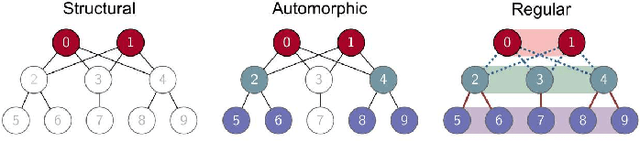
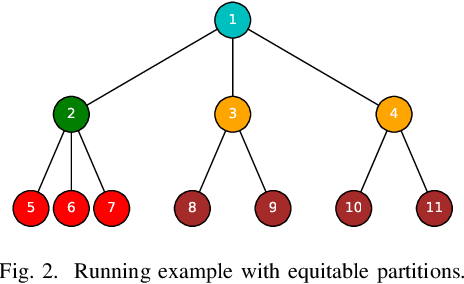
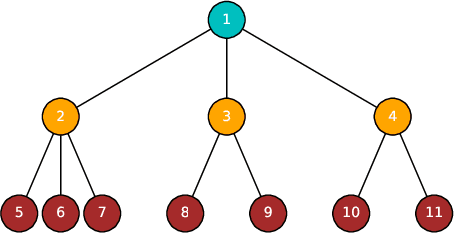
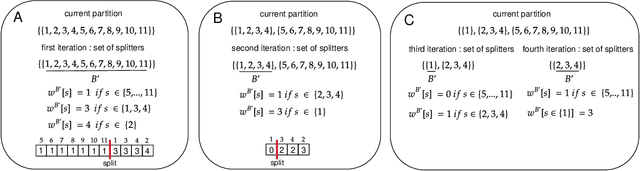
Structural network embedding is a crucial step in enabling effective downstream tasks for complex systems that aims to project a network into a lower-dimensional space while preserving similarities among nodes. We introduce a simple and efficient embedding technique based on approximate variants of equitable partitions. The approximation consists in introducing a user-tunable tolerance parameter relaxing the otherwise strict condition for exact equitable partitions that can be hardly found in real-world networks. We exploit a relationship between equitable partitions and equivalence relations for Markov chains and ordinary differential equations to develop a partition refinement algorithm for computing an approximate equitable partition in polynomial time. We compare our method against state-of-the-art embedding techniques on benchmark networks. We report comparable -- when not superior -- performance for visualization, classification, and regression tasks at a cost between one and three orders of magnitude smaller using a prototype implementation, enabling the embedding of large-scale networks which could not be efficiently handled by most of the competing techniques.
Closed-form Continuous-Depth Models
Jun 25, 2021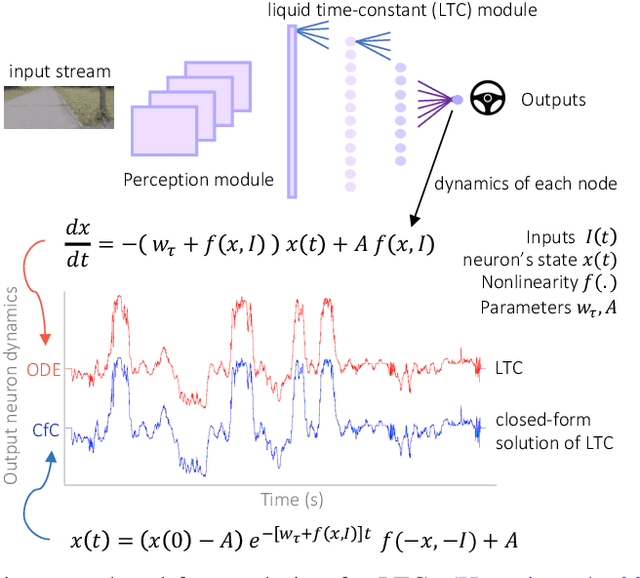
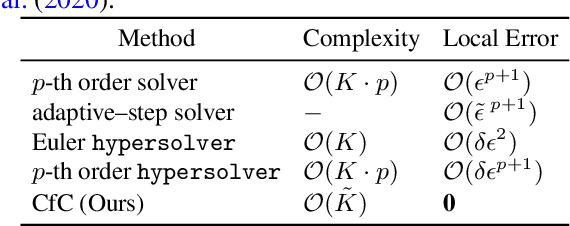
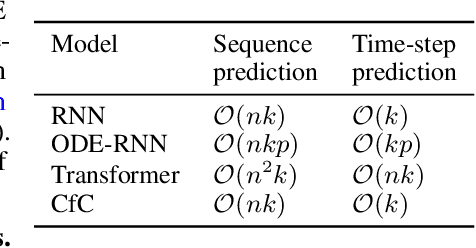
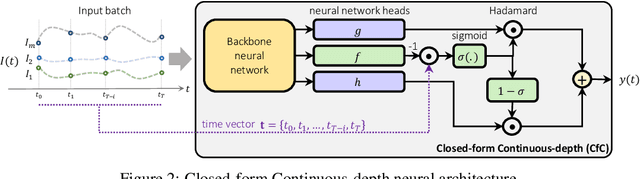
Continuous-depth neural models, where the derivative of the model's hidden state is defined by a neural network, have enabled strong sequential data processing capabilities. However, these models rely on advanced numerical differential equation (DE) solvers resulting in a significant overhead both in terms of computational cost and model complexity. In this paper, we present a new family of models, termed Closed-form Continuous-depth (CfC) networks, that are simple to describe and at least one order of magnitude faster while exhibiting equally strong modeling abilities compared to their ODE-based counterparts. The models are hereby derived from the analytical closed-form solution of an expressive subset of time-continuous models, thus alleviating the need for complex DE solvers all together. In our experimental evaluations, we demonstrate that CfC networks outperform advanced, recurrent models over a diverse set of time-series prediction tasks, including those with long-term dependencies and irregularly sampled data. We believe our findings open new opportunities to train and deploy rich, continuous neural models in resource-constrained settings, which demand both performance and efficiency.