 Add to Chrome
 Add to Firefox
 Add to Edge
Scaling Weisfeiler-Leman Expressiveness Analysis to Massive Graphs with GPUs
Jul 01, 2026
The stable coloring of the Weisfeiler-Leman (1-WL) test is a cornerstone of Graph Neural Networks because it provides an upper bound to the expressive power of message-passing architectures. Unfortunately, computing it presents two fundamental bottlenecks. First, classic algorithms are inherently sequential and cannot exploit modern massively parallel hardware. Second, these are \emph{global} algorithms, i.e., they require availability in memory of the full graph, severely limiting applicability to real-world instances. We leverage a linear-algebraic interpretation of 1-WL stable coloring and introduce two key contributions: (i)~a randomized refinement algorithm with tight probabilistic guarantees and (ii)~a correctness-preserving batching scheme that decomposes the graph into independently processable subgraphs while provably returning a stable coloring of the original graph. This approach maps directly to GPU-efficient primitives. In numerical experiments, our CUDA implementation delivers speedups up to two orders of magnitude over classical CPU-based partition refinement and, for the first time, successfully computes stable colorings on web-scale graphs with over 30 billion edges, where CPU baselines time out or fail.

Neural Network Compression by Approximate Differential Equivalence
May 31, 2026Neural network compression is commonly achieved by pruning parameters based on local importance scores, e.g., magnitude-based pruning. We propose a complementary approach that compresses models by aggregating neurons with similar functional behavior rather than removing weights independently. Our method encodes a trained network as a polynomial ODE system and applies a lumping method called Approximate Forward Differential Equivalence to identify neurons with approximately matching induced dynamics. A single tolerance parameter, $\varepsilon$, controls the compression level and induces a smooth trade-off between model size and predictive accuracy. We evaluate the method on synthetic datasets derived from nonlinear dynamical systems with known ground-truth behavior and on public regression benchmarks. Across both settings, the proposed approach achieves substantial parameter reduction while preserving accuracy, and consistently compares favorably with magnitude-based pruning and Wanda at similar compression levels. These results suggest that differential equivalence-based aggregation is a principled and effective alternative to conventional weight-centric pruning.
RAwR: Role-Aware Rewiring via Approximate Equitable Partition
May 10, 2026While Graph Neural Networks (GNNs) have demonstrated significant efficacy in node classification tasks, where predictions rely on local neighborhood information, the performance of GNNs often drops when prediction tasks depend on long-range interactions. These limitations are attributed to phenomena such as oversquashing, where structural bottlenecks restrict signal propagation across the network topology. To address this challenge, we introduce RAwR, a computationally efficient rewiring framework that augments the input graph with a quotient graph derived from equitable partitions. This approach facilitates accelerated communication between nodes that share identical structural roles, as identified by the Weisfeiler-Leman graph coloring, and thereby reduces the total effective resistance of the system. Furthermore, by employing an approximate definition of the equitable partition, RAwR enables a controllable reduction of the quotient graph, which, in its most condensed state, recovers the conventional Master Node rewiring technique. Empirical evaluations across a diverse suite of benchmarks -- including homophilic, heterophilic, and synthetic long-range datasets -- demonstrate that RAwR achieves state-of-the-art results. Our contribution is further supported by an analytical investigation using a teacher-student model of linear GNNs, which elucidates the theoretical foundations of role-based rewiring. This analysis leads to the formulation of Spectral Role Lift (SRL), a metric designed to identify the optimal approximate equitable partition for maximizing predictive performance.
Efficient Network Embedding by Approximate Equitable Partitions
Sep 16, 2024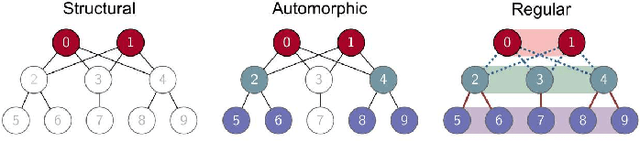
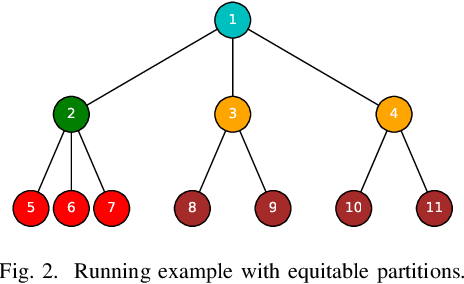
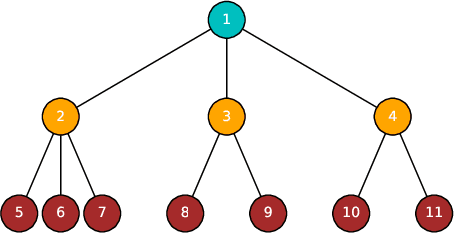
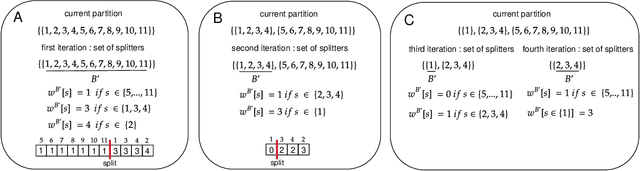
Structural network embedding is a crucial step in enabling effective downstream tasks for complex systems that aims to project a network into a lower-dimensional space while preserving similarities among nodes. We introduce a simple and efficient embedding technique based on approximate variants of equitable partitions. The approximation consists in introducing a user-tunable tolerance parameter relaxing the otherwise strict condition for exact equitable partitions that can be hardly found in real-world networks. We exploit a relationship between equitable partitions and equivalence relations for Markov chains and ordinary differential equations to develop a partition refinement algorithm for computing an approximate equitable partition in polynomial time. We compare our method against state-of-the-art embedding techniques on benchmark networks. We report comparable -- when not superior -- performance for visualization, classification, and regression tasks at a cost between one and three orders of magnitude smaller using a prototype implementation, enabling the embedding of large-scale networks which could not be efficiently handled by most of the competing techniques.
Learning Queuing Networks by Recurrent Neural Networks
Feb 25, 2020


It is well known that building analytical performance models in practice is difficult because it requires a considerable degree of proficiency in the underlying mathematics. In this paper, we propose a machine-learning approach to derive performance models from data. We focus on queuing networks, and crucially exploit a deterministic approximation of their average dynamics in terms of a compact system of ordinary differential equations. We encode these equations into a recurrent neural network whose weights can be directly related to model parameters. This allows for an interpretable structure of the neural network, which can be trained from system measurements to yield a white-box parameterized model that can be used for prediction purposes such as what-if analyses and capacity planning. Using synthetic models as well as a real case study of a load-balancing system, we show the effectiveness of our technique in yielding models with high predictive power.