 Add to Chrome
 Add to Firefox
 Add to Edge
Towards Agentic Agent-based Models: Feasibility, Performance, and Statistical Model Checking
Jul 20, 2026
Agent-based models (ABMs) rely on simple, explicit and reproducible rules for individual decision making, while complex collective behavior emerges from interactions among agents. Recent advances in large language models (LLMs) make it tempting to replace, enrich, or perturb these rules with LLM-based agentic capabilities. However, this raises a methodological question: how does introducing LLM-driven decisions affect the reliability, computational cost, and behavior of ABM simulations? We investigate this for Mesa ABM models, a popular Python library for ABMs, analyzed by statistical model checking. Building on Mesa's integration with the statistical model checker MultiVeStA, we extend the classical Schelling segregation model with a hybrid population: ordinary agents classify neighbors using the standard symbolic rule, while one agent delegates this task to an LLM through tool calls. The LLM-enabled agent receives natural-language descriptions of neighboring agents and invokes tools that increment counters of similar/different neighbors; these counters determine its happiness according to the original Schelling dynamics. This provides a minimal but controlled setting where the semantic, operational, and computational behavior of LLM-based decisions can be studied inside an otherwise standard ABM. We report preliminary experiments with locally served LLMs of different sizes, showing that smaller models may fail simple semantic classification experiments or become operationally unusable during repeated tool-call generation, while larger tested models pass these preliminary checks. We discuss how statistical model checking can estimate classical ABM observables and quantify the impact of introducing agentic LLM components into simulation models.

Statistical Model Checking of the Keynes+Schumpeter Model: A Transient Sensitivity Analysis of a Macroeconomic ABM
May 11, 2026Agent-based models (ABMs) are increasingly used in macroeconomics, but their analysis still often relies on ad hoc Monte Carlo campaigns with heterogeneous statistical effort across parameter settings. We show how statistical model checking (SMC), implemented through MultiVeStA, can provide a principled analysis layer for a realistic macroeconomic ABM without rewriting the simulator in a dedicated formalism. Our case study is the heuristic-switching Keynes+Schumpeter(K+S) model, analysed hrough a transient sensitivity campaign over one-parameter sweeps, two macro observables (unemployment and GDP growth), and one auxiliary micro-level probe (market share) on the post-warmup phase of a 600-step horizon. The analysis is driven by reusable temporal queries, observable-specific precision targets, and confidence-based stopping rules that automatically determine the simulation effort required by each configuration. Results show a clear contrast across parameter families: macro-financial and structural sweeps produce the strongest transient effects, whereas several heuristic-rule sweeps remain much weaker under the same precision policy. More broadly, the paper shows that SMC can support reproducible and informative quantitative analysis of substantively rich economic ABMs, while making uncertainty estimates and simulation cost explicit parts of the reported results.
GravityGraphSAGE: Link Prediction in Directed Attributed Graphs
May 10, 2026Link prediction (inferring missing or future connections between nodes in a graph) is a fundamental problem in network science with widespread applications in, e.g., biological systems, recommender systems, finance and cybersecurity. The ability to accurately predict links has significant real-world applications, such as detecting fraudulent financial transactions or identifying drug-target interactions in biomedicine. Despite a rich literature, link prediction is still challenging, especially for graphs enriched with information on edges (direction) and nodes (attributes). In fact, research on link prediction, especially the one based on Graph Deep Learning (GDL), has mostly focused on undirected graphs, without fully leveraging node attributes. Here, we fill this gap by proposing Gravity-GraphSAGE (GG-SAGE), a modified version of GraphSAGE, a GDL model for node embeddings, composed of a gravity-inspired decoder. This implementation is the first example in the literature of a GraphSAGE backbone adopted for directed link prediction. Using the benchmark datasets Cora, Citeseer, PubMed and 16 real-world graphs from the online Netzschleuder repository, we show that our proposed model outperforms state-of-the-art GDL link prediction techniques. Using further experimental evidence, we relate the quality of the output of our model with various characteristics of the graph, suggesting that our framework scales well when applied to data of increasing complexity.
RAwR: Role-Aware Rewiring via Approximate Equitable Partition
May 10, 2026While Graph Neural Networks (GNNs) have demonstrated significant efficacy in node classification tasks, where predictions rely on local neighborhood information, the performance of GNNs often drops when prediction tasks depend on long-range interactions. These limitations are attributed to phenomena such as oversquashing, where structural bottlenecks restrict signal propagation across the network topology. To address this challenge, we introduce RAwR, a computationally efficient rewiring framework that augments the input graph with a quotient graph derived from equitable partitions. This approach facilitates accelerated communication between nodes that share identical structural roles, as identified by the Weisfeiler-Leman graph coloring, and thereby reduces the total effective resistance of the system. Furthermore, by employing an approximate definition of the equitable partition, RAwR enables a controllable reduction of the quotient graph, which, in its most condensed state, recovers the conventional Master Node rewiring technique. Empirical evaluations across a diverse suite of benchmarks -- including homophilic, heterophilic, and synthetic long-range datasets -- demonstrate that RAwR achieves state-of-the-art results. Our contribution is further supported by an analytical investigation using a teacher-student model of linear GNNs, which elucidates the theoretical foundations of role-based rewiring. This analysis leads to the formulation of Spectral Role Lift (SRL), a metric designed to identify the optimal approximate equitable partition for maximizing predictive performance.
Efficient Network Embedding by Approximate Equitable Partitions
Sep 16, 2024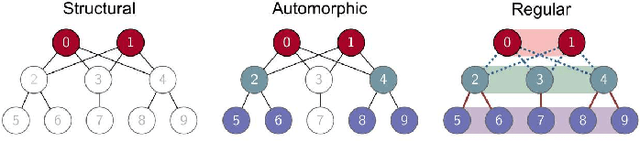
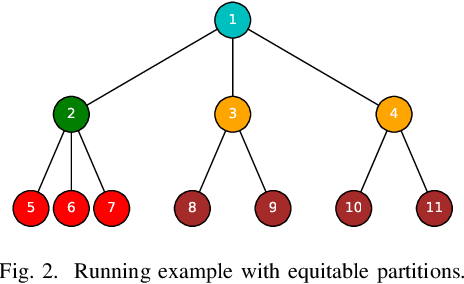
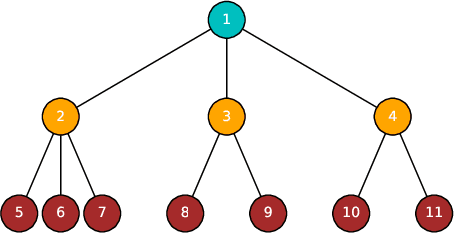
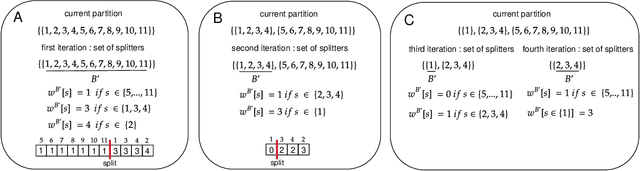
Structural network embedding is a crucial step in enabling effective downstream tasks for complex systems that aims to project a network into a lower-dimensional space while preserving similarities among nodes. We introduce a simple and efficient embedding technique based on approximate variants of equitable partitions. The approximation consists in introducing a user-tunable tolerance parameter relaxing the otherwise strict condition for exact equitable partitions that can be hardly found in real-world networks. We exploit a relationship between equitable partitions and equivalence relations for Markov chains and ordinary differential equations to develop a partition refinement algorithm for computing an approximate equitable partition in polynomial time. We compare our method against state-of-the-art embedding techniques on benchmark networks. We report comparable -- when not superior -- performance for visualization, classification, and regression tasks at a cost between one and three orders of magnitude smaller using a prototype implementation, enabling the embedding of large-scale networks which could not be efficiently handled by most of the competing techniques.
Accurate and fast anomaly detection in industrial processes and IoT environments
Apr 27, 2024We present a novel, simple and widely applicable semi-supervised procedure for anomaly detection in industrial and IoT environments, SAnD (Simple Anomaly Detection). SAnD comprises 5 steps, each leveraging well-known statistical tools, namely; smoothing filters, variance inflation factors, the Mahalanobis distance, threshold selection algorithms and feature importance techniques. To our knowledge, SAnD is the first procedure that integrates these tools to identify anomalies and help decipher their putative causes. We show how each step contributes to tackling technical challenges that practitioners face when detecting anomalies in industrial contexts, where signals can be highly multicollinear, have unknown distributions, and intertwine short-lived noise with the long(er)-lived actual anomalies. The development of SAnD was motivated by a concrete case study from our industrial partner, which we use here to show its effectiveness. We also evaluate the performance of SAnD by comparing it with a selection of semi-supervised methods on public datasets from the literature on anomaly detection. We conclude that SAnD is effective, broadly applicable, and outperforms existing approaches in both anomaly detection and runtime.