 Add to Chrome
 Add to Firefox
 Add to Edge
Large-Scale High-Quality 3D Gaussian Head Reconstruction from Multi-View Captures
May 05, 2026
We propose HeadsUp, a scalable feed-forward method for reconstructing high-quality 3D Gaussian heads from large-scale multi-camera setups. Our method employs an efficient encoder-decoder architecture that compresses input views into a compact latent representation. This latent representation is then decoded into a set of UV-parameterized 3D Gaussians anchored to a neutral head template. This UV representation decouples the number of 3D Gaussians from the number and resolution of input images, enabling training with many high-resolution input views. We train and evaluate our model on an internal dataset with more than 10,000 subjects, which is an order of magnitude larger than existing multi-view human head datasets. HeadsUp achieves state-of-the-art reconstruction quality and generalizes to novel identities without test-time optimization. We extensively analyze the scaling behavior of our model across identities, views, and model capacity, revealing practical insights for quality-compute trade-offs. Finally, we highlight the strength of our latent space by showcasing two downstream applications: generating novel 3D identities and animating the 3D heads with expression blendshapes.

Efficient Deformable Shape Correspondence via Kernel Matching
Sep 15, 2017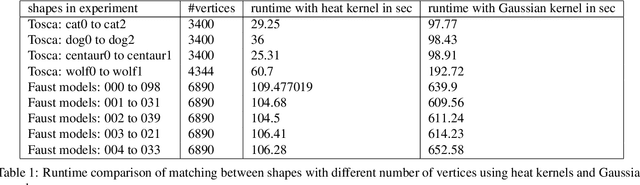
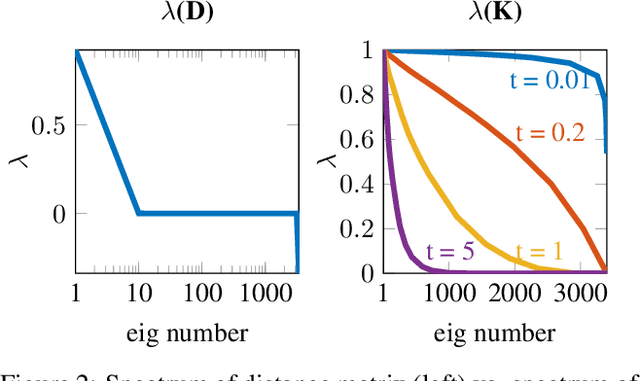
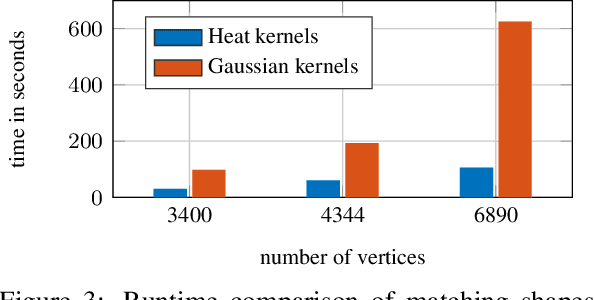
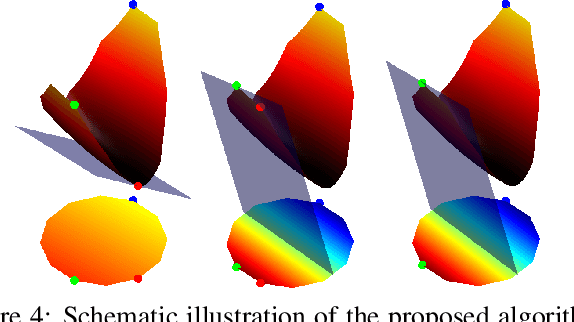
We present a method to match three dimensional shapes under non-isometric deformations, topology changes and partiality. We formulate the problem as matching between a set of pair-wise and point-wise descriptors, imposing a continuity prior on the mapping, and propose a projected descent optimization procedure inspired by difference of convex functions (DC) programming. Surprisingly, in spite of the highly non-convex nature of the resulting quadratic assignment problem, our method converges to a semantically meaningful and continuous mapping in most of our experiments, and scales well. We provide preliminary theoretical analysis and several interpretations of the method.
Product Manifold Filter: Non-Rigid Shape Correspondence via Kernel Density Estimation in the Product Space
Apr 07, 2017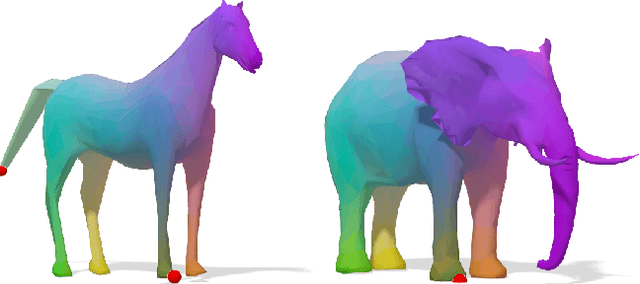
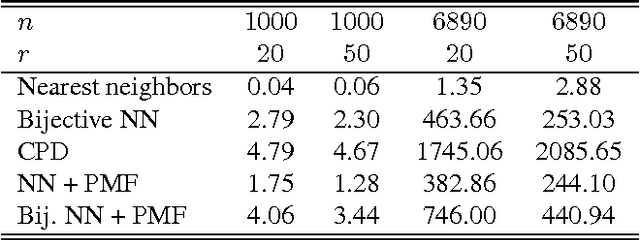
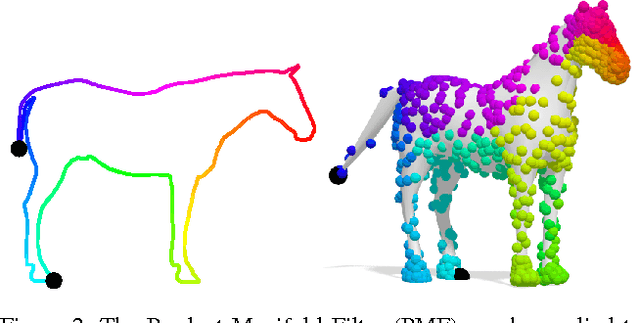
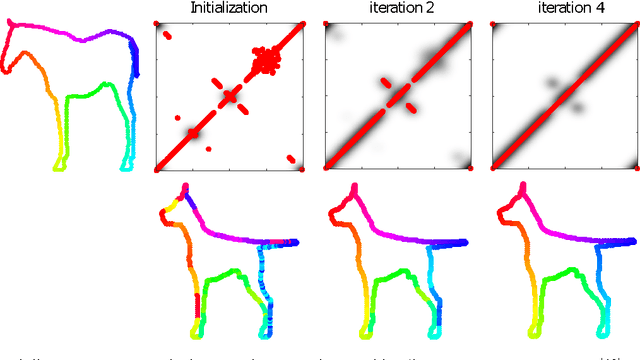
Many algorithms for the computation of correspondences between deformable shapes rely on some variant of nearest neighbor matching in a descriptor space. Such are, for example, various point-wise correspondence recovery algorithms used as a post-processing stage in the functional correspondence framework. Such frequently used techniques implicitly make restrictive assumptions (e.g., near-isometry) on the considered shapes and in practice suffer from lack of accuracy and result in poor surjectivity. We propose an alternative recovery technique capable of guaranteeing a bijective correspondence and producing significantly higher accuracy and smoothness. Unlike other methods our approach does not depend on the assumption that the analyzed shapes are isometric. We derive the proposed method from the statistical framework of kernel density estimation and demonstrate its performance on several challenging deformable 3D shape matching datasets.
Bayesian Inference of Bijective Non-Rigid Shape Correspondence
Jul 12, 2016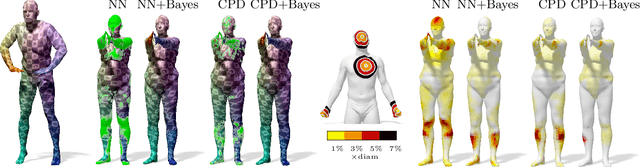
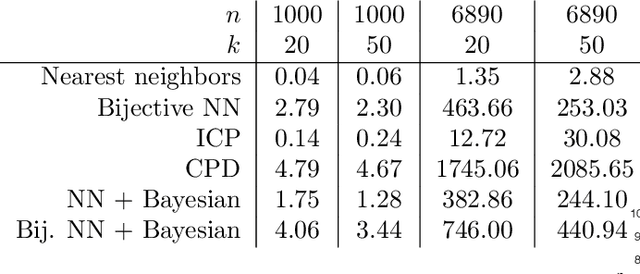
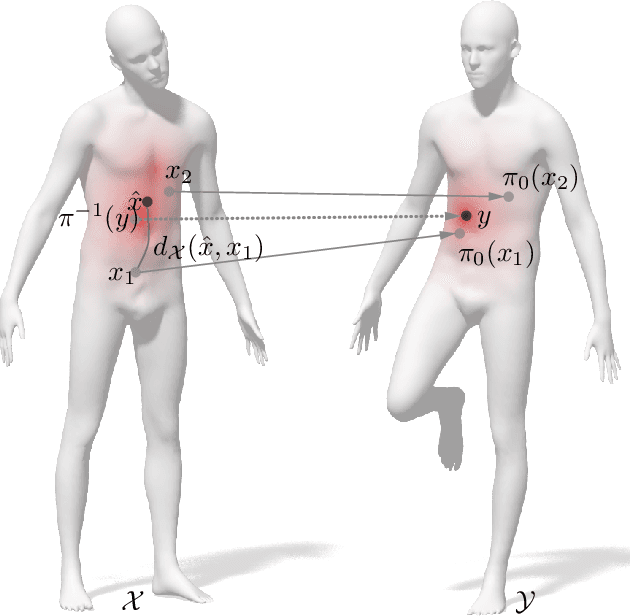
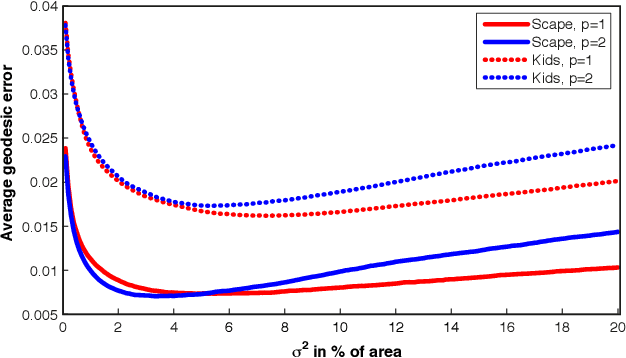
Many algorithms for the computation of correspondences between deformable shapes rely on some variant of nearest neighbor matching in a descriptor space. Such are, for example, various point-wise correspondence recovery algorithms used as a postprocessing stage in the functional correspondence framework. In this paper, we show that such frequently used techniques in practice suffer from lack of accuracy and result in poor surjectivity. We propose an alternative recovery technique guaranteeing a bijective correspondence and producing significantly higher accuracy. We derive the proposed method from a statistical framework of Bayesian inference and demonstrate its performance on several challenging deformable 3D shape matching datasets.