 Add to Chrome
 Add to Firefox
 Add to Edge
EgoHTR: Egocentric 4D Demonstrations of Human Terrain Traversal
Jul 15, 2026
Deploying humanoid robots in unstructured terrain remains an open problem. While classic reinforcement learning struggles with the sheer complexity of real-world interactions, more promising methods leveraging human priors remain limited to models lacking contextual awareness. The restricted motion synthesis is a direct consequence of existing dataset pipelines failing to capture human-scene sequences in challenging environments. To bridge this gap between humanoid learning and scene reconstruction, we introduce the Egocentric Human-Terrain Reconstruction (EgoHTR) dataset. We develop and open-source a reconstruction pipeline capturing 55 scene-aligned 4D human motion sequences in diverse, complex environments using a multi-sensor setup of egocentric wearables and a portable 3D scanner. The resulting dataset comprises over 150k frames, which we evaluate against motion-capture ground truth, demonstrating state-of-the-art accuracy and establishing a rigorous benchmark for human motion analysis and synthesis. Further, we leverage this data to train perceptive locomotion policies, demonstrating hardware deployment on a Unitree G1 for reconstructed reference motions. Our pipeline enables community-driven dataset extensions and factors the problem to help researchers build foundational, context-aware robots that reliably traverse uneven terrain.

Multi-Domain Motion Embedding: Expressive Real-Time Mimicry for Legged Robots
Dec 08, 2025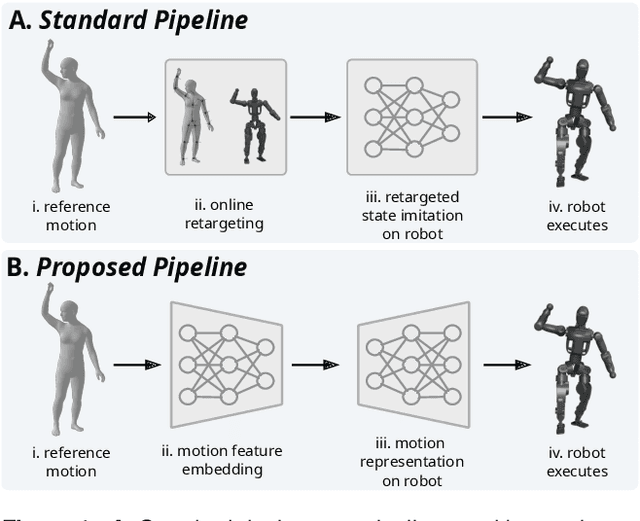
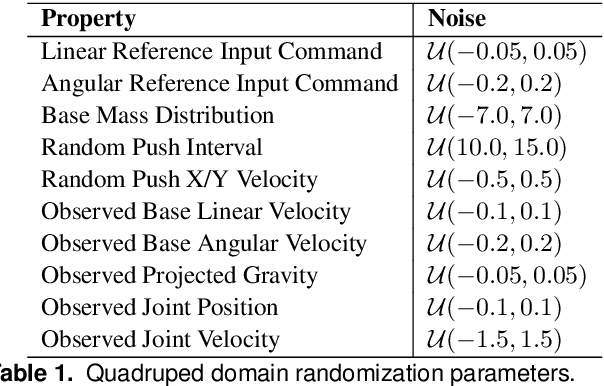
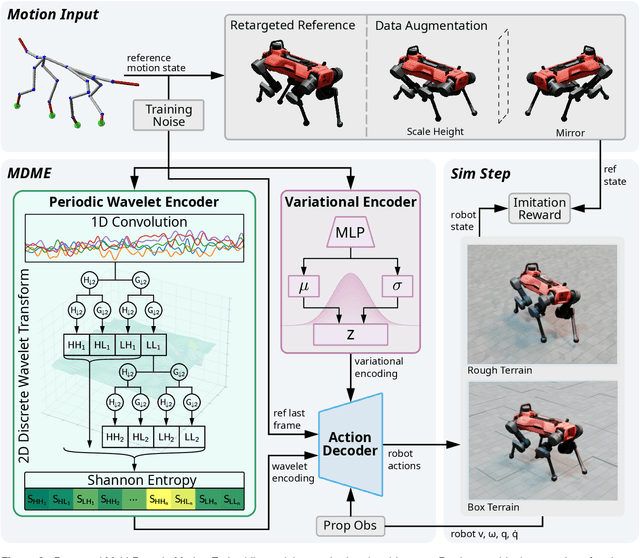
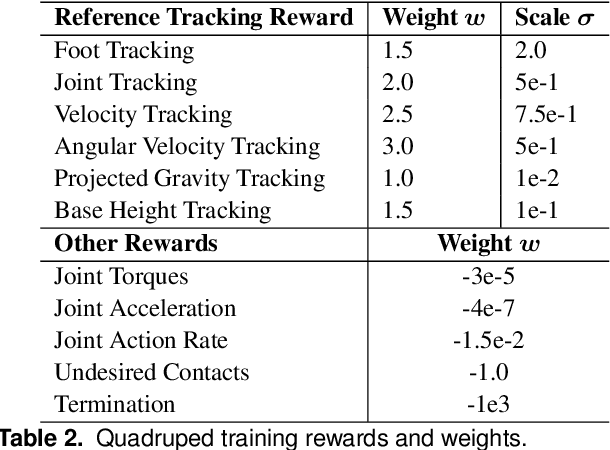
Effective motion representation is crucial for enabling robots to imitate expressive behaviors in real time, yet existing motion controllers often ignore inherent patterns in motion. Previous efforts in representation learning do not attempt to jointly capture structured periodic patterns and irregular variations in human and animal movement. To address this, we present Multi-Domain Motion Embedding (MDME), a motion representation that unifies the embedding of structured and unstructured features using a wavelet-based encoder and a probabilistic embedding in parallel. This produces a rich representation of reference motions from a minimal input set, enabling improved generalization across diverse motion styles and morphologies. We evaluate MDME on retargeting-free real-time motion imitation by conditioning robot control policies on the learned embeddings, demonstrating accurate reproduction of complex trajectories on both humanoid and quadruped platforms. Our comparative studies confirm that MDME outperforms prior approaches in reconstruction fidelity and generalizability to unseen motions. Furthermore, we demonstrate that MDME can reproduce novel motion styles in real-time through zero-shot deployment, eliminating the need for task-specific tuning or online retargeting. These results position MDME as a generalizable and structure-aware foundation for scalable real-time robot imitation.