 Add to Chrome
 Add to Firefox
 Add to Edge
No Hidden Prompts Needed! You Can Game AI Peer Review with Presentation-Only Revisions
Jun 11, 2026
As AI-generated reviews move from experimental tools into peer-review infrastructure, most robustness concerns have focused on explicit attacks such as hidden instructions and prompt injection. We study a harder and more policy-relevant failure mode: no hidden text, no prompt injection, and no changes to methods, experiments, figures, equations, proofs, or numerical results. The attacker modifies only presentation-level content, such as the abstract, contribution framing, related work, discussion, and narrative structure. We introduce adversarial repackaging: a closed-loop attack that uses AI-reviewer feedback to search for presentation-level revisions while keeping the scientific evidence fixed. Across three mainstream AI reviewers, adversarial repackaging achieves a 75.1% attack success rate and a mean score gain of +1.21/10. The effect is not explained by ordinary prose polishing. We also reveal that strategies that change how the reviewer interprets the paper, such as related-work repositioning and analytical discussion expansion, substantially outperform surface edits such as local polishing, table formatting, and algorithm boxes. Our analysis reveals two deeper structural failure modes. First, AI reviewers are easier to impress than to convince: highlighting strengths reliably increases perceived merit, while attempts to dissolve weaknesses frequently backfire. Second, AI reviewers can confuse the appearance of addressing a limitation with actually resolving it, allowing unchanged evidence to be reinterpreted as stronger scientific contribution. These results show that the deployment risk is not only malicious hidden instructions, but the emergence of paper presentation itself as an optimization surface. We release a contamination-free rolling benchmark and attack framework for testing whether AI reviewers remain anchored to scientific content under presentation-only edits.

CLEVER: A Curated Benchmark for Formally Verified Code Generation
May 21, 2025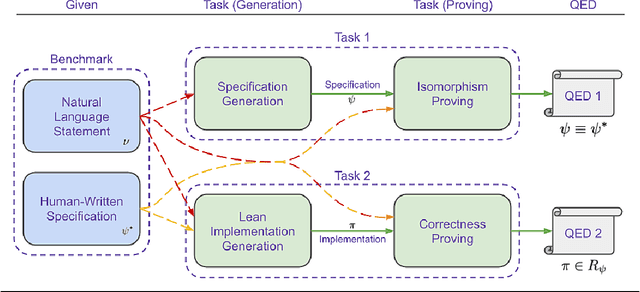
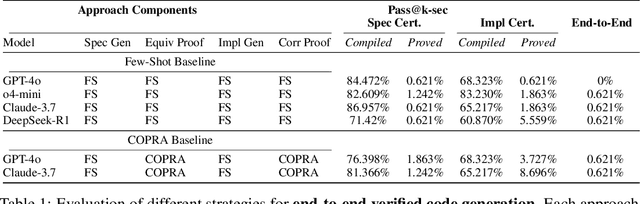
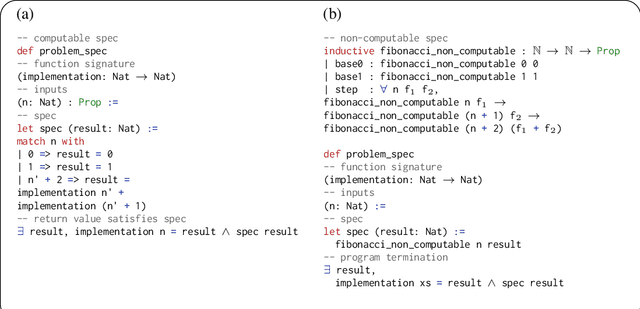
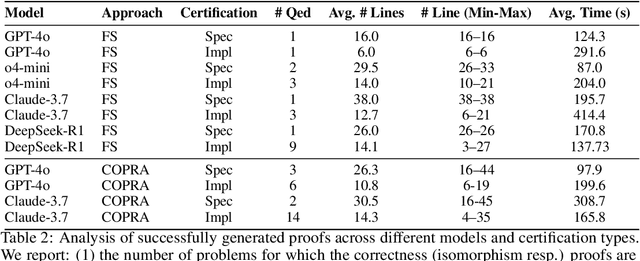
We introduce ${\rm C{\small LEVER}}$, a high-quality, curated benchmark of 161 problems for end-to-end verified code generation in Lean. Each problem consists of (1) the task of generating a specification that matches a held-out ground-truth specification, and (2) the task of generating a Lean implementation that provably satisfies this specification. Unlike prior benchmarks, ${\rm C{\small LEVER}}$ avoids test-case supervision, LLM-generated annotations, and specifications that leak implementation logic or allow vacuous solutions. All outputs are verified post-hoc using Lean's type checker to ensure machine-checkable correctness. We use ${\rm C{\small LEVER}}$ to evaluate several few-shot and agentic approaches based on state-of-the-art language models. These methods all struggle to achieve full verification, establishing it as a challenging frontier benchmark for program synthesis and formal reasoning. Our benchmark can be found on GitHub(https://github.com/trishullab/clever) as well as HuggingFace(https://huggingface.co/datasets/amitayusht/clever). All our evaluation code is also available online(https://github.com/trishullab/clever-prover).