 Add to Chrome
 Add to Firefox
 Add to Edge
REFINE-DP: Diffusion Policy Fine-tuning for Humanoid Loco-manipulation via Reinforcement Learning
Mar 14, 2026
Humanoid loco-manipulation requires coordinated high-level motion plans with stable, low-level whole-body execution under complex robot-environment dynamics and long-horizon tasks. While diffusion policies (DPs) show promise for learning from demonstrations, deploying them on humanoids poses critical challenges: the motion planner trained offline is decoupled from the low-level controller, leading to poor command tracking, compounding distribution shift, and task failures. The common approach of scaling demonstration data is prohibitively expensive for high-dimensional humanoid systems. To address this challenge, we present REFINE-DP (REinforcement learning FINE-tuning of Diffusion Policy), a hierarchical framework that jointly optimizes a DP high-level planner and an RL-based low-level loco-manipulation controller. The DP is fine-tuned via a PPO-based diffusion policy gradient to improve task success rate, while the controller is simultaneously updated to accurately track the planner's evolving command distribution, reducing the distributional mismatch that degrades motion quality. We validate REFINE-DP on a humanoid robot performing loco-manipulation tasks, including door traversal and long-horizon object transport. REFINE-DP achieves an over $90\%$ success rate in simulation, even in out-of-distribution cases not seen in the pre-trained data, and enables smooth autonomous task execution in real-world dynamic environments. Our proposed method substantially outperforms pre-trained DP baselines and demonstrates that RL fine-tuning is key to reliable humanoid loco-manipulation. https://refine-dp.github.io/REFINE-DP/

DEXOP: A Device for Robotic Transfer of Dexterous Human Manipulation
Sep 04, 2025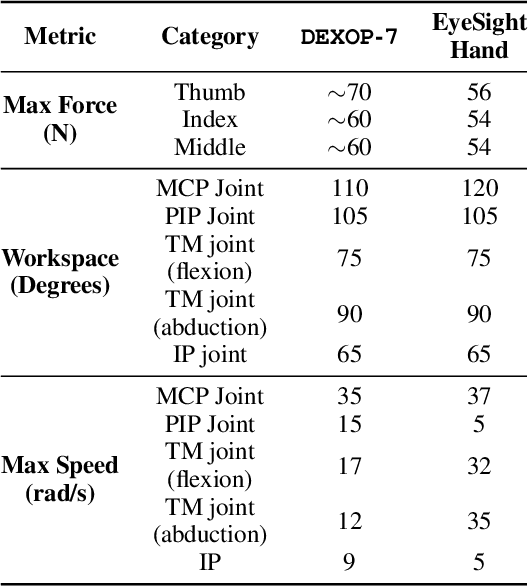
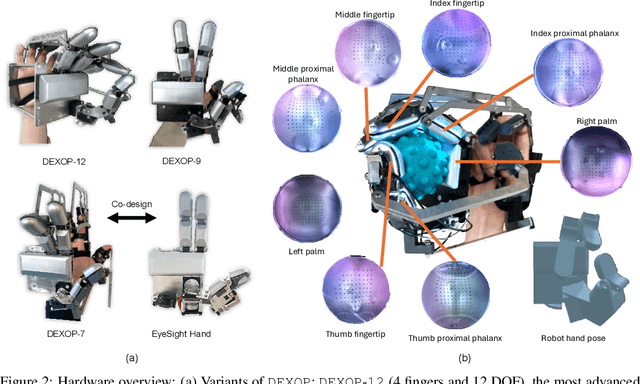
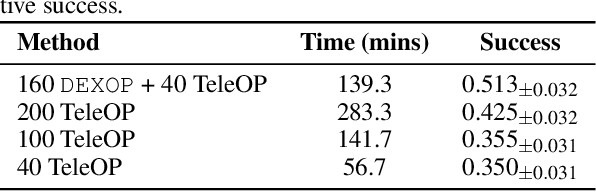
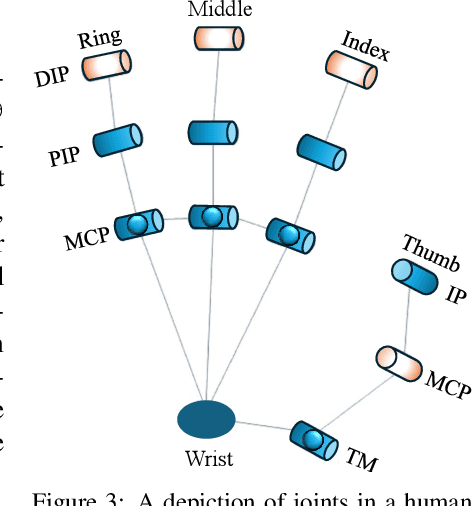
We introduce perioperation, a paradigm for robotic data collection that sensorizes and records human manipulation while maximizing the transferability of the data to real robots. We implement this paradigm in DEXOP, a passive hand exoskeleton designed to maximize human ability to collect rich sensory (vision + tactile) data for diverse dexterous manipulation tasks in natural environments. DEXOP mechanically connects human fingers to robot fingers, providing users with direct contact feedback (via proprioception) and mirrors the human hand pose to the passive robot hand to maximize the transfer of demonstrated skills to the robot. The force feedback and pose mirroring make task demonstrations more natural for humans compared to teleoperation, increasing both speed and accuracy. We evaluate DEXOP across a range of dexterous, contact-rich tasks, demonstrating its ability to collect high-quality demonstration data at scale. Policies learned with DEXOP data significantly improve task performance per unit time of data collection compared to teleoperation, making DEXOP a powerful tool for advancing robot dexterity. Our project page is at https://dex-op.github.io.
Reachability Barrier Networks: Learning Hamilton-Jacobi Solutions for Smooth and Flexible Control Barrier Functions
May 16, 2025Recent developments in autonomous driving and robotics underscore the necessity of safety-critical controllers. Control barrier functions (CBFs) are a popular method for appending safety guarantees to a general control framework, but they are notoriously difficult to generate beyond low dimensions. Existing methods often yield non-differentiable or inaccurate approximations that lack integrity, and thus fail to ensure safety. In this work, we use physics-informed neural networks (PINNs) to generate smooth approximations of CBFs by computing Hamilton-Jacobi (HJ) optimal control solutions. These reachability barrier networks (RBNs) avoid traditional dimensionality constraints and support the tuning of their conservativeness post-training through a parameterized discount term. To ensure robustness of the discounted solutions, we leverage conformal prediction methods to derive probabilistic safety guarantees for RBNs. We demonstrate that RBNs are highly accurate in low dimensions, and safer than the standard neural CBF approach in high dimensions. Namely, we showcase the RBNs in a 9D multi-vehicle collision avoidance problem where it empirically proves to be 5.5x safer and 1.9x less conservative than the neural CBFs, offering a promising method to synthesize CBFs for general nonlinear autonomous systems.